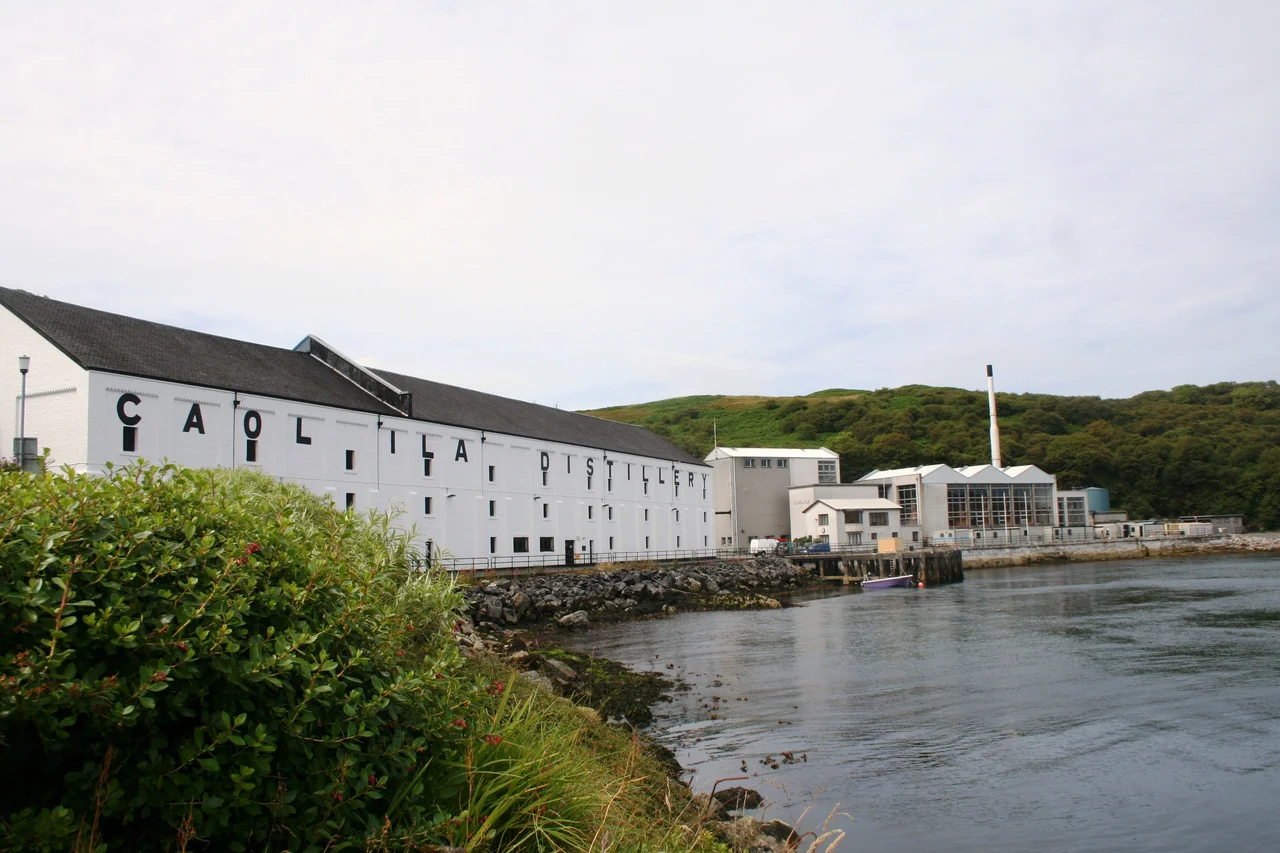

Caol Ila Distillery
The stillhouse has a wall of glass. Walk in for the tour at Caol Ila and you find yourself in what feels like a very expensive aquarium, except the water is the Sound of Islay, the rocks are the Paps of Jura rising three miles away across the strait, and the fish are six enormous copper pot stills lined up to face the view. The architect George Leslie Darge designed it this way in the early 1970s, and the room is now one of the most photographed industrial interiors in Scotland. You came for whisky. You leave thinking about a distillery that decided its workers should get the best office view on the island.
The Sound
Caol Ila means the Sound of Islay in Gaelic - caol for narrow strait, Ila being the island's name. The distillery sits at the narrowest point of the strait between Islay and Jura, a place where the tide runs hard enough to pull a small boat sideways on a calm day. The location was chosen in 1846 by Hector Henderson for the same reason most Islay distilleries chose their sites: a steady supply of soft hill water flowing down from a peat-stained loch, easy access by boat for shipping out the finished whisky in casks, and proximity to barley imported from the eastern Highlands and the Hebrides. The original distillery struggled. Henderson sold up in 1854, and the buildings passed through a succession of owners before Bulloch Lade of Glasgow took over in 1863. By the 1880s Caol Ila was producing more than 147,000 imperial gallons a year. The 1871 census records Duncan Johnston as the manager - nephew of John Johnston of Lagavulin, cousin to the Johnstons of Laphroaig. The same families ran half of the island's distilleries from the same kitchens.
Wartime and Rebuilding
Caol Ila lost its independence in 1927 when the Distillers Company - DCL - took a controlling interest. Three years later DCL handed it to Scottish Malt Distillers, which controlled most of the big-volume Speyside and Islay distilleries that supplied the blended Scotch market. The whisky still went almost entirely into blends. Then in 1942 the British government restricted the supply of barley to distillers because of the war, and Caol Ila simply shut down. It reopened in 1945. The old buildings carried on until 1972, when DCL took an unusual decision: they demolished the entire distillery and rebuilt it from scratch. The new plant was much larger, designed for industrial volume, with six pot stills instead of two. George Leslie Darge - a Glasgow architect who designed several of the corporation's late-twentieth-century distillery rebuilds - gave Caol Ila its trademark wall of glass. Production resumed in 1974. The whisky from before 1972 is now extremely rare; the whisky from after is a different animal made on much bigger equipment in a building that looks like nothing else on the island.
The Johnnie Walker Engine
Caol Ila is the largest distillery on Islay by volume. Around 95 percent of what comes off its stills goes into blends - principally the Johnnie Walker family, where Caol Ila provides the smoky, mineral note that distinguishes Black Label from a non-Islay blended Scotch. This is the secret of Islay's biggest single malt producer: most of the whisky never wears the Caol Ila label. It is the smoke in someone else's bottle, the depth in someone else's pour. Since 1999 the distillery has also produced an unpeated spirit - sometimes called Highland Caol Ila - using barley that has not been smoked with peat. Most of this also goes into blends. The relatively small fraction that does emerge as single malt is lighter and more floral than the Lagavulins and Ardbegs and Laphroaigs of the southern coast. The 12-year-old expression is the workhorse, with peppery notes and a pale gold colour from refill bourbon casks. It has won double gold at the San Francisco World Spirits Competition twice. The 18- and 25-year-olds are increasingly hard to find. None of this is what Caol Ila is for, in the corporate sense. The point of the place, from Diageo's perspective, is the volume going into other bottles.
The View From the Window
If you take the visitor tour, the stillhouse is the moment most people remember. The room is bigger than a school gymnasium. The six stills are nearly twenty feet tall, lyne arms angling out toward condensers at the back of the room. The wall of glass faces east. Through it: the Sound of Islay, dark blue and moving; the cliffs of Jura on the far side, three miles distant; and the Paps of Jura - three conical quartzite mountains rising to 2,576 feet, the tallest peaks for a hundred miles in any direction. On a clear day the Paps look almost too perfect, like a stage set. On a misty day they appear and disappear in the cloud. The stillhouse is heated by the stills themselves and smells of warm copper and slightly cooked barley. The workers who tend the stills have spent decades looking at the same view. The single most expensive thing the new owners did during the 1972 rebuild may turn out to have been giving them the wall of glass. The view is the thing, and the view is free.
From the Air
Caol Ila distillery sits at 55.85°N, 6.11°W, on the eastern shore of Islay overlooking the Sound of Islay 1nm south of Port Askaig. From the air the long modern building and the row of six tall copper pot stills are distinctive against the steep wooded slope behind. Islay Airport (EGPI) lies 8nm to the south-southwest. The Paps of Jura - three quartzite peaks rising to 785m - are clearly visible 3nm east across the Sound and provide an unmistakable visual reference for the whole area. Strong tidal currents through the Sound mean rapidly changing winds; expect turbulence on the lee side of Jura on west winds and a strong venturi effect through the strait itself.
Nearby Stories
- Kintyre 5.8 km away
- HMS Vandal 21 km away
- Jura, Scotland 25 km away
- Rathlin Island 28 km away
- Battle of Lagganmore 29 km away
- Skerryvore 39 km away
- North West 200 39 km away
- German submarine U-218 55 km away