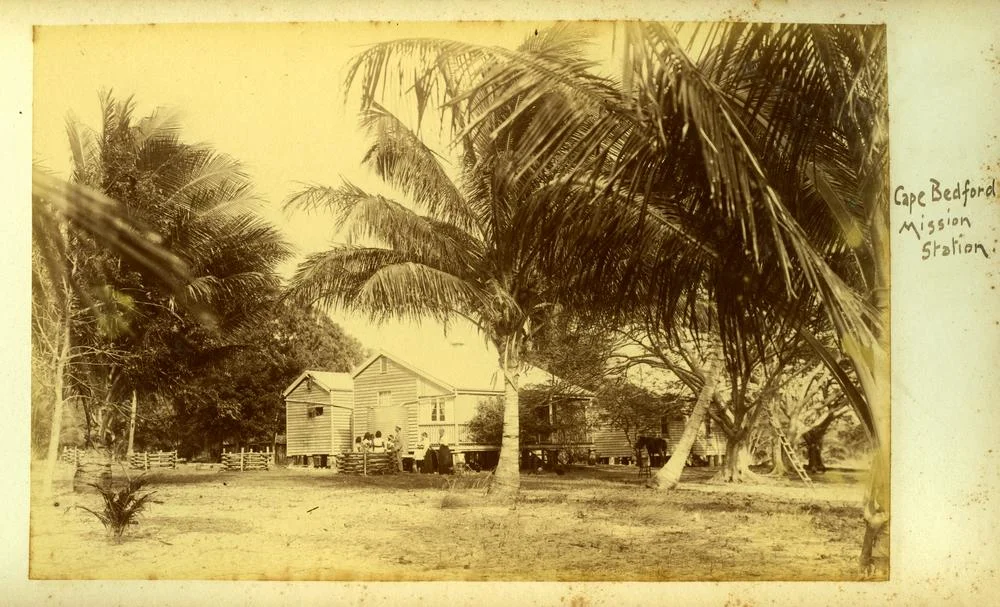

Cape Bedford Mission
The Guugu Yimithirr had a name for the German missionary who spent fifty-five years among them: Muni, their word for 'black,' which is also what his surname, Schwarz, means in German. Those who knew him in the bush called him walarr, after his flowing beard. Georg Heinrich Schwarz arrived at Cape Bedford in 1887, a young man from Bavaria, and stayed until he was an old one - long enough to see children he had baptised grow grey. It is one of the stranger intimacies in Australian history, and it makes what happened in 1942 all the harder to bear.
The First Mission on the Cape
Cape Bedford began almost by accident. In 1885 the Lutheran missionary Johann Flierl was passing through Cooktown, bound for German New Guinea, when he was delayed for months - and used the time to found a mission on the sandy coast north of town. It was the first Christian mission on the Cape York Peninsula and remains the oldest surviving one in northern Queensland. Flierl soon moved on, but Schwarz and his colleague Wilhelm Poland stayed, and the community took root at two sites: Elim on the coast and a new inland outstation called Hope Vale. The missionaries insisted on teaching in Guugu Yimithirr, and for the first fifteen years - as government funding came and went with strings attached - the residents were at least trilingual, fluent in their own language, German, and English.
An 'Officially-Pampered Hun'
Being a German mission in a British colony was never comfortable, and two world wars made it dangerous. Even after Schwarz was naturalised in 1905, married to an Australian, with Australian-born children who spoke only English, a neighbour denounced him during the First World War as an 'officially-pampered Hun' and accused the government of subsidising the teaching of 'German sentiment' to Aboriginal people. The slander stuck to the place. Through the 1920s and 1930s there lingered a sense that the mission was, somehow, 'too German' - a suspicion that would prove catastrophic when the next war came.
The Removal
On 17 May 1942, American army trucks rolled into the mission. Schwarz was arrested and interned for the duration of the war. Everyone else - more than 250 Guugu Yimithirr men, women, and children - was given a few hours' notice, marched to the Cooktown wharf, and held there a full day without food or water. Then they were shipped south under armed guard, by sea to Cairns and by train onward, to the Aboriginal reserve at Woorabinda near Rockhampton, some 1,500 kilometres from their country. The official fear was that people who knew the bush might guide a Japanese invasion. The reality was exile. At Woorabinda the cold and sickness took a terrible toll: twenty-eight died in the first month alone, and sixty over the seven years of banishment - close to a quarter of those removed, many of them children and elders.
A Return to Hope
In 1949 a group came home and began again. The army had occupied the land and storms had wrecked what was left, so the mission was rebuilt 25 kilometres away, on the Endeavour River, and given a name that was also a prayer: Hope Vale. Schwarz, by then an old man, is still remembered there. In 1986 it became the first mission in Queensland to receive a Deed of Grant in Trust, turning it into a community governing its own land. From that hard-held ground has come a remarkable line of Aboriginal leaders - among them Noel Pearson, who grew up at Hope Vale and has spent his life arguing that this community's survival was never inevitable, and never finished.
From the Air
Cape Bedford Mission stands at South Cape Bedford, around 15.40 degrees S, 145.23 degrees E, on the coast north of Cooktown within the present-day locality of Hope Vale. From the air the cape is unmistakable: pale dune fields and white sand meeting the deep blue of the Coral Sea, with timbered country rising inland. The modern Hope Vale community lies to the northwest. View at 3,000-5,000 ft in the dry-season clarity of June to August. Nearest airstrips are Cooktown Airport (ICAO YCKN) and Hope Vale's local field; Cairns (YBCS) is the regional gateway roughly 250 nm to the south.
Nearby Stories
- Kuku Nyungkal 13 km away
- Old Laura Homestead 42 km away
- Byerstown 45 km away
- Mrs Watson's Cottage 51 km away
- Rinyirru (Lakefield) National Park 101 km away
- Green Island (Queensland) 124 km away
- HMS Mermaid (1817) 206 km away
- Kapa Kapa Trail 617 km away