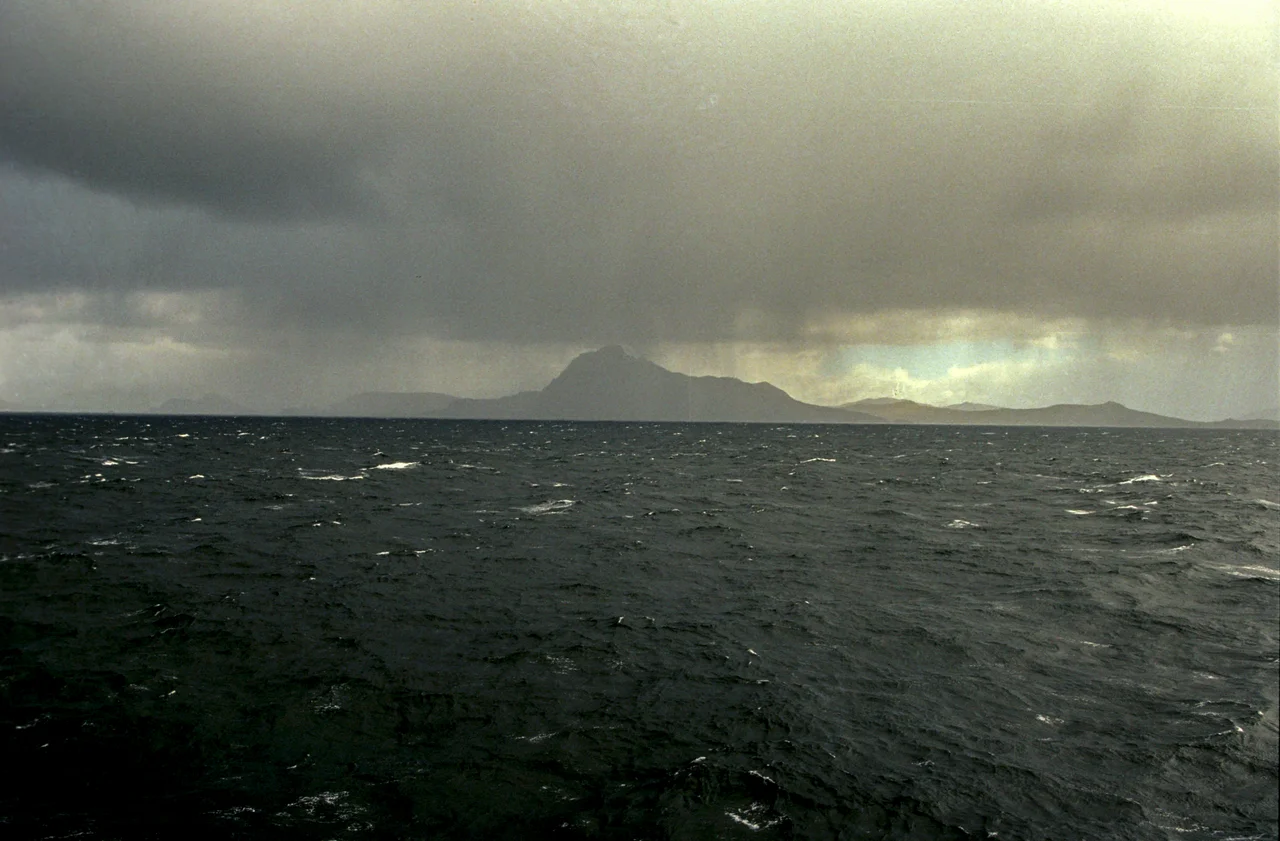

Cape Horn
Sailors call them the screaming sixties, and Cape Horn sits right at their northern edge. Here, at 56 degrees south, the wind blows around the entire planet without a single landmass to slow it, until the Andes and the Antarctic Peninsula funnel it into the narrow throat of the Drake Passage. The waves it raises can run thirty meters high. The Horn itself is almost an anticlimax to look at: a steep, dark headland on tiny Hornos Island, often half-lost in cloud and spray. But for four centuries this rock has been the great trial of the sea, the place that separated able sailors from the rest, and a graveyard for the many who never made it past.
The Cape from Hoorn
It was named by accident of geography and pride of hometown. In January 1616 two Dutch navigators, Willem Schouten and Jacob Le Maire, pushed south past Tierra del Fuego searching for a new route to the Pacific that would bypass the Dutch East India Company's monopoly on the Strait of Magellan. Rounding the continent's final point, they christened it Kaap Hoorn after the city of Hoorn in the Netherlands, the port that had backed their voyage. Decades earlier, in 1526, the Spanish ship San Lesmes under Francisco de Hoces had been blown to these latitudes, which is why Spanish charts still call the surrounding water the Sea of Hoces while English ones name it the Drake Passage. For generations afterward, the Horn became the pivotal milestone of the clipper route, the corner of the world around which global trade was carried under sail.
Why the Horn Kills
Several dangers conspire here, and they reinforce one another. The prevailing westerlies of the Southern Ocean, the roaring forties and furious fifties, blow nearly uninterrupted around the globe, and rounding the Horn forces ships south into the worst of them. Those winds raise enormous swells that travel for thousands of kilometers, then meet the shallow water south of the Horn, which makes the waves shorter, steeper, and far more dangerous. When the powerful eastward current of the Drake Passage runs against a westerly gale, the seas build higher still, and the area west of the Horn is notorious for rogue waves towering up to thirty meters. Add drifting icebergs and the brutal difficulty, in the age of sail, of beating westward against all of it, and the Horn earned its reputation as perhaps the most dangerous ship passage on Earth. Charles Darwin, who saw it from the Beagle, wrote that one sight of such a coast was enough to make a landsman dream for a week about shipwrecks, peril, and death.
The Albatross at the End of the World
Near the Chilean Navy station that watches over these waters stands a monument to everyone the Horn took. Erected in 1992, its steel sheets form, in the gap between them, the silhouette of a soaring albatross. A nearby plaque carries a poem by the Chilean writer Sara Vial, spoken in the albatross's voice: I am the albatross that awaits you at the end of the world, the forgotten souls of dead sailors who rounded Cape Horn from all the oceans of the world. They did not die in the furious waves, the poem insists; today they fly on its wings toward eternity. It is a fitting tribute, because the dead here were not abstractions. They were apprentices barely into their teens, seasoned crews on grain and nitrate ships, men who froze and drowned doing brutal work far from home. The albatross, the great wanderer of these latitudes, watches the seas that swallowed them.
Rounding the Horn Today
The opening of the Panama Canal in 1914 ended the Horn's reign over commerce, and the last commercial sailing ship to round it laden with cargo, the windjammer Pamir, did so in 1949, carrying Australian grain to England. But the Horn never lost its hold on the imagination. To round it under sail remains one of the supreme challenges in yachting. Pioneers chased it singlehanded, the Argentine Vito Dumas first circumnavigating the globe alone via the Horn in 1942, and in 2010 the sixteen-year-old Abby Sunderland became the youngest person to sail around it solo. Today the great ocean races, the Vendee Globe, the Golden Globe, and others, still send their fleets past this rock. A handful of cruise ships round it too, letting passengers glimpse the headland that generations of sailors approached with dread. Tradition once granted a Horn veteran the right to wear a gold earring and dine with one foot on the table, small honors for surviving the end of the world.
From the Air
Cape Horn marks the southern tip of the Tierra del Fuego archipelago in Chile's Magallanes y la Antartica Chilena Region, at roughly 55.98 degrees south, 67.29 degrees west, on small Hornos Island where the Atlantic and Pacific meet at the north edge of the Drake Passage. From the air it appears as a steep, dark headland amid a scatter of storm-battered islands, frequently shrouded in cloud, with a small lighthouse near the Chilean Navy station about a mile east-northeast of the cape proper. The nearest airport is Guardiamarina Zanartu Airport (SCGZ) at Puerto Williams to the north; Punta Arenas (SCCI) is the main regional hub. Conditions are severe: gale-force winds occur up to 30 percent of the time in winter, visibility is often poor, and the region sees barely seven hours of daylight at the June solstice. View from 2,000 to 5,000 feet AGL during rare windows of clear weather.
Nearby Stories
- Bahía Wulaia 77 km away
- Picton, Lennox and Nueva 80 km away
- Beagle Channel 125 km away
- Isla de los Estados 192 km away
- Sinking of ARA General Belgrano 336 km away
- Fumarole Bay 821 km away
- Antarctic Peninsula 1419 km away
- West Antarctica 2785 km away