
Captain Cook Memorial Museum
Climb the narrow stairs to the attic of the brick house on Grape Lane and you can almost see him: a serious young Yorkshireman, bent over charts by the light of candles a servant brought up to him. His name was James Cook, he was seventeen, and the world had not yet heard of him. The shipping master who owned this house, John Walker, had taken Cook on as an apprentice in 1746, and for the next nine years a future legend lived under this roof between voyages on the colliers that hauled coal between the Tyne and London. The house still stands, almost unchanged. The candles are gone, but the attic remains.
The Apprentice Years
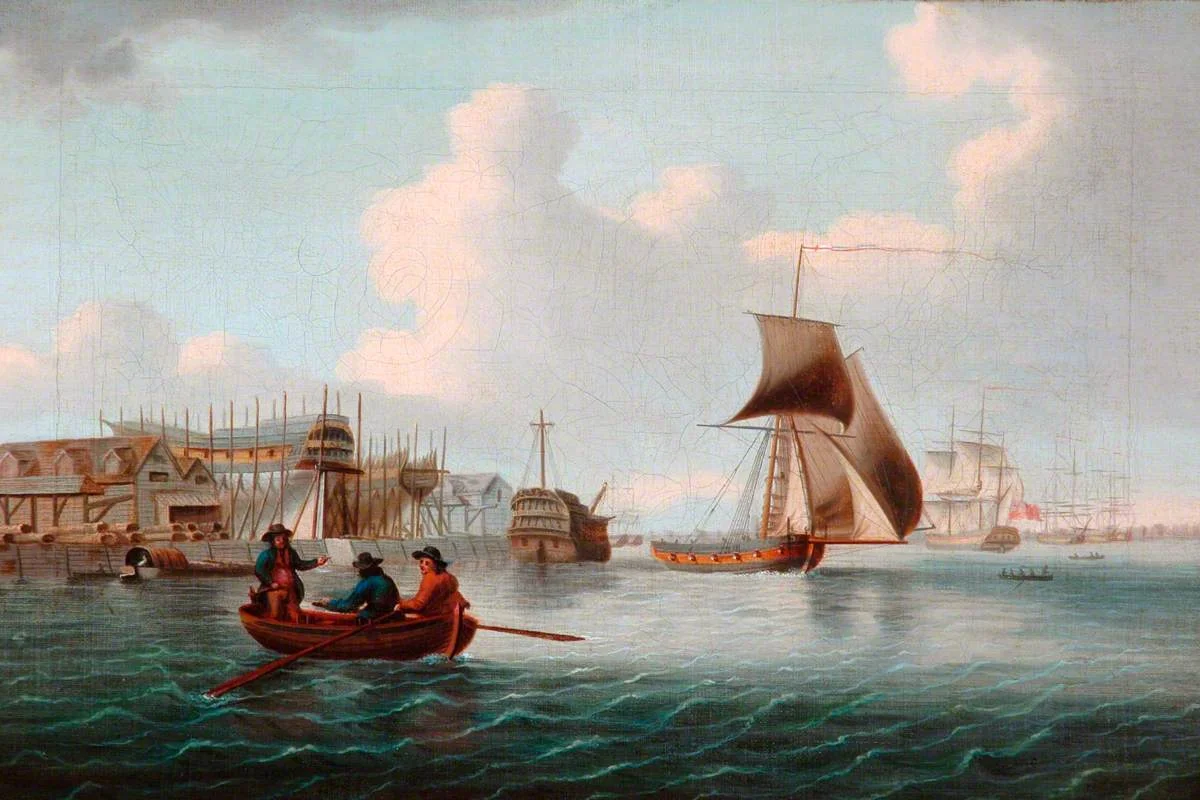
William Sanderson, the grocer in nearby Staithes for whom Cook had worked, made the introduction in 1746. Walker took the young man on for a three-year term, first as apprentice seaman, then seaman, and finally master's mate. The work was unglamorous: hauling coal south to London, occasional runs to the Baltic and Dublin, the brutal rhythm of the North Sea collier trade. But the cats - those flat-bottomed Whitby-built ships, broad and tough enough to ground safely on a beach - taught Cook seamanship of a particular kind. When he later chose Endeavour for his first voyage of discovery, he chose a Whitby cat. The vessel that carried him to Tahiti, New Zealand, and Australia was, in its bones, the same kind of ship he had learned the sea on as a boy on Walker's payroll.
Walker's House
Moses and Susannah Dring built the house in 1688, and a plaque on the wall still records the date. By the time Walker's father bought it in 1729, it was already regarded as a typical well-to-do ship-owner's residence: three floors plus an attic, two rooms on the ground floor, the windows giving onto the bustle of Grape Lane and the harbour beyond. An inventory taken in 1754 survives in such detail that those ground-floor rooms have been furnished according to it and painted in the original colours. The 2001 archaeological dig uncovered the brick-floored kitchen mentioned in that inventory, lying about a metre below today's ground level, along with the foundations of outbuildings from the Walkers' shipping business and a slipway running down to the river. The history of a family's rise from sea captains to bankers is written in those layers.
The Attic and Mary Prowd
The author Young, writing about Cook's biography, described the apprentice studying late into the night in the attic by candles supplied by Mary Prowd, a family servant. It is a small, almost domestic detail in a life that would otherwise be told in oceans and continents. Apprentices in the period were typically released in winter to return to their families in the countryside around Whitby, but some, like Cook, were boarded in town. The arrangement in Grape Lane suited the Walkers, who had space, and suited Cook, whose family in Marton could not easily host him. Mary Prowd's candles, and whatever conversations they accompanied, helped shape a navigator. Cook returned to visit Walker in the winter of 1771-72, after his first voyage. He came back as the most famous captain in Europe to thank the man who had taught him.
What the Museum Holds
The Captain Cook Memorial Museum Trust acquired Walker's House in 1986, after the building had served by turns as a hospital and a private residence. The collection inside is the kind that makes maritime historians light up: original letters from the voyages, including correspondence of Cook, Lord Sandwich, Sir Joseph Banks, and the Forsters; paintings and drawings by the artists who sailed with Cook to the Pacific, among them Sydney Parkinson, William Hodges, and John Webber. There are artefacts from the Pacific islands and New Zealand, original maps and charts, and ship models. In 2009, with help from The Art Fund and other trusts, the museum bought William Hodges' painting of Matavai Bay, Tahiti - the very anchorage Cook visited on his second voyage. The painting now hangs in a house where, half a century before its subject existed in any European's imagination, Cook learned to read a chart.
From the Air
Coordinates 54.4867°N, 0.6118°W. Walker's House sits on Grape Lane on the east side of Whitby's inner harbour, in the lower town beneath the ruined Whitby Abbey on the headland. From the air the harbour mouth and the swing bridge are the giveaway, with the abbey ruins to the southeast forming the strongest landmark. Best viewed below 2,500 ft in clear conditions. Nearest airports: Durham Tees Valley (EGNV) about 40 nm northwest, Newcastle (EGNT) about 60 nm north-northwest, Humberside (EGNJ) about 50 nm south.
Nearby Stories
- Sledmere House 8.6 km away
- Hartlepool 10 km away
- RAF Linton-on-Ouse 17 km away
- Middlesbrough Cathedral 17 km away
- SM UC-75 23 km away
- Arctic Viking (H452) 26 km away
- Breagh Gas Field 28 km away
- German submarine U-2367 50 km away