
Cardona
Rain runs off most mountains. The one just outside Cardona it slowly dissolves. Rising beside this Catalan town is the Muntanya de Sal, a true mountain of rock salt, much of it so pure that large blocks are nearly transparent. It formed some 37 million years ago, in the late Eocene epoch, when an ancient sea evaporated and left its salt buried deep, and over ages the lightweight mineral was squeezed upward through the crust until it broke the surface. People have been carving into it since Roman times. The salt made Cardona rich, gave its lords a grand title, and left the town with a fortress on the hill that guarded the treasure below.
A Mountain You Can Taste
The Salt Mountain is the reason Cardona exists, and it is a genuinely strange thing to stand before. A mass of rock salt sits beneath a thick cap of reddish-brown clay, resting on pale sandstone, and where the salt is exposed it glows, translucent in places, in others clear enough to see straight through. Fresh gullies open after heavy rain, because water carves salt far faster than ordinary stone. Miners have worked this deposit since Roman times, and Cardona's craftsmen long turned pieces of it into carved images, crucifixes, and delicate ornaments. Today the workings form the heart of the Cardona Salt Mountain Cultural Park, where guided tours descend into galleries walled entirely in glittering salt, the passages glistening and faintly damp, the air carrying a sharp mineral tang. The park keeps regular hours, closing only on Mondays. Over the centuries salt from Cardona seasoned tables and preserved food across Catalonia and beyond, an everyday necessity that happened, here, to lie heaped in a whole mountain.
Kings Without Crowns
Wealth like that needed guarding. A fortress has crowned the hill above the town since the year 886, when Guifré el Pilós, the count remembered as the founder of Catalonia's ruling house, raised it to hold this frontier against al-Andalus. In time the site passed to the Dukes of Cardona, who grew so powerful on the proceeds of the salt that they were known as the Lords of the Salt and, more grandly, as the kings without crowns. Theirs was reckoned the foremost family of the Crown of Aragon, second in rank only to the royal house itself. Determined that no one should seize their mountain of money, they made the castle formidable, and it earned its reputation the hard way, proving nearly impregnable during the War of the Spanish Succession as late as 1714.
Stone and Salt
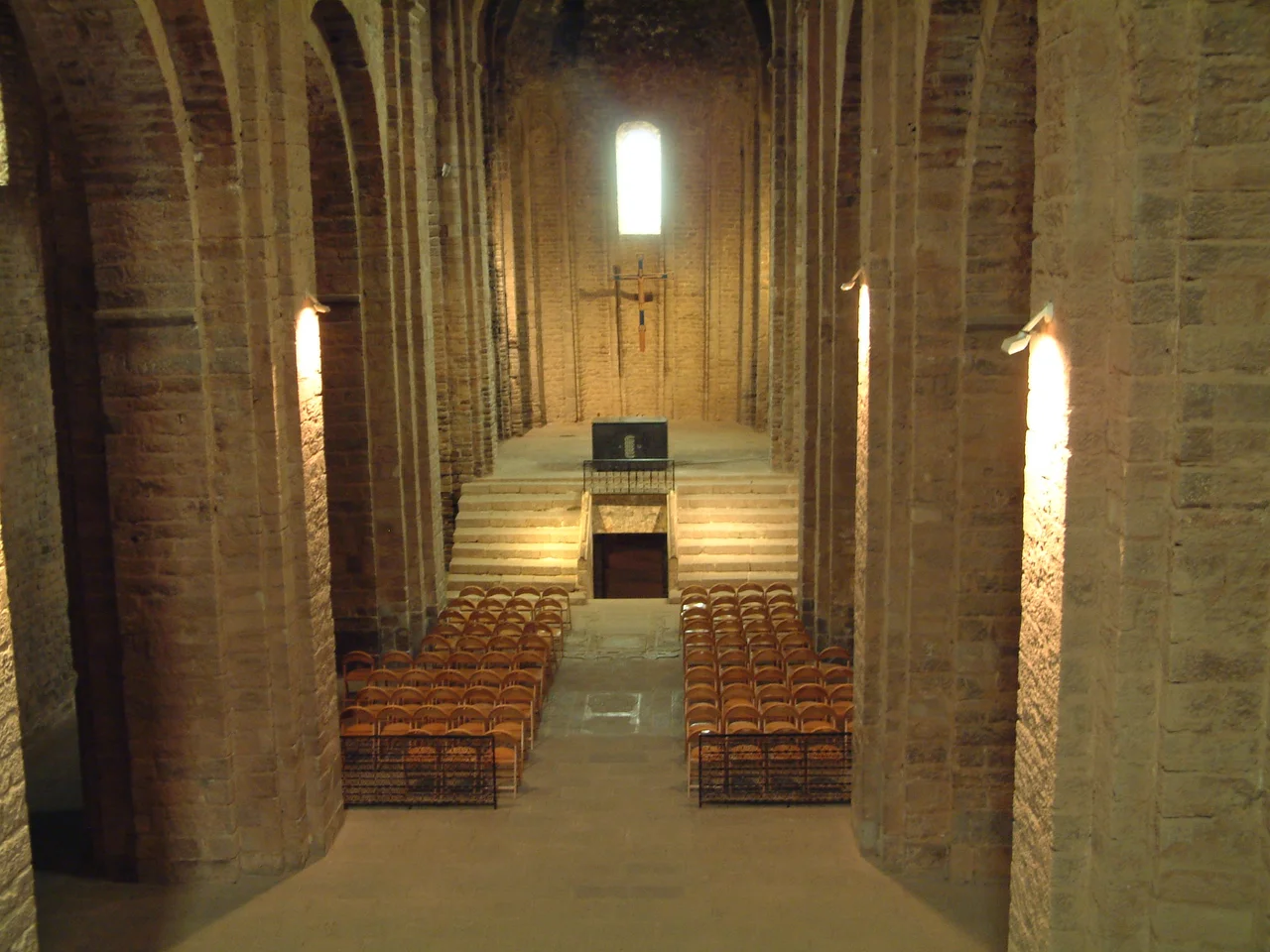
The castle is a layered thing, part fortress, part palace, part church. Within its walls the dukes built a residence, cloisters, and the Romanesque church of Sant Vicenç, whose apses, transept, and lantern tower carry the distinctive Lombard detailing of eleventh-century Catalan builders. The complex now shelters a Parador, one of Spain's state-run historic hotels, so travelers can sleep inside the medieval stronghold overlooking the salt. Down in the town stands another treasure, the church of Sant Miquel, first built in the 11th century and rebuilt in Gothic style in the 14th. Inside hangs a prized polyptych by the medieval painter Pere Vall, depicting Saint Anne, the Virgin, and Saint Amador, along with a carved baptismal font that has served the town since the 1400s.
A Town Off the Main Line
For all its history, Cardona is a quiet place today, home to around 4,550 people. No railway reaches it; the only way in is the C55 road that winds up the Cardener valley, which has helped keep the town off the standard tourist circuit. That isolation is part of the appeal. From the battlements of the castle the view takes in the river, the huddled rooftops, and the pale bulk of the Salt Mountain, and the whole long story of the place lays itself out at once: an improbable natural fortune, the noble house that grew rich defending it, and the fortress that still stands watch over a mountain that is, quietly and endlessly, washing away in the rain.
From the Air
Cardona lies at 41.9136°N, 1.6806°E, about 90 km north of Barcelona in the Cardener valley. Two landmarks stand out from the air: the medieval Castell de Cardona crowning its isolated hill, and just beside it the pale, bare dome of the Muntanya de Sal salt mountain, unlike any ordinary rock nearby. Best viewed from 3,000–5,000 ft AGL. Sabadell (LELL) sits about 55 km south, Barcelona-El Prat (LEBL) roughly 90 km south on the coast, and Girona (LEGE) about 100 km east. This is inland pre-Pyrenean country; skies are often clear, but valley haze and winter fog can settle along the Cardener.
Nearby Stories
- Battle of the Segre 6.6 km away
- Vic Cathedral 12 km away
- Abric Romaní 17 km away
- Bombing of Granollers 17 km away
- Roca dels Bous (archaeological site) 18 km away
- Catalan Romanesque Churches of the Vall de Boi 41 km away
- Abbey of Saint-Martin-du-Canigou 45 km away
- Aiguestortes i Estany de Sant Maurici National Park 68 km away