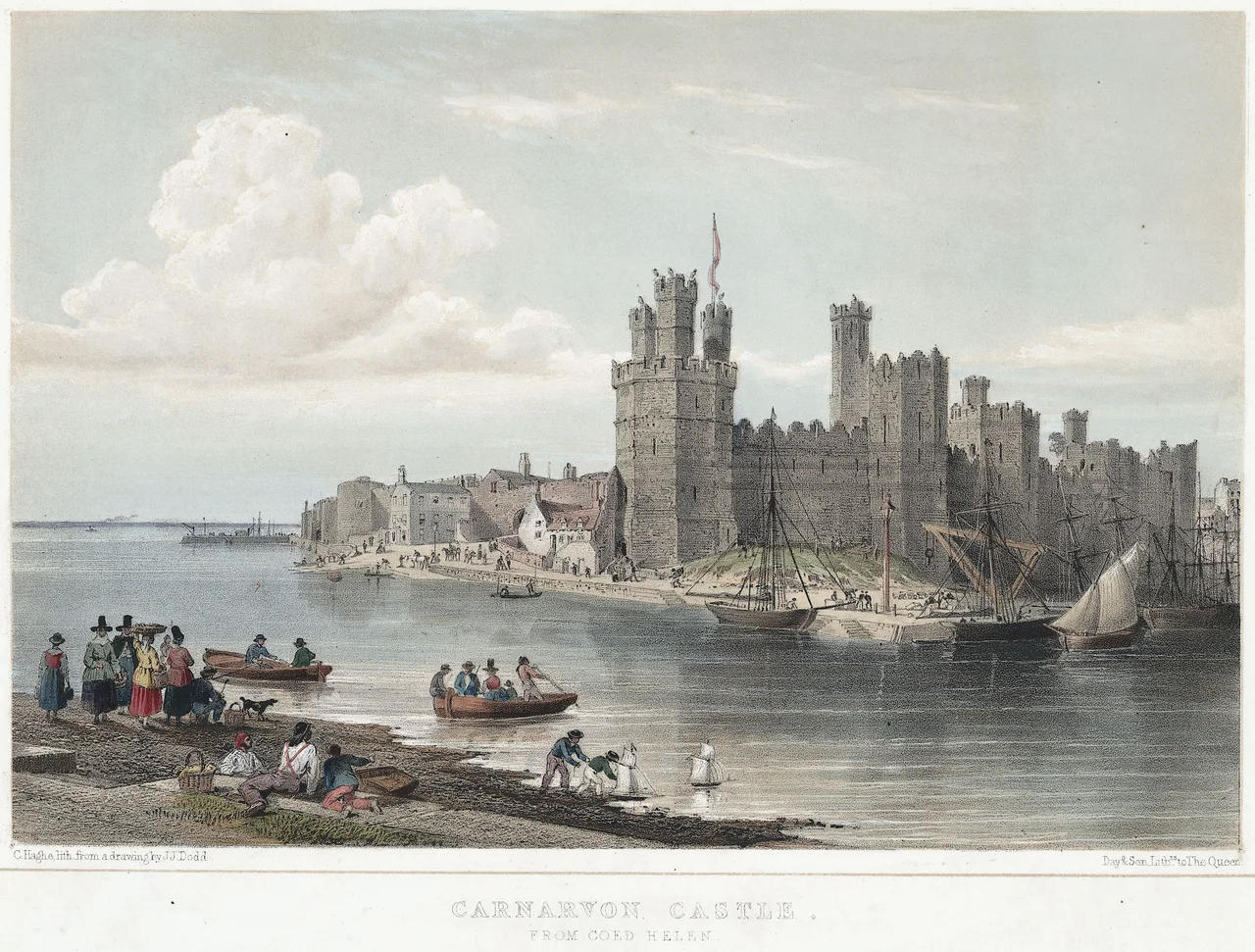

Carnarvon Castle Railway Station
The first public railway in North Wales did not have a locomotive. It had horses - sometimes two, sometimes more - hauling slate wagons nine miles down a gentle gradient from the quarries near Nantlle to the harbour at Caernarfon. It opened on 12 July 1828, three years after the Stockton and Darlington and three years before the Liverpool and Manchester. For 28 years it carried only slate. Then, in 1856, somebody decided to add passengers, and the small wooden Booking Office near Caernarfon harbour - alongside what would become known as Carnarvon Castle station - started selling shillings-and-sixpence tickets to Nantlle.
A Station Without a Platform
Carnarvon Castle was a railway terminus in name only. There was no platform. There was no station siding. Passengers boarded from and alighted onto the trackside, and the train - the 'usual open passenger truck and a closed or first class carriage drawn by two horses', as one 1861 newspaper account put it - simply stopped at an agreed spot near the Booking Office. The Booking Office itself was the line's only piece of dedicated passenger architecture along the entire nine-mile route. Three classes of travel were on offer. A return from Carnarvon Castle to Nantlle in 1857 cost one shilling in 3rd class, one shilling and sixpence in 2nd, and half a crown - two shillings and sixpence - in 1st. The journey took an hour and a half southbound, slightly less coming back, against the prevailing slope. The trains averaged six or seven miles per hour. A horseless person trying to walk to Nantlle would have struggled to keep up.
Slate Was the Real Business
Passenger revenue was a useful sideline - more than a quarter of total income in 1862 - but the Nantlle Railway always made its money from slate. Roof slates from the quarries near Nantlle came down to the quay in horse-drawn wagons, were loaded onto ships, and went out to roof Liverpool, Manchester, the Midlands and as far afield as Australia. Northbound goods were almost entirely slate, with copper ore a distant second. Southbound was almost entirely coal. The passenger service was an afterthought, run by a private contractor named Edward Preston under lease from the railway company. Sunday trains were never offered. The line stopped working its tariff round the Sabbath.
The Standard Gauge Sweeps It Away
By the 1860s the standard-gauge Carnarvonshire Railway was being built through the same valleys, and its northern section between Penygroes and Coed Helen - just south of Caernarfon - would obliterate the Nantlle Railway's tracks. The passenger service ended on 12 June 1865. Slate traffic limped on through a cumbersome transshipment arrangement at Tyddyn Bengam, where Nantlle wagons were pushed onto standard-gauge flatcars three at a time, hauled north, then pushed off and horse-drawn the final stretch to the quay. With complexity came delays, breakages, pilfering, and a quiet shift of cargo back to the road. The Nantlle's single-span stone bridge over the Afon Seiont was finally demolished in 1879-80. Most of the line in Caernarfon disappeared under standard-gauge infrastructure in the 1870s. At the southern end, remarkably, a length of horse-drawn three-foot Nantlle track survived until 1963 - British Railways' last horse-drawn remnant, in operation seventeen years after nationalisation.
What Remains
There is almost nothing left of Carnarvon Castle station to see. The harbour area has been redeveloped repeatedly; the line's path through the lower town vanished into the standard-gauge layout in the 1870s and then into modern road works. The most northerly visible piece of the old Nantlle Railway is Coed Helen tunnel, a 22-yard cut beneath the hill just south of the river, with some embankment traces between the tunnel and the river. There are stone bridge abutments along the same stretch that may or may not be original. Several attempts to revive the route in the early twentieth century - by the Portmadoc, Beddgelert and South Snowdon Railway in 1904 and 1908, then by the Welsh Highland Railway promoters after the First World War - all died in parliamentary committees and unbuilt lines. The horse trains that once paused beside the harbour office to let passengers down onto the cobbles are now a footnote, but they ran the first regular timetable in north Wales, and they did it without burning a single ton of coal.
From the Air
The former Carnarvon Castle station site lies at 53.14 degrees north, 4.28 degrees west on the quayside of Caernarfon harbour at the mouth of the Afon Seiont, immediately west of the castle. Nothing of the station itself remains visible. From the air, look for the harbour, the castle, and the line of Coed Helen across the river where the original railway tunnel still exists. Best viewed at 1,500-3,000 feet. Caernarfon Airport (EGCK) is four nautical miles south-west; RAF Valley (EGOV) lies 15 miles north-west across the Menai Strait.
Nearby Stories
- Wakestock 1.7 km away
- Trefriw 3.8 km away
- Irish Sea 8.7 km away
- Irish Sea Bridge 20 km away
- East–West Interconnector 30 km away
- Machynlleth 36 km away
- HMS Tyler 41 km away
- New Brighton Lifeboat Station 54 km away