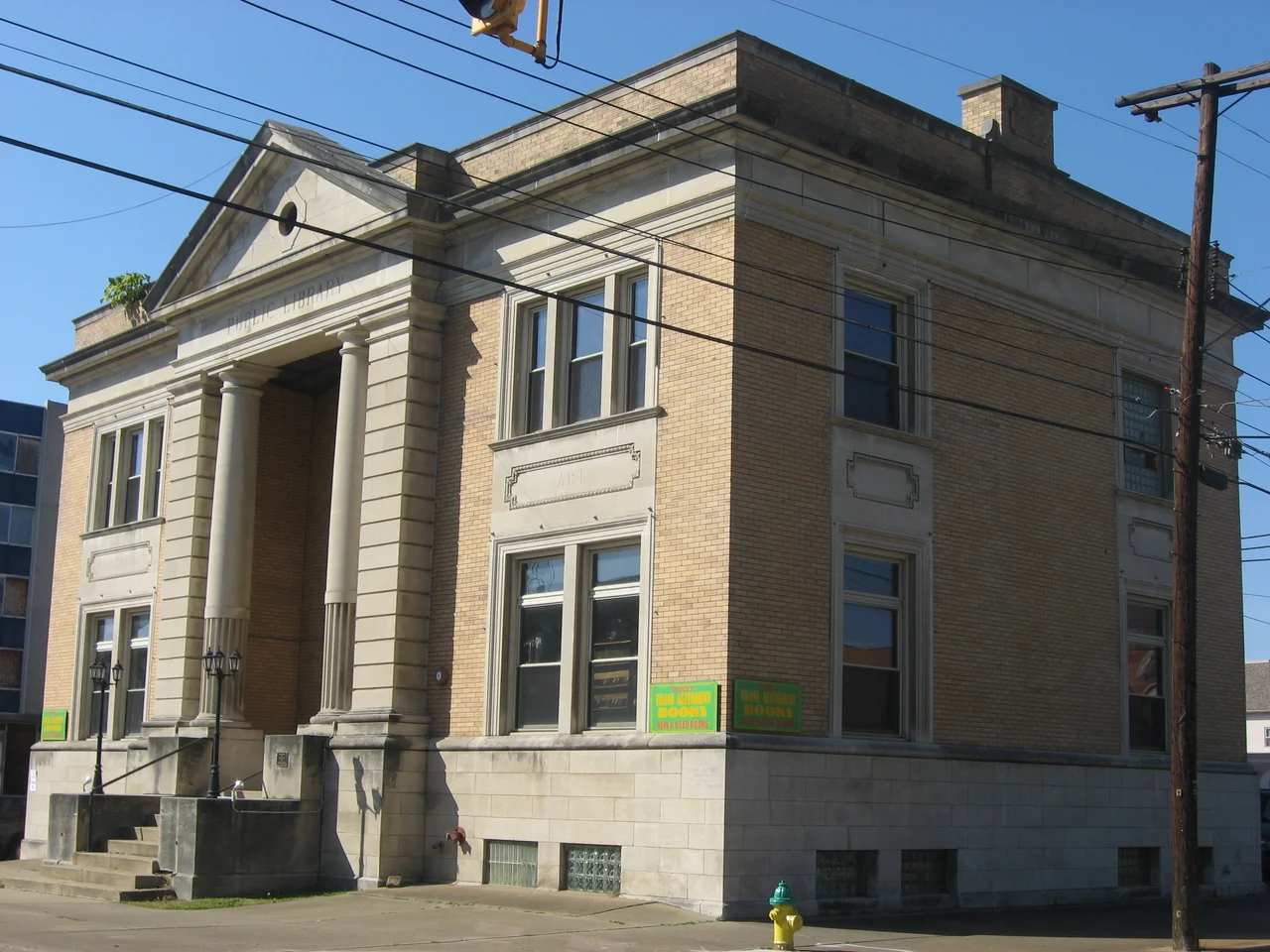

Carnegie Library
Glass floors. The Parkersburg Carnegie Library, completed in 1905, was built with translucent structural glass floors on its upper levels, allowing natural light from the skylight above to filter down to the stacks below. Andrew Carnegie's $34,000 grant for the building paid for the brick and the Doric columns and the spiral staircase, but the glass floors were the architect's distinctive touch - a piece of period engineering that aimed to maximize daylight in an era before reliable electric reading lamps. The library was one of 2,509 Carnegie libraries the steel magnate funded between 1883 and 1929 across the English-speaking world. Most have lost their original interiors. The Parkersburg building has not.
The Carnegie Program
Andrew Carnegie, who had sold his steel empire to J. P. Morgan in 1901 for what amounted to the largest personal fortune in human history to that point, spent the rest of his life giving the money away. His most famous project was the construction of public libraries. The Carnegie program operated on a partnership model: Carnegie's foundation provided the building if the local community provided the land and committed to fund the library's operations from public taxes. Communities that took the deal got a building. The 2,509 libraries Carnegie funded - 1,679 of them in the United States - transformed American small-town civic life. They brought free access to books and learning to towns that had never had a library before. They put a public reading room within walking distance of millions of Americans for the first time.
The Building
The Parkersburg library is a two-story, L-shaped brick structure in the Classical Revival style that was almost mandatory for Carnegie libraries of the era. The facade is detailed in gray stone, with a central pediment supported by two Doric columns - the most restrained of the classical orders, appropriate for a serious civic building. The interior centers on a spiral staircase that connects the floors. The translucent glass floors on the upper level were a piece of period architectural engineering, allowing skylight from the central rotunda to reach the stacks below. The building cost approximately $34,000 in 1905 - roughly $1.2 million in 2026 dollars. It opened to the public to serve a city that, in the oil-and-gas boom of the early 20th century, was one of the most prosperous in West Virginia.
From Library to Bookstore
By the mid-1970s, the building was no longer adequate for a modern public library system. The collection had outgrown the stacks. The infrastructure - electrical, plumbing, accessibility - was 70 years old. The city built a new library building elsewhere and closed the Carnegie building in approximately 1975. The structure sat empty until December 1985, when it reopened as Trans Allegheny Books, the largest used bookstore in West Virginia. The transformation was a happy second life: a building purpose-built for housing books continued to house books, just under different management. The bookstore operated for 25 years and closed in 2010. The building has been seeking a new use ever since.
Listed and Looking
The Carnegie Library was added to the National Register of Historic Places in 1982 - while it was still empty between its library and bookstore lives - on the strength of its architectural significance and its association with the Carnegie program. In early 2021, the building was put up for sale by auction. The future is uncertain. Buildings like this one - intact Carnegie libraries in original interior condition - are increasingly rare. Most have been substantially altered for office or retail use, with the period interior details lost. The Parkersburg building still has its spiral staircase and its glass floors. Whether the next owner chooses to preserve them is a question that will likely be decided in the next few years.
What a Carnegie Library Did
It is easy now to take for granted what Carnegie's libraries accomplished. Free books. Quiet reading rooms. Public access to reference materials. Children's hours. The library habit. In 1905 these were genuinely transformative. The Parkersburg of that year had a population of about 12,000 and was growing fast on the oil and gas economy. Workers and immigrants arrived with limited formal education. Their children needed somewhere to learn. The Carnegie library provided that. Three generations of Parkersburg children grew up in this building before it closed as a library. Many of them - perhaps most - would never have entered any library at all if Carnegie had not funded one within walking distance of their homes. The building's quiet civic work in those 70 years is the larger story that the architectural details are merely the visible record of.
From the Air
Located at 39.27 degrees N, 81.56 degrees W in downtown Parkersburg, Wood County, West Virginia. The Carnegie Library sits in the historic core of the city. Mid-Ohio Valley Regional Airport (KPKB) is the nearest tower-controlled field about 6 nm north. Recommended viewing altitude 3,000 to 4,500 feet MSL. Expect dissected plateau terrain throughout the area; the Ohio River runs along the west side of the city.
Nearby Stories
- Mountaineer Power Plant 5.3 km away
- Burning Springs Complex 7 km away
- Glenville, West Virginia 10 km away
- Strouds Run State Park 11 km away
- Salem University 26 km away
- West Virginia Penitentiary 42 km away
- The Y-Bridge of Zanesville 44 km away
- The Wheeling Suspension Bridge: The Longest Span in the World 81 km away