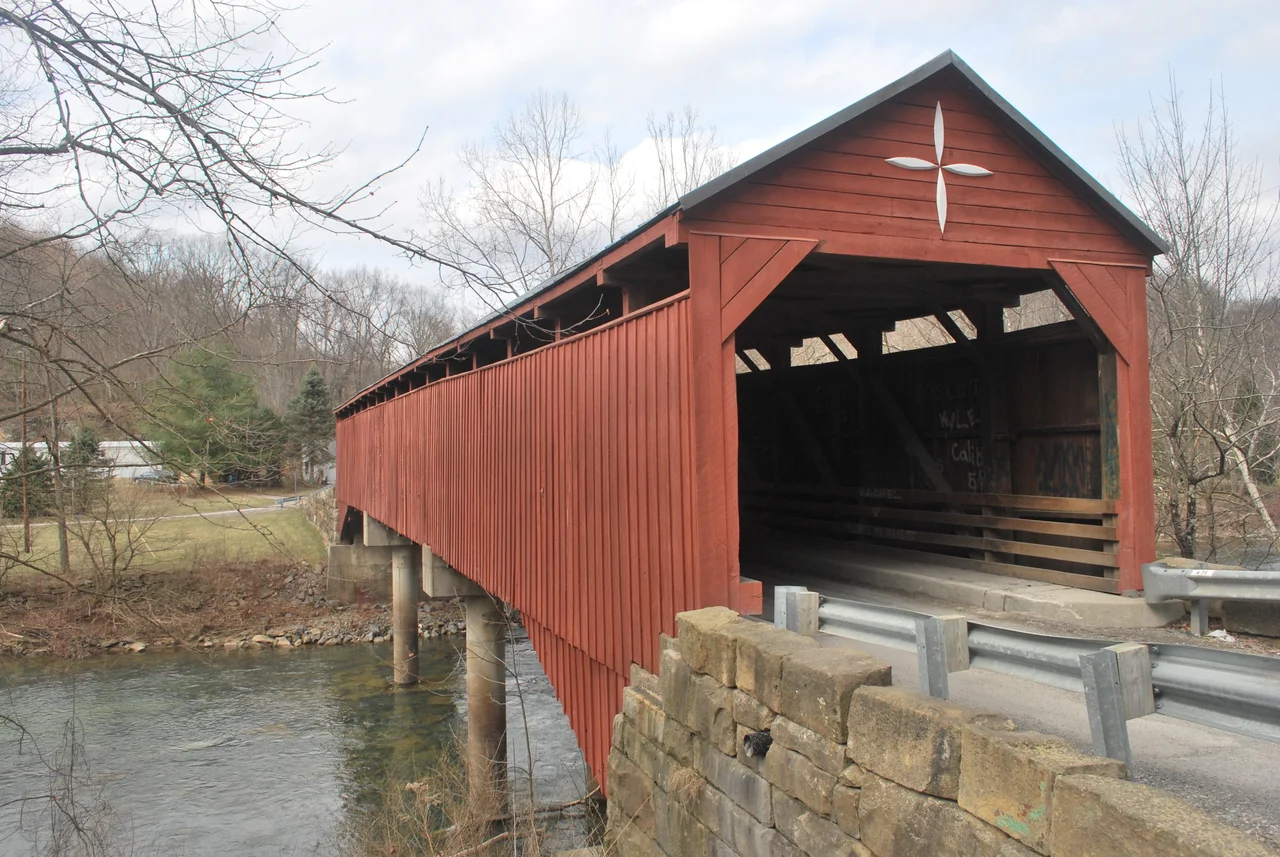

Carrollton Covered Bridge
On August 10, 2017, the Carrollton Covered Bridge burned. Investigators determined the fire was arson. The 161-year-old wooden structure across the Buckhannon River near Carrollton, West Virginia - the second longest and third oldest surviving covered bridge in the state - was left heavily damaged. The state could have replaced it with steel and concrete. Instead, West Virginia Division of Highways crews spent the next several years restoring it, mixing salvaged original timber with new wood, and reopened the bridge in 2022. The new Carrollton Covered Bridge is not exactly the old one. But the truss work that has held this span for more than 160 years is, in large part, still doing its job.
Built by Brothers O'Brien
Emmet J. O'Brien and Daniel O'Brien built the bridge in 1856 to carry the Middle Fork Turnpike, an important connecting route between the Staunton and Parkersburg Turnpike and the road to Clarksburg. At 140 feet long and 16 feet wide, with Burr trusses incorporating multiple kingpost trusses, the bridge was an ambitious piece of nineteenth-century structural engineering. The Burr truss design - a multiple kingpost truss combined with an arch - was patented by Theodore Burr in 1817 and became one of the dominant covered bridge configurations in the eastern United States. The Carrollton bridge's clear span made it one of the longest of its kind in West Virginia. For more than a century, wagons, then automobiles, crossed its single lane on the way between farms and county seats.
The 1962 Compromise
By 1962, the wooden decking was no longer safe to carry the trucks and cars that now used it daily. The state could have closed the bridge. Instead, engineers compromised. The wood decking was replaced with a concrete deck, one lane wide, with a sidewalk added. New concrete piers and abutments went in underneath. The bridge could now carry modern loads, but it was no longer a clear span - the original truss work, which had stood without intermediate support, was now backed up by hidden concrete. Purists of historic preservation noted the change. Drivers crossing the river kept driving. The compromise let the bridge survive into an era when nostalgia, not utility, would justify its existence.
Listing, Arson, Rebuilding
On June 4, 1981, the bridge was added to the National Register of Historic Places. The designation acknowledged what visitors already knew: that Carrollton was one of the few remaining links to a moment when American transportation was wooden and covered. Bridges like this were once everywhere in Appalachia. Most are gone, burned by accident or neglected to collapse. The 2017 arson fit a depressingly common pattern - covered bridges, isolated and combustible, attract vandals. The West Virginia Division of Highways crews who restored the bridge between 2017 and 2022 worked carefully, salvaging what they could from the original timbers and matching the rest with new wood cut to the same dimensions. The reopening in 2022 returned a piece of the county's transportation history to active service.
What the Bridge Still Carries
The bridge still carries West Virginia Route 36 across the Buckhannon River. Traffic on the route is light - a few cars an hour - which is part of why the bridge survives where busier crossings have been replaced with steel. The Buckhannon River below flows quietly most of the year, a tributary that joins the Tygart Valley River to the north. From the road, the bridge announces itself as something exceptional: dark red painted siding, gable roof, the slow geometry of nineteenth-century timber engineering. Walking through it, even today, you can hear your own footsteps echo off the trusses overhead. The smell of treated wood mixes with the river air. The bridge has burned once. It might burn again. For now, it carries traffic the way it was built to.
From the Air
Located at 39.09 degrees north, 80.09 degrees west, in Barbour County, West Virginia, near the small community of Carrollton. Best viewed from 2,500 to 4,000 feet AGL. The bridge crosses the Buckhannon River where West Virginia Route 36 makes its crossing - look for the dark wooden structure spanning the river, distinctive against the surrounding farmland. Nearest airports are North Central West Virginia (KCKB) at Clarksburg to the northwest and Elkins-Randolph County (KEKN) to the southeast.
Nearby Stories
- Weston and Gauley Bridge Turnpike 3.3 km away
- Canaan Valley 6.7 km away
- Spruce Knob-Seneca Rocks National Recreation Area 7.5 km away
- Tygart Valley Homesteads Historic District 10 km away
- Garrett County, Maryland 19 km away
- Salem University 20 km away
- Battle of Fort Necessity 59 km away
- West Virginia Penitentiary 64 km away