.jpg)
Casa Garden
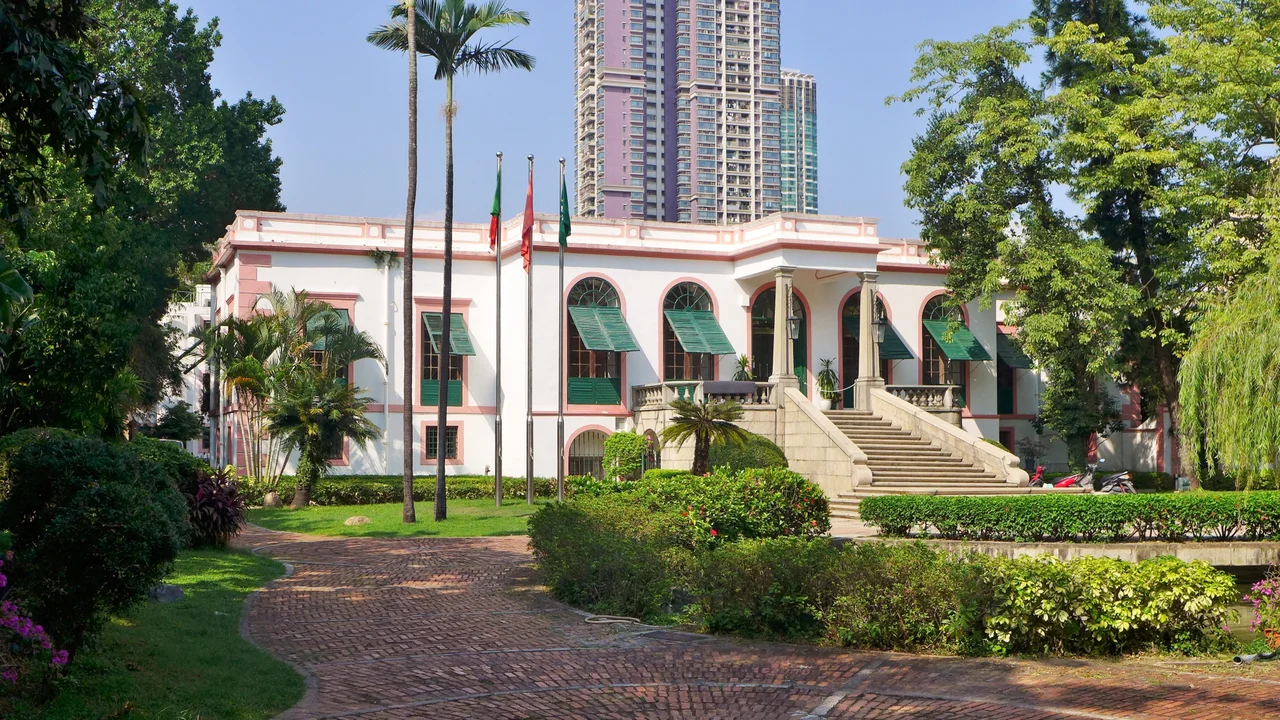
Manuel Pereira built the house in 1770 with the ambitions of a wealthy man who expected to keep it. He did not. Within a generation, the English East India Company was renting the residence to house the directors of its Macau branch — the agents of a trading empire that at its height controlled nearly half the world's commerce using the villa's shaded garden as a place to conduct business at the edge of the South China Sea.
From Villa to Trading Post
In the eighteenth century, Macau occupied a peculiar position in the global economy. The city was the only port in China where European traders were permitted to reside — Canton (Guangzhou) allowed seasonal visits for commerce, but Macau provided year-round shelter. The English East India Company, which held a British monopoly on trade with Asia, needed a permanent foothold on the peninsula. Renting Casa Garden gave the Company's directors a residence that fit the social expectations of colonial Macau: a neoclassical villa with a garden, modest by European standards but conspicuous enough to project authority. The directors who lived here managed trade routes that connected Britain, India, and China in a triangle of silk, cotton, and tea.
A Garden with a Quiet Neighbor
The compound is compact — a garden, the original residence, an art gallery, and, tucked within the grounds, the Old Protestant Cemetery. That cemetery holds a particular significance in Macau's history: it was established in the early nineteenth century for the foreign Protestant residents who were excluded from Catholic burial grounds, and its graves trace the contours of the merchant and missionary communities who passed through the territory. The horticulture of the garden itself reflects Portuguese colonial aesthetics — formal but not grand, designed for shade and conversation rather than display. Bougainvillea and banyan shade the paths between the old walls.
Where Europe's Competing Empires Left Their Mark
The overlap of Portuguese and British presence in the same building across different centuries is not unusual in Macau's history, but Casa Garden makes it unusually legible. The architecture is Portuguese colonial — low, thick-walled, with arcaded verandas suited to the subtropical climate. The occupants for much of its commercial life were British. The territory around it was administered by Portugal until 1999 and is now part of China. Each layer of stewardship left something behind, and the property's current role as headquarters of the Macau delegation of the Orient Foundation — a Portuguese institution devoted to cross-cultural exchange — is consistent with that layered identity.
Heritage Status and Living Use
In 2005, Casa Garden was included among the twenty-five designated sites of the Historic Centre of Macau, the UNESCO World Heritage property that recognizes the peninsula's singular mix of Chinese and European urban heritage. Unlike some heritage buildings that become inert museums of themselves, Casa Garden continues to function as a working cultural institution. It has hosted contemporary art exhibitions — Portuguese artist Sofia Areal showed work here in 2014 after a residency in Macau, later paired with an exhibition at the Museum of the Orient in Lisbon — and the space remains in active use for cultural programming. The art gallery inside the old residence stages rotating shows that often explore exactly the cultural hybridity the building has been accumulating since 1770.
From the Air
Casa Garden is located in the Santo António district of Macau Peninsula at approximately 22.200°N, 113.540°E. The peninsula's dense urban fabric is best surveyed at 2,000–4,000 feet approaching from the northwest over the Pearl River Delta. The area around Santo António sits in the upper-center of the peninsula, just north of the historic core. Macau International Airport (VMMC) is on Taipa Island, roughly 3.5 km to the southeast. The Governador Nobre de Carvalho Bridge provides a useful visual reference connecting peninsula to island. Visibility is best in the dry season, October through March.
Nearby Stories
- 2024 Shenzhen Stabbing 0.8 km away
- Lantau Peak 1.5 km away
- Kweilin Incident 2.4 km away
- Taishan City 7 km away
- Wanshan Archipelago Campaign 38 km away
- Hong Kong 12 68 km away
- Battle of Nanpeng Island 82 km away
- Erhai Lake 1335 km away