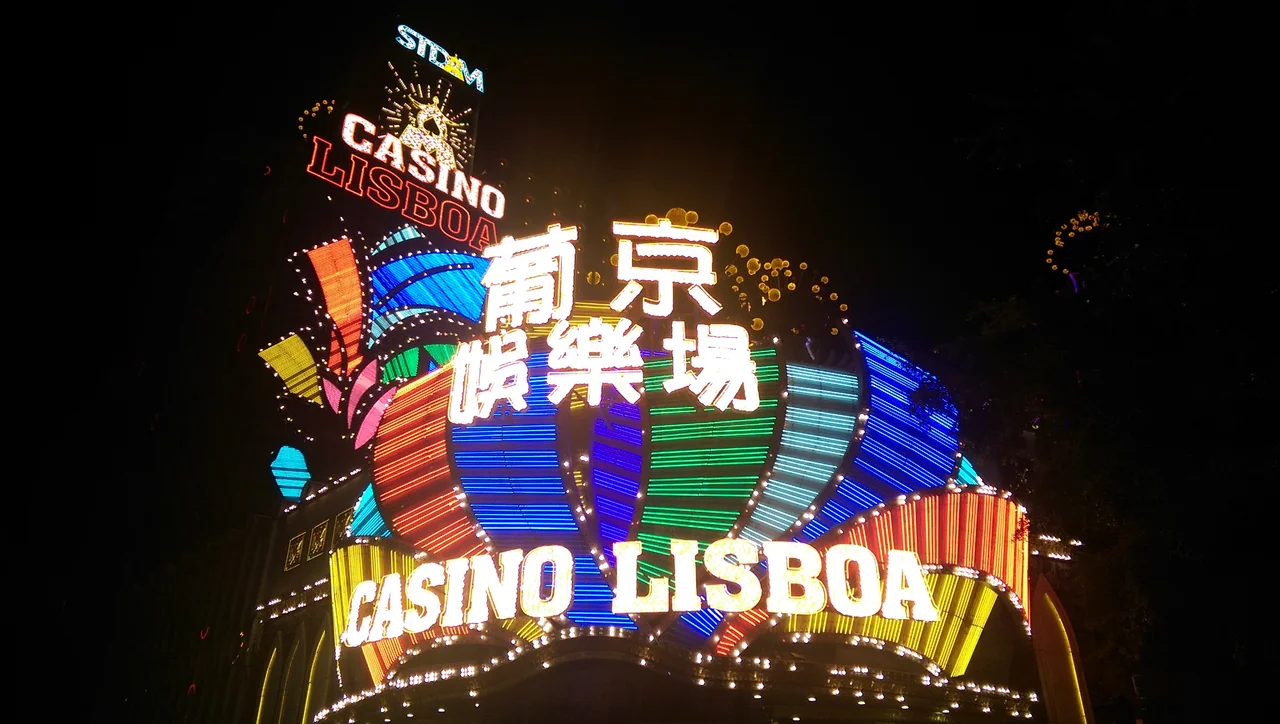

Casino Lisboa (Macau)
Stanley Ho did not build Casino Lisboa to be modest. The twelve-storey round hotel tower was the most distinctive structure on the Macau skyline when it opened in 1970, and for three decades it operated as the visible face of a legal gambling monopoly that made Ho one of the wealthiest people in Asia. The circular tower and the low casino floors attached to it became a landmark navigated by millions of visitors who crossed from Hong Kong by jetfoil to try their luck — a 45-minute trip that, for many, ended here.
Four Men and a Monopoly
Casino Lisboa was the product of a partnership: Stanley Ho, Teddy Yip, Yip Hon, and Henry Fok built the original complex in 1970 under the umbrella of STDM, the Sociedade de Turismo e Diversões de Macau, which held the exclusive gambling concession from the Portuguese colonial government. The concession was a remarkable arrangement — a single company with the legal right to operate all casinos in the territory. For Ho, the Lisboa was the flagship, a three-storey casino floor topped by the circular hotel. A 270-room extension added in 1991 brought the hotel to 927 rooms. By the time a second, taller extension — the Grand Lisboa, a golden lotus-shaped tower — opened next door in 2007, the total room count across the two buildings reached 2,362.
The Floor That Funded a City
For most of the second half of the twentieth century, gambling revenue from the Lisboa and STDM's other properties accounted for the majority of Macau's government income. The territory had almost no other economic base of comparable scale — some light manufacturing, some tourism, but nothing that generated the tax revenue that the baccarat tables did. The Lisboa's casino floor, with its dense arrangement of tables, slot machines, and the constant low noise of chips and cards, was the engine of a city-state. Visitors from Hong Kong, Taiwan, and mainland China arrived in waves, and the casino absorbed them. At peak hours the floor was barely navigable.
When Competition Arrived
For thirty years the monopoly held. Then, in the early 2000s, the Macau government opened the gaming concessions to competition, and the landscape changed rapidly. Wynn Macau opened directly adjacent to the original Casino Lisboa — a confrontation in concrete and glass between the old Macau and the new. The Grand Lisboa extension was partly a response to this pressure: a statement that Ho's empire could compete on scale and architectural ambition with the American-backed megaresorts arriving on the Cotai Strip. The original Casino Lisboa remained in operation, a three-storey building that now looked low and compact beside its gleaming neighbors, but which continued to attract visitors drawn as much by its history as by its gaming tables.
Three Michelin Stars Above the Casino Floor
Among the less expected features of the Lisboa complex was Robuchon à Galera, the Macau outpost of late French chef Joël Robuchon's restaurant group. In 2008 the Michelin Guide awarded it three stars — the highest rating — for its European cuisine: roasted guinea fowl, foie gras, the precise classical techniques that Robuchon's kitchens applied with consistency across his global restaurants. The restaurant later relocated to the top floor of the Grand Lisboa, renaming itself Robuchon au Dôme. Its presence in a casino building was not unusual for Macau, where fine dining and high-stakes gambling have been deliberately packaged together, but the Michelin recognition added a dimension of culinary seriousness to a complex more commonly associated with the gaming floor below.
From the Air
Casino Lisboa sits in the Sé district of Macau Peninsula at 22.190°N, 113.544°E. The twelve-storey circular hotel tower and the adjacent Grand Lisboa's distinctive gold lotus shape are two of the most recognizable structures on the peninsula from the air. Approach from the southeast at 2,000–3,500 feet for the clearest view of the casino district concentrated along Avenida de Lisboa. Macau International Airport (VMMC) is approximately 3 km to the southeast on Taipa Island. The Taipa bridges and the Cotai Strip development on reclaimed land between Taipa and Coloane are visible to the south. The Pearl River Delta's frequent haze reduces visibility in summer; winter months offer the clearest conditions.
Nearby Stories
- 2024 Shenzhen Stabbing 0.8 km away
- Lantau Peak 1.5 km away
- Kweilin Incident 2.4 km away
- Taishan City 7 km away
- Wanshan Archipelago Campaign 38 km away
- Hong Kong 12 68 km away
- Battle of Nanpeng Island 82 km away
- Erhai Lake 1335 km away