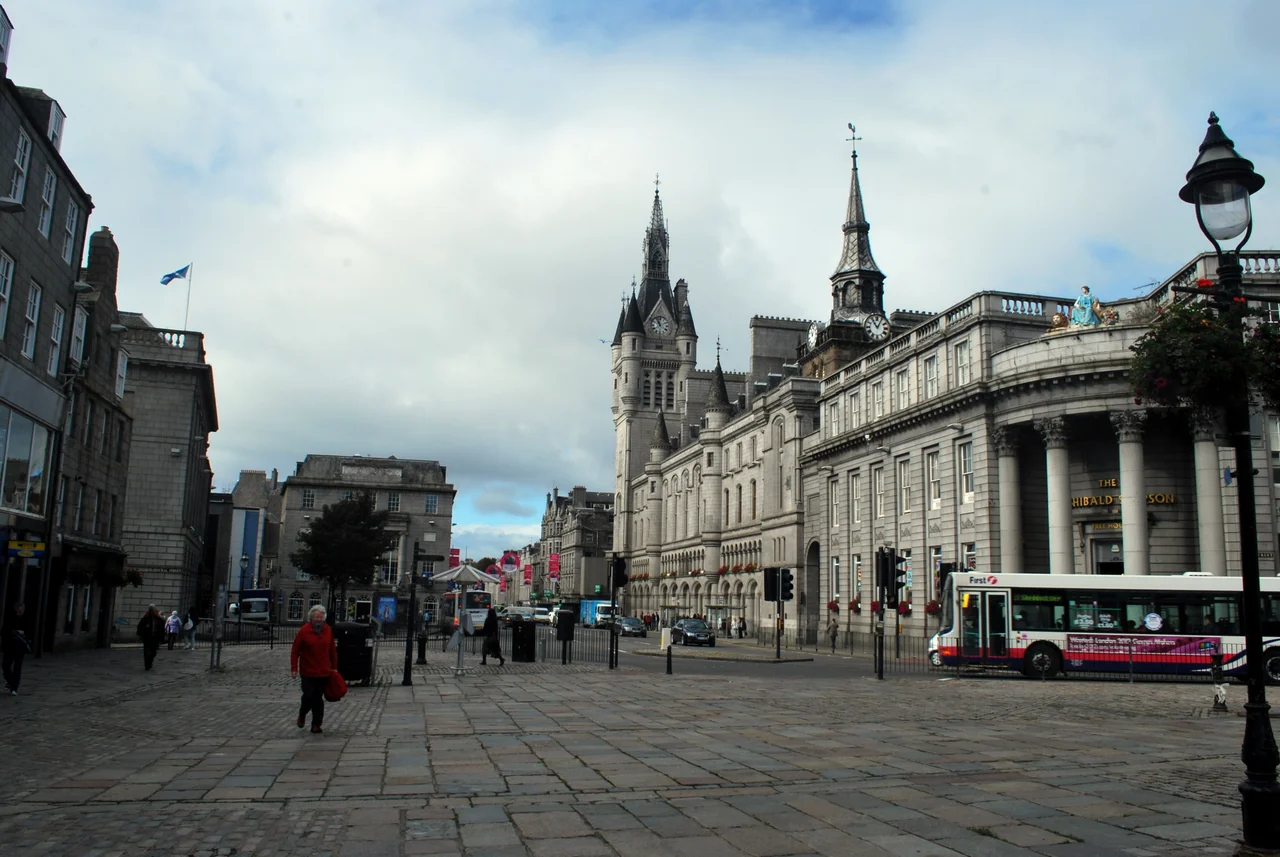

Castlegate, Aberdeen
The castle gates were demolished in 1308, but Aberdeen kept calling the square Castlegate anyway. Names in granite cities have a habit of outlasting their reasons. Today Castlegate is the eastern terminus of Union Street, the main thoroughfare of central Aberdeen, where the city's Mercat Cross still stands beneath the cupped hand of the royal unicorn, and where the Gallowgate runs north toward what was, for centuries, the appointed site of public hangings. The Salvation Army Citadel rises on the upper end of the square in castellated stone - not the original castle, of which nothing remains, but an effective imitation built on its medieval footprint. Walk the square at night when there is a full moon, and locals will tell you the ghost of a unicorn circles the Mercat Cross. Whether you see it or not depends partly on the moon and partly on what you are prepared to believe.
The Vanished Castle
Aberdeen Castle stood on the high ground at the upper end of what is now Castlegate from sometime in the early medieval period until it was destroyed in 1308 - the same year Robert Bruce was settling his blood feud with the Comyns up the road at Inverurie. Bruce's policy in 1308 was to deny English garrisons any Scottish stronghold worth defending, and Aberdeen Castle was demolished as part of that strategy. The site remained associated with military and civic authority. Castlehill Barracks rose there later, housing British army garrisons until they were demolished in 1965 and replaced with two tower blocks - a brutalist redevelopment that locals remember with mixed feelings. The Salvation Army Citadel, with its castellated mansion appearance, now occupies the most prominent part of the original castle hill, and from a distance it does the work of memory: not a real castle, but the right shape in the right place to remind passers-by that one used to stand there.
The Mercat Cross
John Montgomery, a native Aberdeen architect, built the Mercat Cross in 1686. It is an open-arched hexagonal structure, twenty-one feet in diameter and eighteen feet high, with a shaft rising from the centre crowned with a Corinthian capital and the royal unicorn of Scotland on top. The base is decorated with medallions illustrating Scottish monarchs from James I to James VII - a sweep of the entire Stuart line as it existed when the cross was built. Mercat crosses across Scotland marked the right to hold a market: from this stone, royal proclamations were read, sentences pronounced, and on at least one Aberdeen occasion, traitors hanged. The 1686 cross is one of the finest survivors of its kind in the country. Local legend insists that the unicorn at its peak comes down on full-moon nights to circle the Castlegate, a small piece of urban folklore that has attached itself to the right monument.
The Gallowgate
The street running north from Castlegate is the Gallowgate, and it is named exactly what it sounds like: the road to the gallows. Public hangings were carried out at the spot where the bus lane now runs past the courts. A small section of the old granite road paving has been preserved in the carriageway, marking the place. The street name has outlasted the gallows by two centuries, but the stones remember. Castlegate Well, on the western edge of the square, served the city's water supply until it fell out of use. William Lindsay, a goldsmith who held the position of overseer of the city's water in the nineteenth century, paid for the bronze statue that now caps the disused wellhead. Smaller pieces of civic memory - a well, a few paving stones, a vanished gallows - accumulate around the square the way they accumulate around any old city centre, present if you know what to look for and easy to walk past if you don't.
End of the Line
Castlegate served as the eastern terminus of the Aberdeen Corporation Tramways system from the late nineteenth century until the trams were phased out in favour of buses in the twentieth. The terminus role survived the change: buses still turn at the square. A statue of George Gordon, 5th Duke of Gordon, was erected opposite the Mercat Cross in 1844, then relocated to Golden Square in the 1950s during one of Aberdeen's periodic civic reshufflings. The square today is the kind of compact city centre space that British towns built when they still needed everyone to gather in one place - a square that has carried a castle, a barracks, a market, a gallows, a tram terminus, and now a steady traffic of pedestrians, buses, and the occasional moonlit unicorn. The granite buildings around it absorb the rain. The cross holds its position. Aberdeen, as it has been since 1136, gets on with its work.
From the Air
Castlegate sits at 57.15N, 2.09W at the eastern end of Aberdeen's Union Street, just two blocks inland from the harbour. From altitude, look for the wide square at the head of Union Street's mile-long granite spine, with the Salvation Army Citadel's castellated tower marking the upper end and the harbour's docks immediately east. Aberdeen International (EGPD) lies 5nm northwest. Best viewed at 1,500-3,000 ft AGL in clear conditions; the grey granite of central Aberdeen catches the light distinctively, especially after rain - the Granite City earned its nickname the hard way.
Nearby Stories
- Monymusk Priory 3.9 km away
- Deer Abbey 8.6 km away
- Glendronach Distillery 9.8 km away
- Fettercairn Distillery 13 km away
- Dunnottar Castle 16 km away
- Piper Alpha 146 km away
- German submarine U-1274 151 km away
- HMS Nottingham (1913) 192 km away