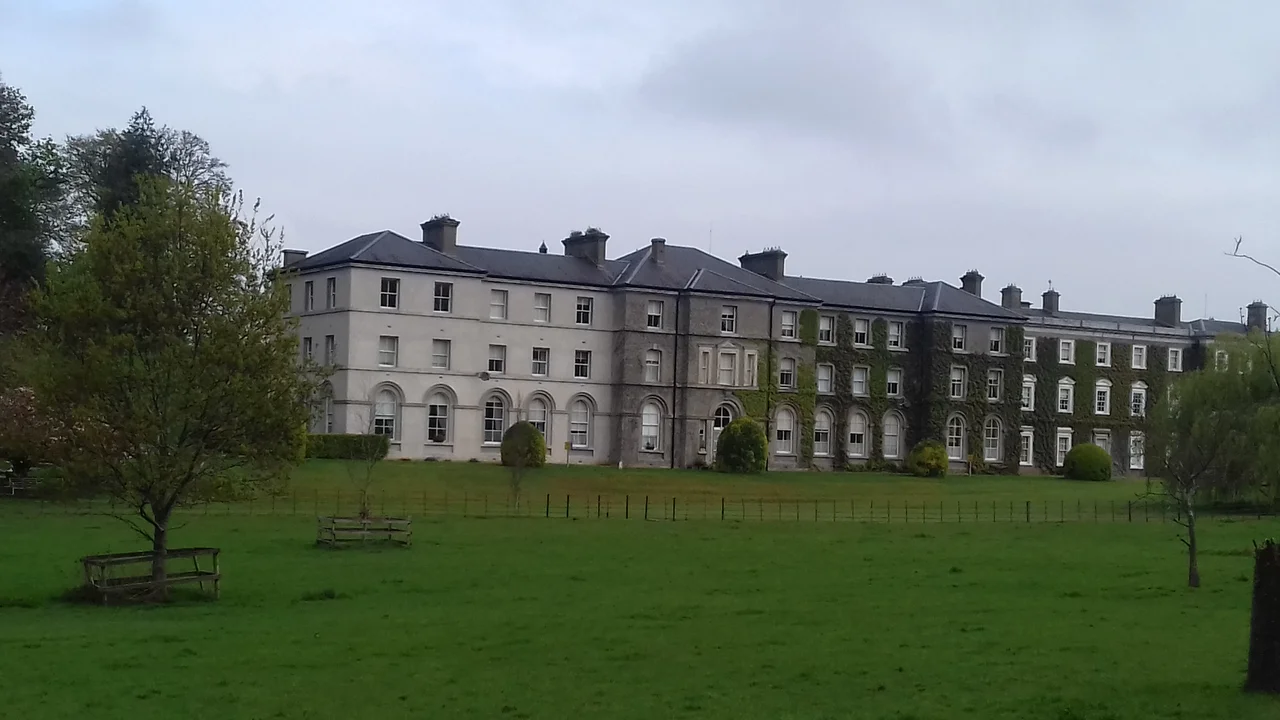

Castleknock College
Two hills rise from the seventy acres of Castleknock College. One is topped by the broken walls of a thirteenth-century Norman castle. The other, called Windmill Hill, is reputed to be the burial mound of Cumhal, father of the legendary warrior Fionn mac Cumhaill. In June 2007 archaeologists digging that second hill found four early Christian skeletons. They could not confirm the legend, but they could not dispel it either. This is the ground on which a small Vincentian boarding school was opened in 1835 with forty-seven boys. Today, almost two centuries later, the school sits beside Phoenix Park and the Farmleigh Estate, and its register of past pupils reads like an index of modern Irish public life.
Built in the Year After Emancipation
The Vincentians arrived first in Maynooth, where they trained priests. In 1830, the year after Catholic Emancipation finally permitted Catholics back into public life in Ireland, they obtained permission from the Archbishop of Dublin to open a day school. They began in central Dublin, at 24 Usher's Quay, in August 1833. Two years later, on 28 August 1835, they opened St Vincent's Ecclesiastical Seminary on a Castleknock hilltop bought from a Protestant school run by William Gwynne. The site came with forty acres. The first pupil enrolled that year was John Lynch of Clones, who later became Archbishop of Toronto. A classmate, Patrick Moran, would be ordained a Vincentian and consecrated as the first Catholic bishop of Dunedin, New Zealand. The school's first president, Philip Dowley, had been Dean of Maynooth and Provincial of the Vincentians. Religious education, in 1835 Ireland, was both vocation and political statement.
The Queen's Visit
On 22 April 1900, Queen Victoria came to call. The visit had been arranged a few days in advance by Rudolph Feilding, 9th Earl of Denbigh, and its significance was immediately understood: this was the first time in history that an English sovereign had set foot inside an Irish Catholic college. The boys lined the avenue. The fathers stood in their soutanes. The Queen, then in the last year of her life, surveyed the place that just sixty-five years earlier her own laws had finally permitted to exist. The visit settled Castleknock at the summit of Irish education, where it has more or less remained. Before Clonliffe College opened in 1861, seminarians for the Dublin Archdiocese came here first, then completed their studies at Maynooth. The Alton Library on the grounds is still the largest second-level school library in Ireland.
Rugby and Stilts
From its founding, the school played sport with intensity. For decades the entire student body played a game peculiar to Castleknock called stilts, on a gravel patch in the grounds, until the priests judged the over-zealous play too dangerous and replaced it with soccer. In 1909 they erected rugby posts, and rugby has been the school's signature game ever since. The Leinster Schools Senior Cup has come back to Castleknock eight times since 1913, and the school has contested more finals than any school in Leinster except Belvedere and Blackrock. Twenty-six past pupils have played rugby for Ireland at full international level - most recently Devin Toner of Leinster, capped seventy times. Brothers James Leo Farrell and Michael Dunne toured with the British and Irish Lions; Farrell joined the legendary 1927 Lions tour to Argentina. On nine rugby pitches and two new sand-based pitches approved in 2024, generations of boys have learned the game on grounds that legend says cover Finn MacCool's father.
The Pastmen
The alumni list is staggering for a single school. Two Taoisigh - Liam Cosgrave and, through one of those Irish education quirks, the school where Éamon de Valera taught for a year in 1910-11. One President of Ireland. Five Attorneys General. Two Supreme Court justices. Three archbishops, including the founders of dioceses in Toronto, Dunedin, Cape Town and Chicago. The founder of the Green Party of Ireland. The Lord Chief Justice of England and Wales, Charles Russell, Baron Russell of Killowen, who in 1896 founded the Past Pupils' Union itself. Then there are the cardiologist Jeremy Swan, co-inventor of the Swan-Ganz catheter that still saves lives in intensive care units. Writer Arthur Mathews, co-creator of Father Ted. Father Francis Browne, the Jesuit priest whose photographs of RMS Titanic remain the most famous record of that ship. And in fiction, the school is one-half of the satirical "Castlerock College" of Ross O'Carroll-Kelly. Two hills. Forty-seven boys in 1835. A long, strange, productive Irish story.
From the Air
Located at approximately 53.37°N, 6.36°W in the western Dublin suburb of Castleknock, immediately adjacent to the Phoenix Park and Farmleigh estate. Best viewed at 2,000-3,500 ft AGL; look for the wooded grounds north-west of the park, with the playing fields clearly visible. Dublin Airport (EIDW) lies 7 km to the north-east; Weston Airport (EIWT) is 12 km to the west.
Nearby Stories
- Athcarne Castle 4.2 km away
- Wicklow Mountains National Park 10 km away
- Castlepollard 12 km away
- Portlaoise 19 km away
- Edward Pakenham 20 km away
- German submarine U-1051 39 km away
- HMS Manners (K568) 52 km away
- HMS Tyler 61 km away