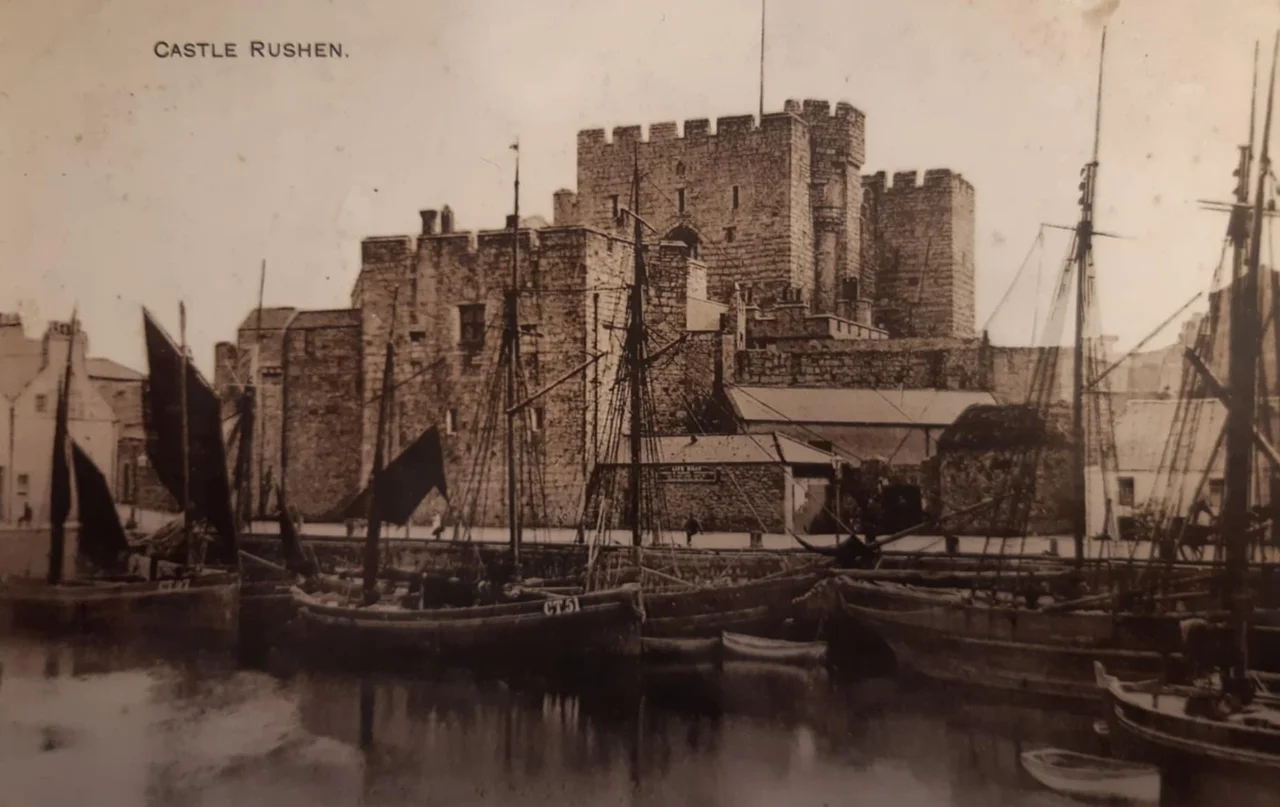

Castletown Lifeboat Station
On a December night in 1828, the steam packet Earl of Roden was driven onto the rocks at Derbyhaven with sixty passengers aboard. At one o'clock in the morning, three Castletown men - the water bailiff, Lloyd's agent and Comptroller of Customs - joined the lifeboat crew and rowed out into the storm. They stood by the wreck until six o'clock. Everyone was brought safely ashore. All three volunteers were awarded the RNLI Silver Medal. This is the kind of story Castletown's lifeboat station accumulated through its ninety-six years of service - small, local, life-saving work, performed by men who often knew the people on the wrecked ships.
Sir William Hillary's Appeal
The Royal National Lifeboat Institution exists largely because of a single Manxman. Sir William Hillary - a Douglas resident who had personally helped rescue 97 men from HMS Vigilant in October 1822 - published 'An Appeal to the British Nation on the Humanity and Policy of forming a National Institution for the Preservation of Lives and Property from Shipwreck' in 1823. At a public meeting in the City of London Tavern on 4 March 1824, he led the founding of what became the RNLI. He asked for a lifeboat at Douglas first. Then, almost immediately, he asked for a second one - at Castletown, on the south coast, where the approaches to the harbour and the rocky shoreline of Derbyhaven and Langness took ships down with grim regularity. A 22-foot 6-inch lifeboat arrived in Castletown in 1826, two years after the institution was founded.
Volunteers, Medals, Wrecks
The Earl of Roden rescue in 1828 set the pattern. The Castletown station went on to receive thirty or more shipwreck calls across its working life, manned by volunteer crews drawn from the harbour and the fishing community. Coxswain William Callow earned the RNLI Silver Medal in 1886 'in recognition of his long and valuable services', and a Second-Service Clasp in 1891 for further rescues - the kind of awards that came not from a single dramatic launch but from years of careful, repeated, dangerous competence. Lifeboats of the era were pulled by oars and assisted by sails - 'Pulling and Sailing' boats, abbreviated P&S - launched off carriages dragged by horses or men. Self-righting designs developed mid-century gave the crews a fighting chance of survival when the boats capsized in heavy seas. By the 1880s Castletown was operating 27-foot, then 32-foot, then 34-foot self-righting craft.
Commercial Traveller No.2
In 1865 the station's lifeboat developed dry rot, and a new 32-foot self-righting boat was funded by the Commercial Travellers Lifeboat Fund - a charity organised by travelling salesmen across the English midlands. The boat was first taken to Sheffield by the Midland Railway Company, paraded through the streets, exhibited in the Botanical Gardens, and named Commercial Traveller No.2 by Miss Jessop, the daughter of Sheffield's mayor. Then the Isle of Man Steam Packet Company shipped it free of charge from Liverpool to Castletown. On the night of 28 May 1877, Commercial Traveller No.2 was launched at one o'clock in the morning to the barque Junak of Split - then part of the Austro-Hungarian Empire - driven ashore in Castletown Bay on a passage from Alexandria to Glasgow. The regular coxswain was ill. The Honorary Secretary, Mr Quayle, joined the crew. All fourteen of the Junak's men were rescued.
Faith, Hope and Charity
In 1881 the RNLI received a bequest of £1,500 from Mrs S. H. Bradshaw of Reading, with instructions that it fund three new lifeboats. Faith went to one station, Charity to another, and Hope - a 34-foot self-righting P&S boat - was placed at Castletown in 1885. She served the town for eleven years. The last boat was Thomas Black, a 35-foot self-righting lifeboat funded by the bequest of Mrs Isabella Black of Eastbourne, who left £1,000 specifically for this purpose. A new boathouse with slipway was built at the head of the outer harbour to receive her, at a cost of £1,100, replacing the older boathouse that had stood in the shadow of Castle Rushen at the inner harbour. On 6 February 1912, the Thomas Black launched into a strong southeasterly to the brigantine Albion of Portsmouth, struck on the rocks of the Langness Peninsula. Seven men were taken off and landed at Derbyhaven.
The Station Closes
After the Albion service in 1912, Castletown had only one more launch on record. The growing prevalence of motor-powered ships - less likely to be blown ashore in poor weather, more capable of clawing off a lee shore - was steadily reducing the demand for sailing lifeboats. Two world wars further changed the patterns of merchant shipping in the Irish Sea. In 1922 the RNLI closed Castletown Lifeboat Station after ninety-six years of service across two organisational eras (RNIPLS 1826-1854, RNLI 1856-1922 with a gap from sometime in the 1840s). The boathouse was sold the following year. The Thomas Black was sold to a private owner in Port St Mary. Today the south of the Isle of Man is covered by the RNLI station at Port St Mary, which still operates a full-time inshore and offshore lifeboat service to the same waters that Castletown's volunteers covered for nearly a century.
From the Air
Located at 54.073°N, 4.651°W at the outer harbour of Castletown, in the south of the Isle of Man. The former boathouse stood near where the harbour wall extends into Castletown Bay. Ronaldsway Airport (EGNS) is 2km northeast. The Langness Peninsula extends southeast into the bay - many of the rescues happened on its rocky east shore. Best viewed at low cruising altitude (1,500-2,500 ft AGL) on approach to or departure from EGNS. Castle Rushen rises 250m north of the lifeboat station site, an unmistakable medieval landmark.
Nearby Stories
- RAF Jurby Head 14 km away
- German submarine U-246 16 km away
- German submarine U-1051 17 km away
- Kilclief Castle 18 km away
- Ardglass 31 km away
- St Bees Lighthouse 44 km away
- Trwyn Du Lighthouse 54 km away
- Seascale Lifeboat Station 61 km away