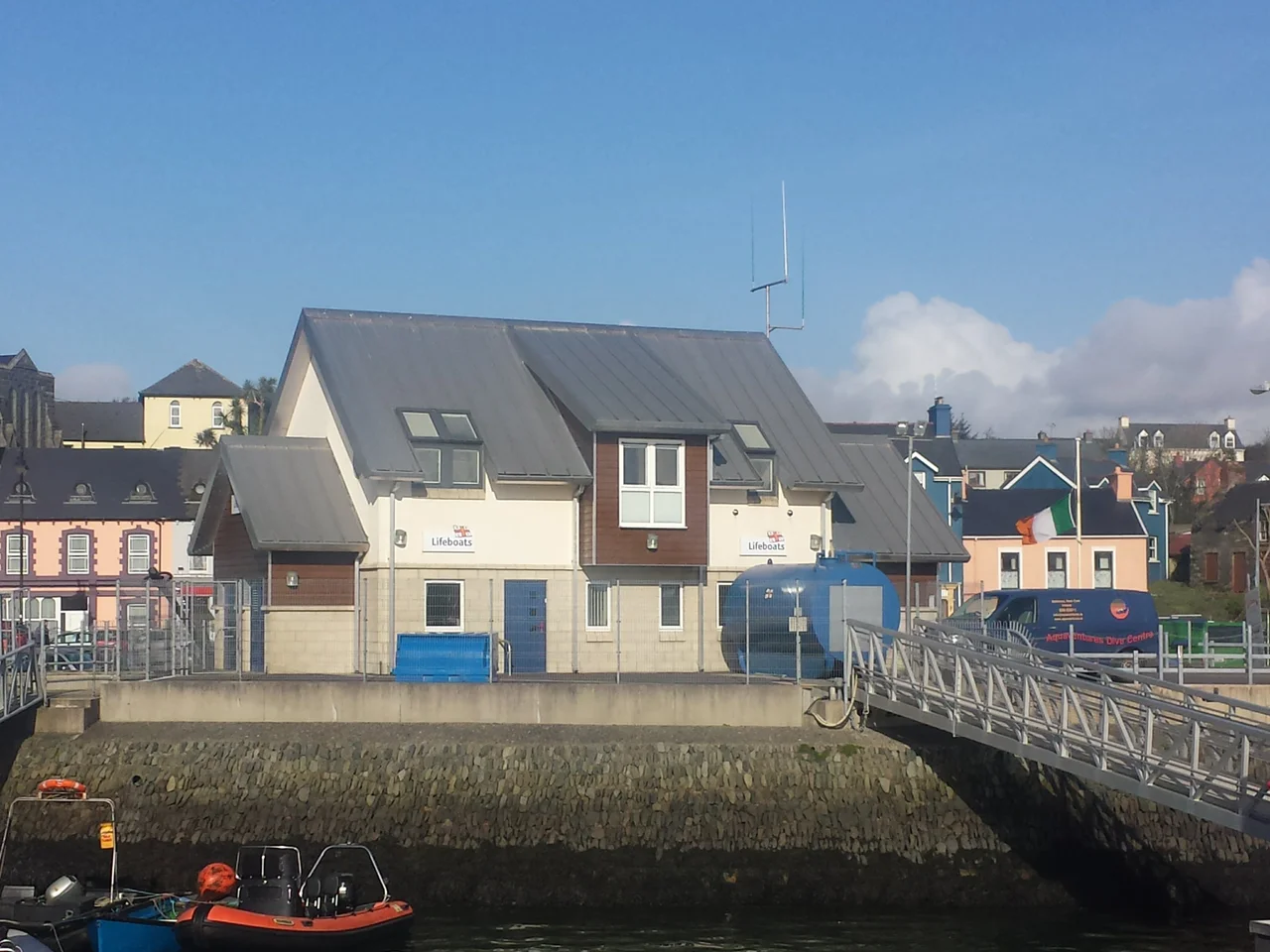

Castletownbere Lifeboat Station
On 10 October 2018, the trawler Clodagh O lost its engines off Castletownbere and started to drift toward the rocks. The wind was Force 9 on the Beaufort scale - storm strength, gusting hard, the kind of weather where the sea changes from a surface to a shape. Coxswain Dean Hegarty took the Castletownbere lifeboat out anyway, got a line aboard the trawler in conditions that would have argued against any other plan, and towed her back to harbour with all six of her crew alive. For that night's work he became the first Irishman in over a decade to be awarded an RNLI bronze medal.
A Coast Without Cover
The west coast of Ireland faces the open North Atlantic. The fetch of the storms that come in off it is measured in thousands of miles, and the weather that arrives at the headlands has had nothing to break it since Newfoundland. For most of the twentieth century, the Royal National Lifeboat Institution maintained dense coverage along the east and south coasts of Ireland and across the Irish Sea, but the western seaboard - the part most likely to need rescue - had remarkably few stations. As recently as 1990 only four lifeboat stations were operational on the west coast. By 2000 the RNLI had opened seven more. Castletownbere was one of them. A lifeboat was sent in 1997 to evaluate the harbour, and the station was confirmed permanent in October 1998.
The New Building
For years the crew worked out of poorly-located temporary facilities. Every callout took longer than it should have. A new building and moorings finally came into use on 19 May 2013, sited so that the lifeboat could be launched far faster than before. The current boat is a Severn-class - a 17-metre, all-weather, self-righting design built for sustained offshore work. The Severn carries a small daughter boat called a Y-class on its stern for close-quarters rescues. Adjacent RNLI stations sit at Valentia to the north and Baltimore to the east; between them they cover hundreds of nautical miles of coastline where the trawlers, yachts, fishing skiffs and the occasional drifting kayak run into trouble.
The Crew
The Castletownbere crew are not paid professionals. Like every RNLI lifeboat crew, they are volunteers - fishermen, marine engineers, mechanics, people who know the local waters because they work them. When the pager goes, they leave whatever they are doing and run for the boat. The coxswain - the senior member of the crew who takes command at sea - is the one who decides whether a callout can be safely attempted and what tactics to use in conditions that often look impossible from the shore. Dean Hegarty's bronze medal in 2018 was the first awarded to an Irish coxswain in more than ten years, a measure of how rarely such recognition is given and how exceptional the Clodagh O rescue was. The medal is engraved with the citation, the date, and the boat that was saved.
What the Station Is For
The RNLI's standard of cover is to reach any vessel in distress within two hours of launch, anywhere in its area of responsibility. The Severn class at Castletownbere has the range and speed to honour that promise across a wide swath of Atlantic. Most callouts are not the bronze-medal kind. They are pleasure boats with engine trouble in a rising swell, a fishing trawler with a fouled net, a kayaker carried out by an ebb tide, a yacht dismasted near the Skelligs. A few times a year, the weather and the situation conspire to produce something more serious. The station and its crew exist for both kinds of day - the routine kind that fills the logbook and the rare kind that ends in a medal ceremony at the RNLI headquarters in Poole.
From the Air
Castletownbere Lifeboat Station at 51.652 N, 9.908 W, on the north shore of Berehaven Sound just east of the working fishing harbour. Cork Airport (EICK) is approximately 90 nm east; Kerry Airport (EIKY) is 35 nm north. Approach low along the sound for a clear view of the moorings and the station building. Recommended viewing altitude 1,000-2,000 ft AGL. The open Atlantic begins immediately south and west of Bere Island - watch for changeable visibility once clear of the sheltered harbour.
Nearby Stories
- Iveragh Peninsula 4.6 km away
- Ballydehob 5 km away
- Battle of Callann 5.2 km away
- HMHS Llandovery Castle 8.9 km away
- Inishvickillane 21 km away
- SM U-68 41 km away
- RMS Lusitania 66 km away
- Sao Miguel 1909 km away