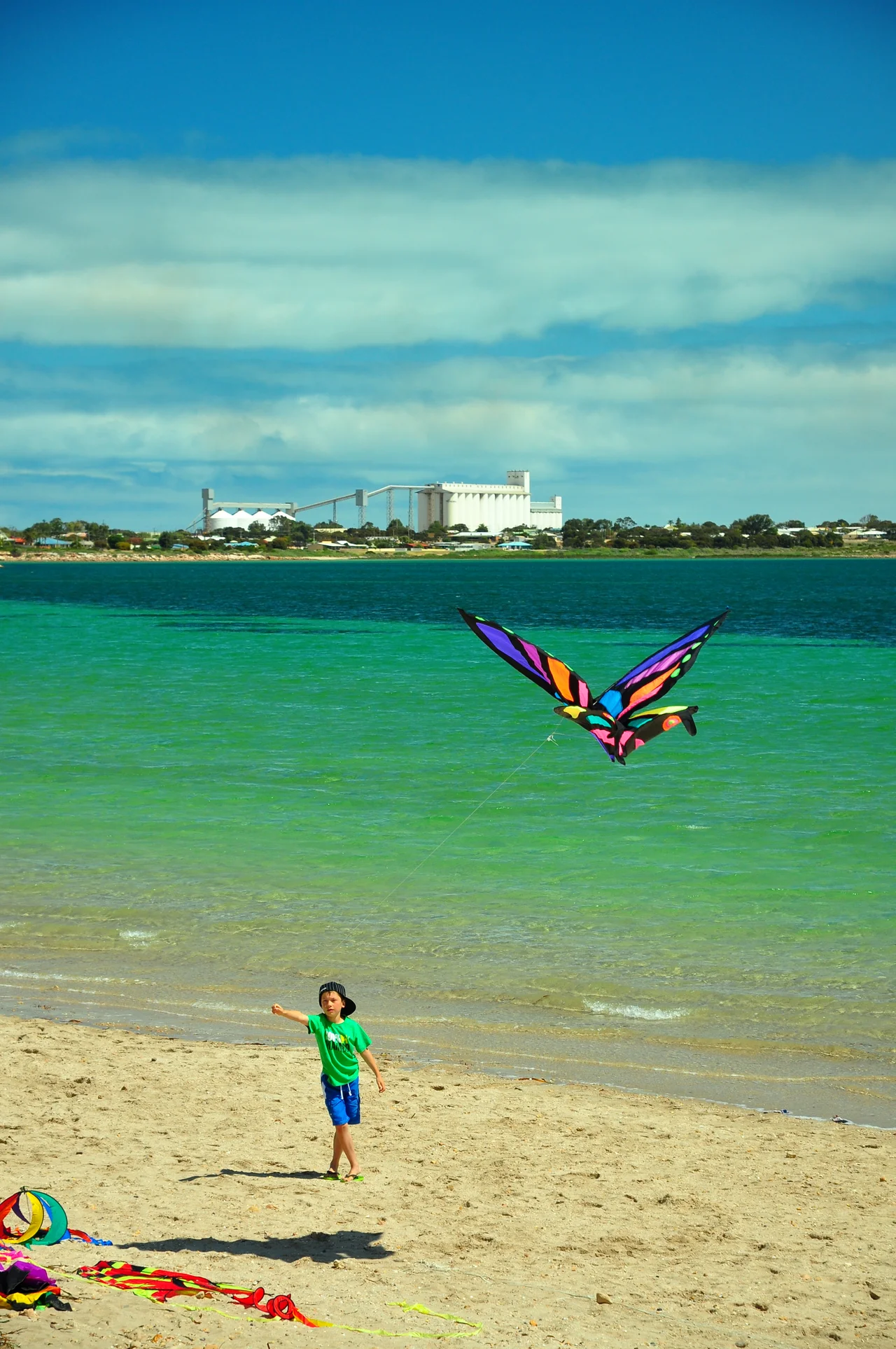

Ceduna, South Australia
The name says rest. Ceduna comes from a Wirangu word - sometimes written Chedoona - thought to mean a place to sit down and rest, and for travellers grinding across the outback toward the Nullarbor, the meaning still fits. But this town on the shores of Murat Bay is more than a pause in a long drive. It is the western frontier of the Eyre Peninsula, 786 kilometres from Adelaide, where Goyder's Line - the boundary of country that gets enough rain to farm - finally gives out, and the land beyond turns dry and vast.
The People of This Coast
Long before any town, this was Wirangu country. When the seas rose between 18,000 and 7,500 years ago, they drowned the old coastal plains and reshaped where peoples lived. That deep history has not faded into the past tense. The district council of Ceduna has the highest proportion of Aboriginal residents of any local government area in South Australia, and Indigenous homelands ring the town, twenty to thirty minutes out. At Crossways Lutheran School, around four in five students are Indigenous. This is a place where the oldest continuous culture on earth remains woven into daily life, not displayed behind glass.
Denial and Disappointment
European names arrived with explorers who mostly went away unimpressed. Matthew Flinders anchored at nearby Fowlers Bay in January 1802 and christened Denial Bay out of pure frustration - he had hoped a river might let him push inland, and found none, naming the place for 'the deceptive hope' it had raised. The Frenchman Nicolas Baudin came soon after and scattered names from Napoleon's court across the map: Murat Bay, Cape Thevenard, Decres Bay. An 1839 expedition reported the bay 'valuable' but the hinterland 'waterless,' and interest stalled. Only in 1901 was the town proclaimed - though for years locals stubbornly called it Murat Bay until the railway named its siding Ceduna in 1915 and the name finally stuck.
The Dish That Heard the World
For a remote town, Ceduna once sat at the centre of the nation's conversation. In 1969 a great satellite earth station was built here, operated by the Overseas Telecommunications Commission, and by 1984 nearly half of all Australia's international telephone and data traffic passed through this single far-western dish. Technology eventually made it redundant, but the dish did not fall silent - it now listens to the heavens instead, working as a radio astronomy observatory for the University of Tasmania, tied into the national CSIRO telescope network. The same antenna that once relayed the world's phone calls now traces radio signals from the depths of space.
The Afternoon the Sun Went Out
On 4 December 2002, the moon's shadow raced across the planet and the line of total eclipse passed directly over Ceduna. It was a near thing: the day had turned cloudy, and just down the road at Thevenard the view stayed shrouded - but over Ceduna itself the southwestern sky cleared at exactly the right moment, late in the afternoon, and the sun winked out over the town as thousands watched. Ceduna has stayed a place where the elements make headlines. On 26 January 2026, its thermometer hit 49.5 degrees Celsius, a reminder that this gentle resting place sits on the hard edge of the Australian interior.
From the Air
Ceduna lies at approximately 32.13 degrees south, 133.68 degrees east, on Murat Bay at the western base of the Eyre Peninsula, 786 km northwest of Adelaide. From altitude, look for the town beside the bay with the deep-sea port of Thevenard 3 km west on its cape, the long jetty reaching into the water, and the distinctive white OTC satellite dish nearby. The airport (ICAO YCDU) is 2 km east beside the Eyre Highway. The cold semi-arid climate brings warm, dry summers and generally clear skies, with strong heat possible in summer.
Nearby Stories
- Point Bell Conservation Park 16 km away
- St Francis Island 50 km away
- Poochera, South Australia 65 km away
- Nundroo, South Australia 97 km away
- Murphy's Haystacks 106 km away
- Wilgena Station 123 km away
- Tarcoola railway station 144 km away
- Great Australian Bight 312 km away