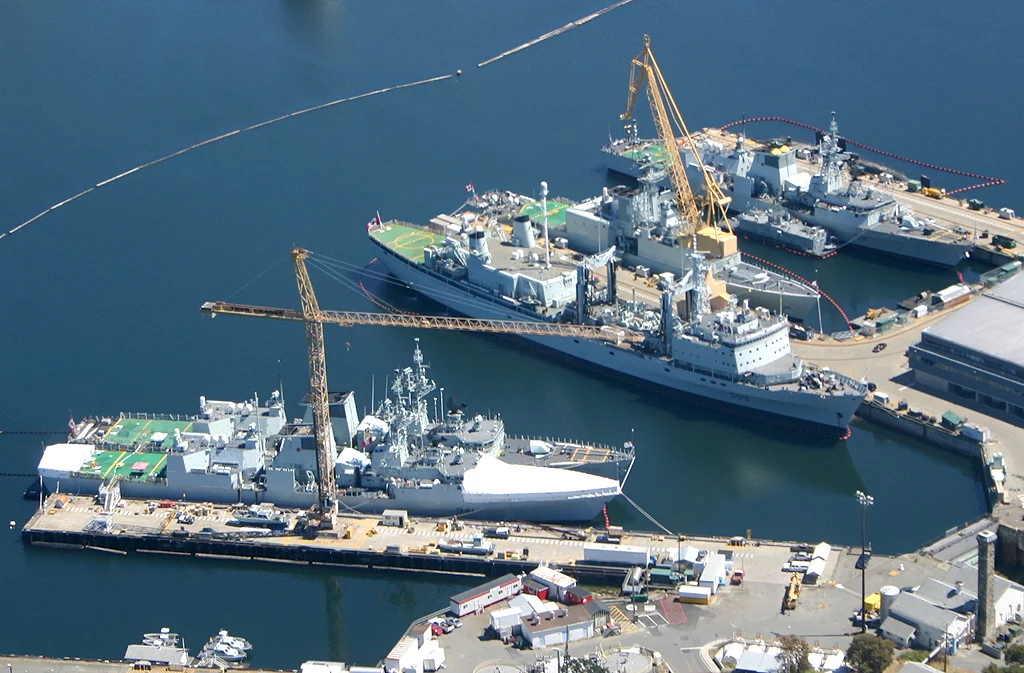

CFB Esquimalt
It started with a hospital for patients who never came. In 1855, with the Crimean War running and British warships operating against Russian positions in the North Pacific, Rear-Admiral Henry William Bruce asked Governor James Douglas for somewhere to put the sick and wounded he expected to be carrying back. Douglas obliged. Three wooden huts went up on the shore of Esquimalt Harbour, and the Royal Navy waited. The casualties did not materialize. What did was a precedent: the navy now owned buildings on Vancouver Island, and buildings have a way of attracting more buildings. Those Crimean huts were the seed of what is now Canadian Forces Base Esquimalt - 41 square kilometres, 4,411 military personnel, 2,762 civilians, and the entire Pacific fleet of a G7 navy.
The Empire's Far Corner
For six decades this was a British establishment. The Esquimalt Royal Navy Dockyard operated from 1842 to 1905 and served as the Royal Navy's Pacific Station until 1911 - the command responsible for an ocean's worth of British interests, run from a harbour at the bottom corner of Vancouver Island because it was the best deep, sheltered anchorage the Crown had on this coast. The stonework from that era is still in daily use. His Majesty's Canadian Dockyard Esquimalt occupies the same ground, and the federal heritage register reads like an inventory of Victorian naval life: the sail loft, the spar shed, the cordage stores, the rum and salt meats stores, the graving dock pumphouse, the Royal Navy Prison. When Canada took the place over, it inherited a working nineteenth-century navy yard and simply kept using it.
Everything a Fleet Requires
A naval base is less a place than a system, and Esquimalt holds nearly all of it inside one perimeter. Naden handles training and administration. The dockyard berths and services the ships. Fleet Maintenance Facility Cape Breton does the heavy repair work, its final construction phase completed in 2020. The Naval Officer Training Centre Venture turns civilians into officers, and the Fire Fighting and Damage Control School teaches sailors the specific horror of a shipboard fire - a skill that cannot be learned on the job, because on a ship there is nowhere to run. There are 716 married quarters spread across nine residential sites including Belmont Park, Work Point, and Royal Roads. People are born here, go to school here, and retire here. The base even publishes its own newspaper, The Lookout.
The Fleet and Its Outposts
Canadian Fleet Pacific sails from these jetties: patrol frigates, tugs, a fireboat, and a squadron of Orca-class patrol craft training tenders named with a certain West Coast bluntness - Orca, Raven, Caribou, Renard, Wolf, Grizzly, Cougar, Moose. The base's reach extends well beyond the harbour. The Canadian Forces Maritime Experimental Test Range at Nanoose Bay tests sonobuoys and torpedoes in deep, instrumented water up-island. Canadian Forces Ammunition Depot Rocky Point stores ordnance and maintains missiles and torpedoes at a safe remove. Naval Radio Section Aldergrove, over on the mainland in the Fraser Valley, handles the long-distance transmitting and receiving that keeps ships in contact across the Pacific. The Albert Head training area near Metchosin covers 88 hectares and now hosts a Canadian Rangers patrol company and a cadet summer training centre.
Guns Pointed at an Empty Strait
The coastline around Esquimalt is studded with fortifications built against threats that mostly stayed theoretical. Fort Albert Head went up in the late 1800s alongside Fort Rodd Hill and other installations, all intended to cover the Strait of Juan de Fuca and the approaches to Victoria Harbour against a naval attack that never came. The gun emplacement at Signal Hill is still on the heritage register. It is a recurring pattern here, and it started with those 1855 hospital huts: Esquimalt has spent 170 years preparing carefully for events that largely declined to occur, and in the process built one of the most complete naval infrastructures on the Pacific coast. Preparedness that is never tested still costs the same to maintain, and it still shapes a town.
The Navy as Landlord
Strip away the ceremony and CFB Esquimalt is, above all, the region's economic engine. It is the largest employer in the community by a wide margin, supporting 7,866 jobs and putting roughly $760 million into the local economy in 2023. That number reshapes everything around it - housing, schools, the retail strip, the demographics of an entire municipality. Greater Victoria is often described as a retirement town and a government town, which is true and incomplete. It is also a navy town, and has been since before British Columbia was a province. The Crimean huts are long gone. Almost everything else the navy has built here is still standing, still staffed, and still waiting.
From the Air
CFB Esquimalt centres on 48.431 N, 123.432 W at the southern tip of Vancouver Island, on the Strait of Juan de Fuca immediately west of Victoria. A viewing altitude of 2,000-4,000 feet MSL gives the clearest read of the layout: the deep, sheltered notch of Esquimalt Harbour with the dockyard jetties and drydock along its east side, the Naden complex inland, and Work Point and Signal Hill on the headlands. Grey hulls at the jetties are the unmistakable visual signature. Victoria's Inner Harbour and the Legislature dome lie about 2 nm east, and on clear days the Olympic Mountains fill the horizon across 15 nm of strait to the south. This is busy and partly restricted airspace - Victoria International (CYYJ) is about 12 nm north at Patricia Bay, Victoria Harbour Water Aerodrome (CYWH) is 2 nm east with heavy floatplane traffic, and William R. Fairchild International (KCLM) sits across the international border at Port Angeles. Check NOTAMs and restricted areas over the base and Rocky Point before approaching. Weather is mild and comparatively dry for the coast, but morning marine fog in the strait is common year-round.
Nearby Stories
- Arbutus Ridge, Cowichan Valley 2.5 km away
- San Juan Island National Historical Park 4.5 km away
- Eastsound 11 km away
- Juan de Fuca Marine Trail 11 km away
- Mesachie Lake 13 km away
- Sappho, Washington 17 km away
- Spruce Railroad Trail 19 km away
- Port Townsend 22 km away