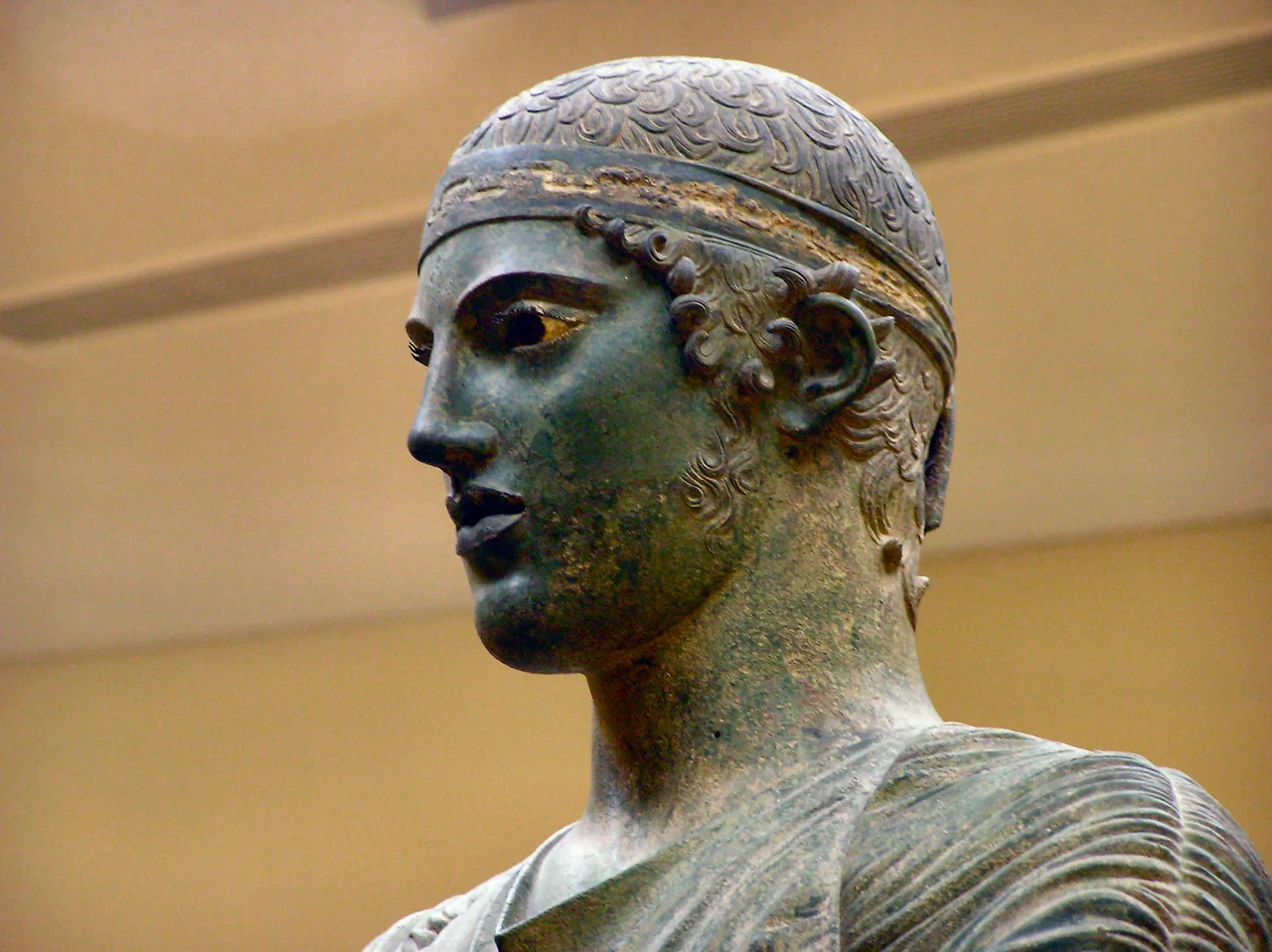

Charioteer of Delphi
In 373 BC, an earthquake shook the sanctuary of Apollo at Delphi. Rock and debris cascaded down the hillside, burying whatever lay in the way. Among the things buried was a bronze youth, 1.8 meters tall, still holding the reins of a chariot that no longer existed around him. He stayed there for over two thousand years. When French archaeologists excavated the site in 1896, they found him — serene, intact in most particulars, his inlaid eyes still holding something that the word "expression" seems too thin to describe.
The Accident of Survival
Most ancient bronze statues are gone. The fate of bronze in the ancient and medieval worlds was the melting pot: victorious armies stripped defeated sanctuaries; churches melted pagan gods into vessels and bells; ordinary poverty converted art into coin. The bronzes that survive do so almost always by accident — shipwreck, burial, forgetting. The Charioteer of Delphi survived because a rockfall buried it so thoroughly at Delphi in 373 BC that no one looted or melted it in the following centuries. The statue remains mostly intact: the left forearm is lost, some copper inlays on the lips are gone, most of the silver eyelashes have disappeared, and the decorative headband is damaged. The eyes themselves — made of inlaid stone and glass paste — are present and startling. Every account of seeing the Charioteer in person dwells on the eyes.
A Victor's Offering
The statue was not made to be a standalone figure. It was part of a larger sculptural group commissioned to commemorate a victory at the Pythian Games — the great athletic and artistic festival held at Delphi in honor of Apollo. Inscriptions on the limestone base associate it with Polyzalus, the tyrant of Gela in Sicily, who won with his chariot team at the Pythian Games, most likely in either 478 or 474 BC. The full group originally included a chariot, at least four horses, and possibly two grooms; fragments of the horses were found with the statue. The Sicilian rulers of this period were enormously wealthy, able to commission bronze at a scale and quality that mainland Greek city-states rarely matched. The sculptural group stood in the sanctuary as a permanent statement of that wealth and that victory, an offering to Apollo in bronze that would outlast stone.
The Figure Himself
The Charioteer is clothed, which is unusual. In the athletic culture of ancient Greece, competitors and their depictions were typically nude. That the young man in the bronze wears a full-length, belted tunic — a xystes — has led to the interpretation that he was of lower status than his master, perhaps the driver of the team rather than the aristocratic owner. It has been speculated he may have been enslaved. Whether that interpretation is correct is not certain; the sources do not confirm it directly. What the figure shows is a young man in the moment after the race, during the victory procession. The champion's headband encircles his head. His fingers still curl around the reins. The pose is formal, the face absolutely still — not the mannered grin of the Archaic period (what scholars call the "Archaic smile") but something inward, self-contained, facing whatever comes next after triumph.
Style and Its Moment
The Charioteer dates to around 470 BC — the beginning of the Early Classical period, the moment when Greek sculpture was moving decisively away from the rigidly frontal, idealized Archaic style toward the more naturalistic, psychologically suggestive art of the High Classical period. The statue is stylistically between those two worlds: more naturalistic than the kouroi of the Archaic era, but more restrained and formal than the mature Classical works that came later. The feet, noted in ancient sources for the extraordinary quality of their modeling, show an interest in anatomical truth that was new. The sculptor is unknown. The work has been associated with Pythagoras of Rhegion and with Calamis, both active in this period, but neither attribution is confirmed. What is clear is that it resembles bronzes of Athenian origin in style — the Piraeus Apollo is sometimes cited for comparison — which suggests the casting may have been done in Athens rather than Sicily, despite the Sicilian patron.
In the Museum, and Beyond
The Charioteer is displayed in the Delphi Archaeological Museum, at the sanctuary site on the slopes of Mount Parnassus. It is not alone there — Delphi's museum holds an extraordinary concentration of ancient works — but it is the piece visitors remember. The statue's afterlife in modern culture has been quiet but persistent. Around 1907, the Venetian-based Spanish designer Mariano Fortuny y Madrazo created a finely pleated silk dress he named the Delphos gown, directly inspired by the Charioteer's draped tunic. The gown became a landmark of early 20th-century fashion. In 2003, a Delphos gown was the only fashion garment in the permanent collection of the Museum of Modern Art in New York — an unlikely thread connecting a Sicilian tyrant's offering at an ancient Greek sanctuary to the fashion houses of the 20th century.
From the Air
The Charioteer of Delphi is housed at the Delphi Archaeological Museum at 38.48°N, 22.50°E, on the slopes of Mount Parnassus in Phocis, central Greece. The sanctuary of Delphi is visible from altitude as a set of terraced ruins climbing the steep southern face of Parnassus; the Sacred Way, stadium, and theater are distinguishable on clear days. Nearest major airport by road distance: LGTS (Thessaloniki) to the north, or LGAV (Athens Eleftherios Venizelos) to the southeast — Athens is the standard visitor gateway, approximately 180 km by road. Nearest major airport by straight-line distance across the Gulf of Corinth: LGRX (Araxos), approximately 80 km to the southwest, though this requires crossing the gulf. Recommended viewing altitude: 6,000–10,000 feet to see Parnassus in context; lower passes along the Pleistos river gorge below Delphi reveal the sanctuary's dramatic vertical siting on the mountain.
Nearby Stories
- Battle of Leontion 2.8 km away
- Siege of Livadeia 3.1 km away
- Pyre of Heracles 8.2 km away
- Corinth Rail Disaster 8.8 km away
- Rio–Antirrio Bridge 9.9 km away
- Heraion of Perachora 13 km away
- Prousou Monastery 15 km away
- Free and Real 30 km away