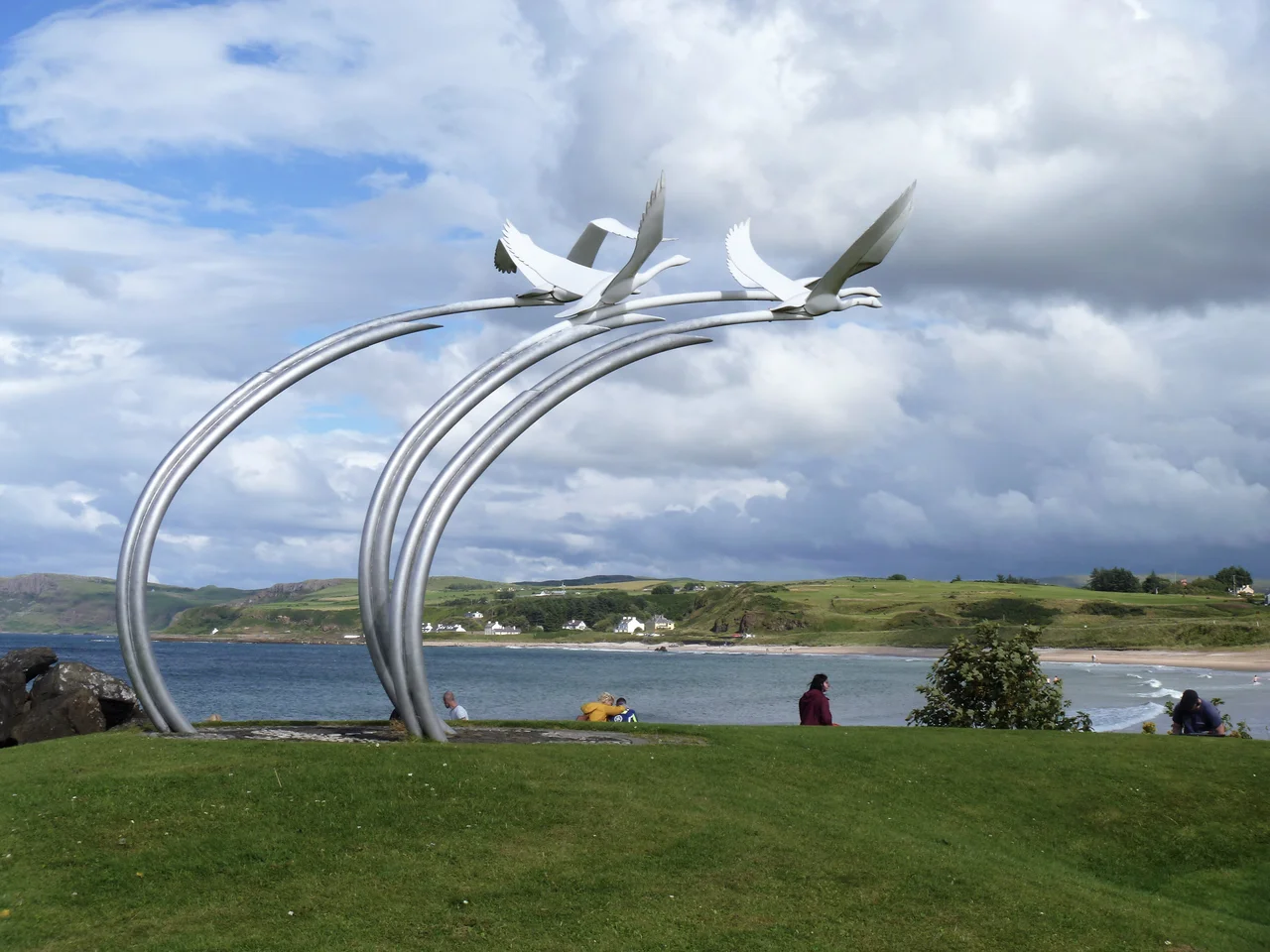

Children of Lir
Their stepmother could not bring herself to kill them. She raised the druid's wand intending to, and then her nerve failed at the last instant. Instead she turned the four children of Lir into swans and bound them to nine hundred years on the waters of Ireland. Three hundred on Lough Derravaragh in the calm midlands, three hundred on the Sruth na Maoile between Ireland and Scotland where the storms tear, and three hundred on the cold Atlantic off Iorrus Domhnann, the very stretch of coast you are flying over now. The endpoint of their curse, the small island of Inishglora west of the Mullet Peninsula, is here. So is the bell that freed them.
The Stepmother's Spell
Aoife was the sister of the children's dead mother, and Lir, their grieving father, married her hoping for some restoration. Instead, jealousy gathered in her like weather. The children were Fionnghuala, Aodh, Fiachra, and Conn. One day Aoife took them on a journey and, at the shore of Lough Derravaragh, struck them with a druid's wand. They became four white swans. She allowed them one mercy: their human voices, the gift of song that would, the story says, surpass anything mortal. The spell would last nine centuries, broken only when a particular royal marriage came to pass and when the Christian bell sounded over them. When Aoife returned to her father Bodb's court without the children, his suspicion fell. The truth came out. He cursed her into a demon of the air, and she remained that way.
Three Stations of Suffering
The three hundred years on Lough Derravaragh were almost gentle. The De Danann and the later-arriving Milesians both gathered at the lake to hear the children's plaintive singing, and a proclamation went out that no swan was to be killed in Erin. Then the time turned. The swans flew north to Sruth na Maoile, the narrow stretch of sea between Ireland's northeast and the Scottish coast, where storms drove them apart and reunited them again and again across three hundred years of cold. After that, they came west to Iorrus Domhnann, the old name for this part of Erris and the islands off it. Here, one winter, the sea froze around them and their feet froze to the ice. In their suffering they cried out to 'the King of Heaven' for protection. The protection came. The legend marks this moment as their conversion.
The Bell at Inishglora
When the nine hundred years were almost done, the swans came to Inishglora, the small island that lies off the Mullet Peninsula's western coast. By then Saint Patrick had brought Christianity to Ireland. A holy man named Mochaomhóg had settled on the island. One morning the swans heard his bell ringing for matins and were frightened. Fionnghuala, the eldest, understood: this was the sound that would liberate them. They listened. They sang afterwards. The monk recognised their song for what it was and went looking for the singers. He bound them with silver chains, gently. When a king named Lairgnen tried to seize the swans for his wife Deoch, his touch broke the spell. The feathers fell away, and there stood three very old men and an old woman, lean and bony, ancients who had been waiting almost a millennium to die. Fionnghuala asked to be baptised and buried. Mochaomhóg did both. He grieved for them. The story ends there.
A Legend in Bronze and Bells
The Children of Lir have not stopped being told. In Dublin, sculptor Oisín Kelly's bronze statue stands in the Garden of Remembrance on Parnell Square, four swans rising out of the cast figures of children; it commemorates the rebirth of the Irish nation through 900 years of struggle for independence, the parallel deliberately drawn. Another statue sits in Castlepollard near Lough Derravaragh, and a third in Ballycastle, County Antrim, near the Sea of Moyle. Thomas Moore wrote his 'Silent O Moyle' about Fionnghuala. Hamilton Harty composed an orchestral tone poem in 1938. Patrick Cassidy's 1991 oratorio set the libretto in Irish. The Ballyglass lifeboat is named Clann Lir. Sinéad O'Connor sang of 'Lir's children.' The cursed swans have outlived not only Aoife but most of the kings who would have remembered her, and they may well outlive us too.
From the Air
Inishglora, the legendary endpoint of the Children of Lir's curse, lies at approximately 54.20°N, 10.11°W just off the western coast of the Mullet Peninsula. The Children of Lir's story spans multiple Irish locations, but Inis Gluairé (Inishglora) is the final station and the most local to this geohash. From the air, the small island is best viewed in clear weather from low altitude after departure from Belmullet Aerodrome (EIBT, about 10 km east). Ireland West Airport (EIKN) is roughly 80 km east. The waters here are open Atlantic; mist often softens the offshore islands, lending the same atmosphere the legend describes.
Nearby Stories
- Achill Island 1.4 km away
- Ballycastle, County Mayo 10 km away
- Battle of Castlebar 17 km away
- Action of 7 May 1794 27 km away
- Glencolmcille 55 km away
- RMS Carinthia (1925) 84 km away
- RMS Empress of Britain (1930) 87 km away
- The Laki Eruption: The Volcano That Changed World History 1149 km away