
Chingola
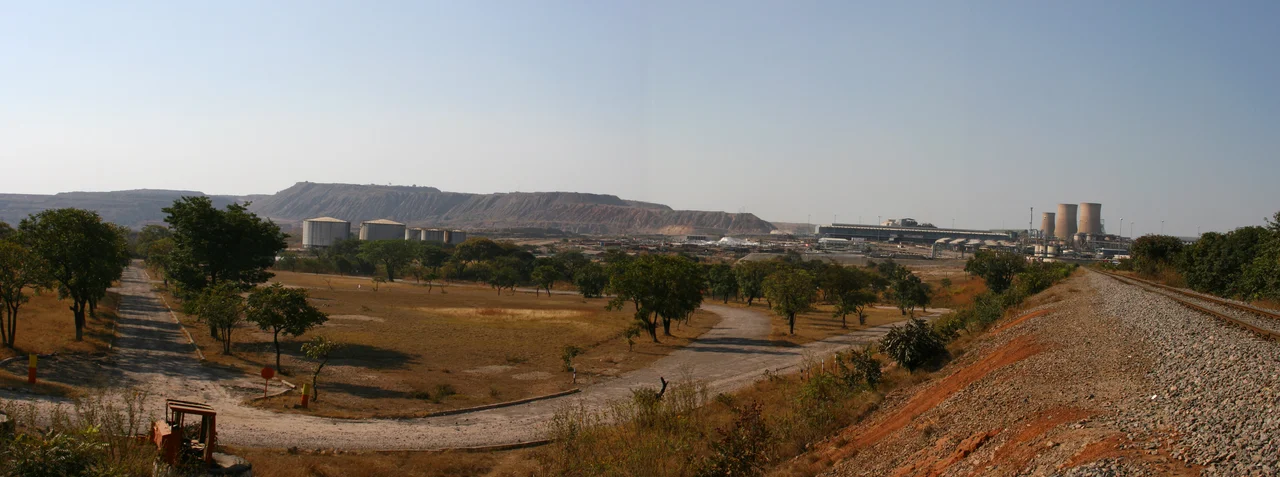
The ground around Chingola is missing 400 meters of itself. That is the depth of the Nchanga Open Pit at its lowest point - a terraced crater sunk into what used to be ordinary Copperbelt plateau. The pit workings form an 11-kilometer arc around the west and north of the town, covering almost 30 square kilometers. Look down on Chingola from the air and the arrangement is unmistakable: a town of a quarter million people orbiting the red, stepped hollow that made it exist.
Built for the Mine
Chingola was founded in 1943, late by Copperbelt standards. Most of the region's other towns had been established during the earlier mining push, but Nchanga's high-grade deep-shaft copper deposit required its own service town, and Chingola was it. The sequence matters: first the mine, then the town. Everything about the place - the roads, the railway spur, the orientation of the suburbs - reflects the geography of copper. The single-track freight line from Kitwe still hauls Nchanga's ore south to the Nkana smelters. The T3 highway threads north through Chililabombwe and Konkola toward the DR Congo border at Lubumbashi, following the veins of the Central African Copperbelt across the colonial line that split them. The T5 road starts in Chingola and runs west toward Angola through Solwezi and Mwinilunga, a reminder that this is a junction town as much as a mining one.
The Scale Underground and Above
Nchanga's Open Pit is the second-largest open-cast mine on Earth. The working terraces descend in concentric rings, each ledge wide enough for haul trucks that look small from the viewing points at the rim. Alongside the original pit, newer projects have sprouted on the town's edges. Moxico Resources began building a Mimbula copper project leach pad and solvent extraction plant in 2021, working a rich oxide and sulphide deposit on a mining licence just outside Chingola. The town's economy rises and falls with copper prices in ways that residents feel quickly - when London Metal Exchange prices drop, the Copperbelt hurts; when they climb, the haul trucks run through the night.
Where the Hippos Stay
Ten kilometers north of the pit, the Kafue River slows through a stretch known simply as Hippo Pool. Declared a National Monument in 1954, it remains what the copper country would look like if nobody had arrived with blasting caps - pools of quiet brown water, tangled bush, and the snorts and huffs of resident hippos at dusk. Sixty kilometers northwest, the Chimfunshi Wildlife Orphanage takes in chimpanzees orphaned by the bushmeat trade, one of the largest chimpanzee sanctuaries in the world. And eight kilometers out along the T3 toward Kitwe, Five Mile Rock breaks the horizon - a roadside landmark every Chingolan knows. The contrast is the point. The town is both a mining engine and the gateway to some of Zambia's quieter wild places.
Sons of the Copperbelt
Chingola has sent more than copper out into the world. Patson Daka, born here in 1998, came up through Nchanga Rangers' youth system before moving to Europe and eventually to the Premier League. Sprinter Samuel Matete, born in 1968, ran the 400-meter hurdles for Zambia at three Olympics and set an African record that stood for decades. Environmental activist Chilekwa Mumba led the legal fight that forced British mining parent companies to accept liability for pollution damage caused by their Zambian subsidiaries - a case that traveled all the way to the UK Supreme Court. Boxer Felix Bwalya, diplomat Elias Munshya, and Archbishop Richard Moth - who became Archbishop of Westminster in 2026 - all carry Chingola on their biographies. The Nchanga Stadium in Nchanga North still hosts the Rangers on match days, and the town still claims its own when they succeed elsewhere.
A Town That Reads the Price of Copper
Kasompe Airport (IATA: CGJ) serves as Chingola's aerial link - a modest strip that has outlived several cycles of Copperbelt boom and bust. Two shopping malls, Park Mall and Motherland, anchor the commercial core. The 2022 census counted 256,560 residents, a figure that drifts up or down with the mining economy. The fortunes of Chingola are tied to a commodity traded in London and Shanghai, but the town itself is emphatically here - in the red dust that settles on everything, in the church services on Sunday mornings, in the way people still talk about the old days when Nchanga was king and the copper cheques were bigger. The mine remains the reason Chingola exists. The town is what grew up to live alongside it.
From the Air
Located at 12.54°S, 27.87°E, in the far northwest of Zambia's Copperbelt Province, 1,380 meters above sea level. Served by Kasompe Airport (CGJ) for general aviation; the region's main airport is Simon Mwansa Kapwepwe International (NLA) at Ndola, about 60 nautical miles southeast. The Nchanga Open Pit is an unmistakable landmark from cruise altitude - a vast stepped crater 400 meters deep, visible on satellite imagery as a distinctive terraced red-brown gouge just west and north of the town. The Kafue River runs to the north, and the Copperbelt Highway (T3) heads north toward the DR Congo border. Clear weather year-round except during the wet season (November-April); best viewing in the dry months.
Nearby Stories
- Congo Pedicle 10 km away
- Kalulushi 15 km away
- Simon Mwansa Kapwepwe International Airport 15 km away
- 1961 Ndola Transair Sweden Douglas DC-6 Crash 46 km away
- Kafue River 80 km away
- Capture of Lubumbashi 84 km away
- Luishia Mine 162 km away
- North-Western Province, Zambia 263 km away