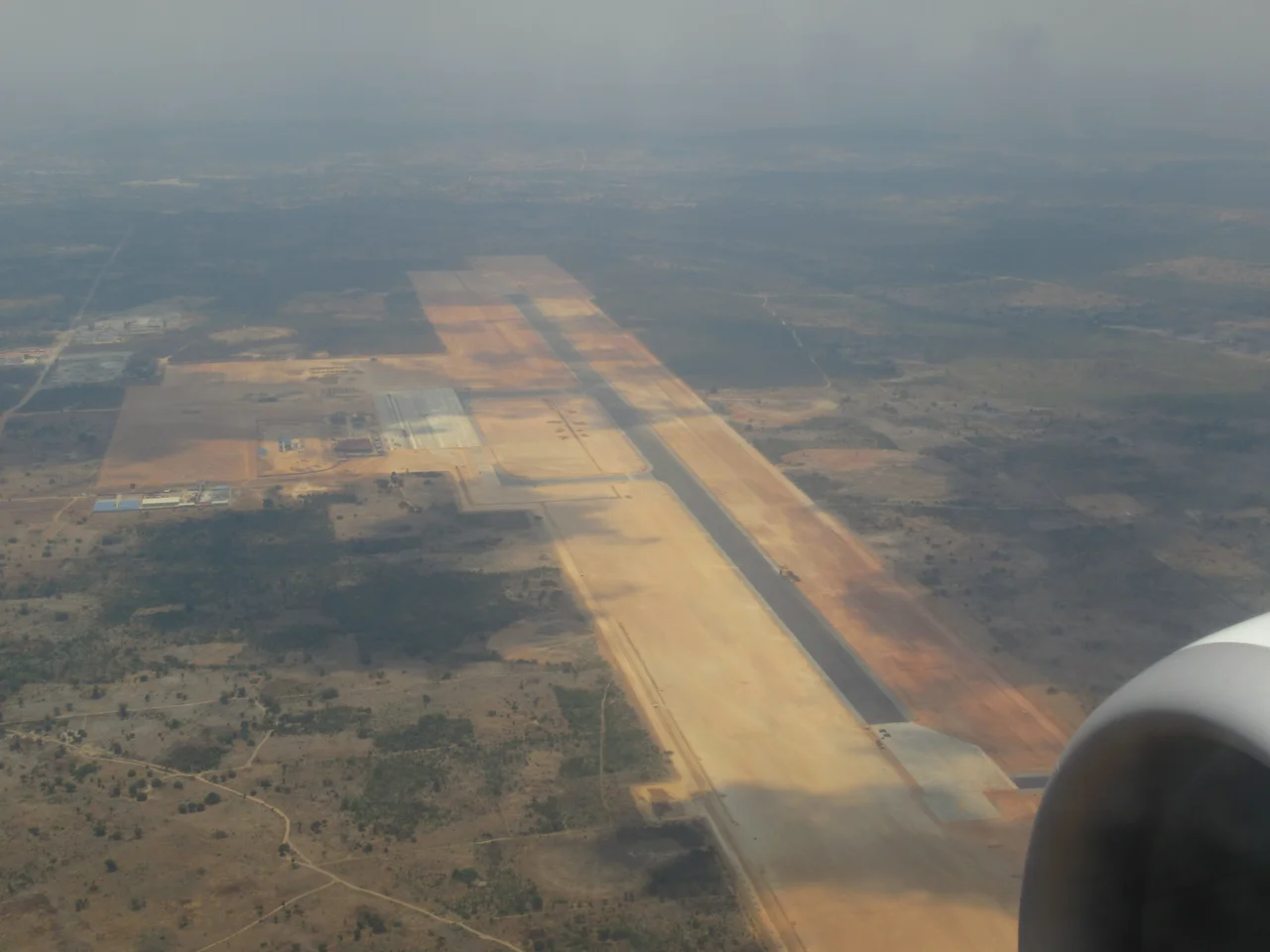

Simon Mwansa Kapwepwe International Airport
On 4 April 2021, an Ethiopian Airlines cargo flight out of Addis Ababa touched down at an airport that had not yet opened. The Boeing 737-800, registration ET-AYL, had filed for Simon Mwansa Kapwepwe International in Ndola's Itawa suburb. Instead, it found the then-unopened Copperbelt International Airport fifteen kilometers west of the city, where runway markings indicating closure were, according to later reporting, indistinct. Two and a half hours later, a second Ethiopian Airlines 737 - ET-AQP - approached the same unopened runway. This one realized the mistake at fifty feet above the ground, went around, and landed at the correct airport. Zambia's Transport Ministry opened an investigation. Four months later, the new airport opened officially under a new name, inheriting the old airport's IATA code. Today, Simon Mwansa Kapwepwe International is Zambia's newest major gateway, built at a cost of $397 million, and it sits a few hundred meters from the site where Dag Hammarskjold's DC-6 went down in 1961.
The Man on the Sign
Simon Mwansa Kapwepwe was one of the founding figures of independent Zambia - a close associate of Kenneth Kaunda in the independence movement, and from 1967 to 1970 the nation's vice president. He later broke with Kaunda, founded his own political party, and spent years in political opposition. He died in 1980. In September 2011, Zambia's new president Michael Sata decided to rename the country's airports in honor of political figures, and Ndola's airport - then still at its original Itawa location - took Kapwepwe's name. When the new airport opened west of the city in August 2021, the name came with it. The old Itawa airport, where the Kapwepwe name had originated, was renamed Peter Zuze Air Force Base in honor of a Zambian military figure, returning it closer to the military function it had originally served before becoming a civilian airport in the 1950s.
From Itawa to the West
The Itawa airport had served Ndola since the 1950s, when a military airfield southeast of the city was converted to civilian use. By the 2010s it was inadequate for the commercial traffic the Copperbelt needed - a region of copper, cobalt, and cement industries with regular flights to Lusaka, Johannesburg, Nairobi, and beyond. Construction of a new facility began in 2017, fifteen kilometers west of the city on a site that had historical weight of its own - adjacent to the memorial marking where the UN Secretary-General's plane had crashed in 1961. Families living at the site of the new airport were compensated and relocated. The Aviation Industry Corporation of China, through AVIC International, engineered and built the facility. The total cost came to $397 million. When President Edgar Lungu commissioned the airport on 5 August 2021, the operation moved from Itawa in a single coordinated shift. Ndola, which had been served by its original airport for roughly seven decades, became the home of the newest major airport in Zambia overnight.
A Memorial at the End of the Runway
The proximity to the Dag Hammarskjold Crash Site Memorial is not coincidental. Hammarskjold's DC-6, inbound to the old Ndola Airport in Itawa on the night of 18 September 1961, came down in forest west of the city. He and fifteen others aboard died. The official Rhodesian inquiry at the time blamed pilot error. Subsequent investigations, including a UN-commissioned review that reported in 2017, found enough evidence of possible external interference - including eyewitness accounts of a second aircraft and indications the DC-6 may have been under attack - to keep the question alive more than half a century later. The new Kapwepwe airport sits on terrain shaped by this history. Pilots on approach to runway 10/28 pass within sight of the memorial. The crash site is now protected and open to visitors, a quiet clearing among second-growth forest where a marker commemorates one of the most consequential unresolved deaths of the twentieth century.
What the New Airport Means
With a modern terminal, a longer runway, and capacity to handle the wide-body aircraft that the old Itawa field could not, Simon Mwansa Kapwepwe International changed Ndola's connectivity. Scheduled passenger service now includes Ethiopian Airlines to Addis Ababa, Kenya Airways to Nairobi, and Proflight Zambia's domestic network to Lusaka and Mansa. Regional services reach Lubumbashi in DR Congo, Dar es Salaam in Tanzania, Maun in Botswana, Johannesburg, and Windhoek. For the Copperbelt - Zambia's industrial core - the airport matters because copper exports and mining-related travel depend on reliable air cargo and business connections. The region's mining economy has been restructuring for years, with Chinese, Indian, and Zambian interests competing for control of aging operations. A modern airport is part of the infrastructure that any of that restructuring requires. The accidental Ethiopian Airlines landing in April 2021 became an embarrassing footnote, but it also became a kind of accidental test flight: the runway worked. Five months later, with proper markings and official opening, the traffic started arriving the way it was supposed to.
From the Air
Located at 12.96°S, 28.52°E, elevation approximately 1,311 m (4,301 ft). IATA code NLA, ICAO code FLSK. Runway 10/28, 3,575 m. Simon Mwansa Kapwepwe International is 15 km west-northwest of central Ndola, in Zambia's Copperbelt Province. The Dag Hammarskjold Crash Site Memorial lies just south of the airport, within walking distance of the terminal. Commercial service includes Ethiopian Airlines, Kenya Airways, Proflight Zambia, and regional operators connecting to Lusaka (25 min), Nairobi, Addis Ababa, Johannesburg, Lubumbashi, Dar es Salaam, and Maun. The former airport site in Itawa southeast of Ndola is now Peter Zuze Air Force Base. Approach considerations: terrain is relatively flat Copperbelt plateau, minimal obstacles. Clearest operating conditions May-October (dry season); November-April rainy season can bring afternoon thunderstorms.
Nearby Stories
- Chambishi 8.2 km away
- Kalulushi 9.2 km away
- Lake Kashiba 36 km away
- Congo Pedicle 43 km away
- Central Province, Zambia 98 km away
- Kasanka National Park 144 km away
- Zambezian flooded grasslands 173 km away
- Bangweulu Wetlands 177 km away