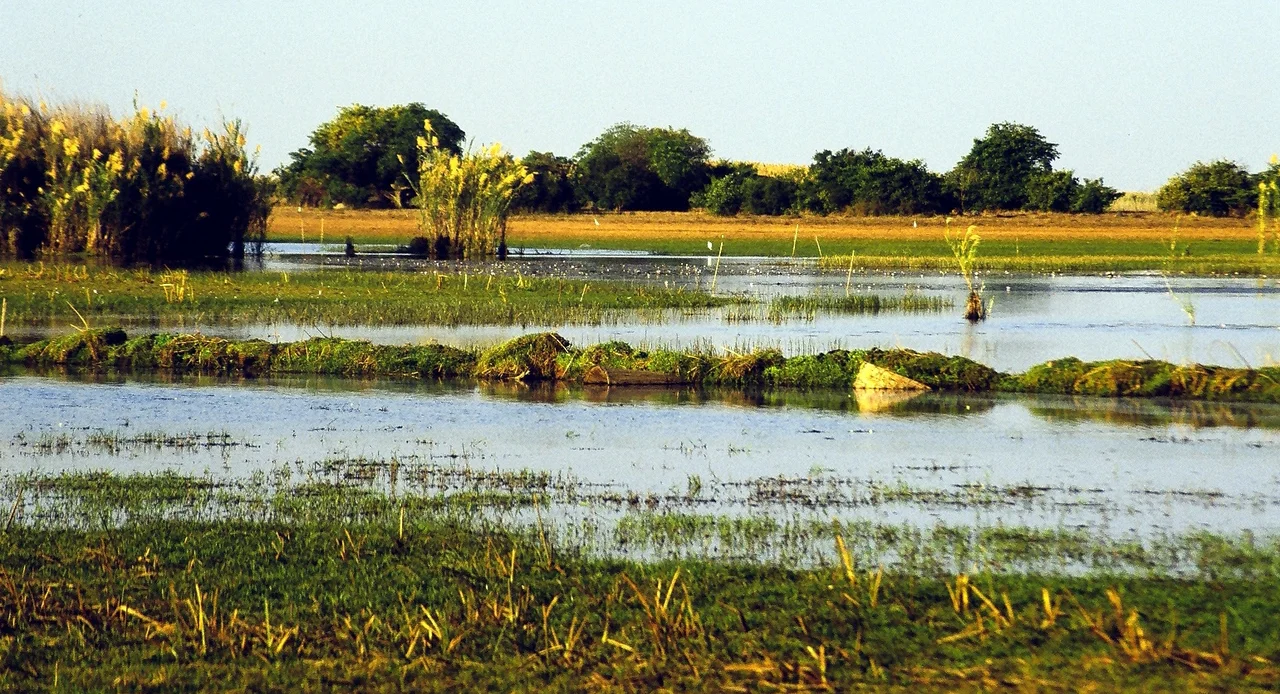

Bangweulu Wetlands
The name tells you everything you need to know before you arrive. Bangweulu: where the water meets the sky. Stand anywhere in this 9,850-square-kilometer mosaic of floodplains, papyrus swamps, and seasonally flooded grasslands in northeastern Zambia, and you understand why the people who have lived here for centuries saw no seam between the two. The light plays tricks. The reeds stretch farther than seems possible. Somewhere out there, a prehistoric-looking bird with a shoe-shaped beak is staring, perfectly still, at a lungfish.
Where Water Meets Sky
Four rivers feed this place - the Chambeshi, the Luapula, the Lukulu, and the Lulimala - converging into one of the most important wetland ecosystems on Earth. The Ramsar Convention, which keeps global watch over wetlands, lists Bangweulu among the world's most significant. BirdLife International calls it an Important Bird Area. The region shifts with the seasons: permanent swamps give way to floodplains that pulse wider and narrower as the rains come and go, and miombo woodland stands on the drier margins where the water retreats. First described scientifically in the 1940s, it remains a place whose geography resists tidy description. The wet season blurs the edges. The dry season reveals channels no one knew existed. And everywhere, that horizon of reeds and water and enormous African sky.
The Shoebill and the Lechwe
Bangweulu is the last refuge of the black lechwe, a swamp-dwelling antelope that evolved to run through knee-deep water. By 2020, conservationists counted about 36,600 of them here - nowhere else on Earth holds a significant population. Alongside them graze buffalo, Burchell's zebra, sitatunga, tsessebe, roan and sable antelope. Elephants and hippopotamus move through the channels. In 2016, African Parks and the Fondation Segre relocated 600 animals into the wetlands, reintroducing hartebeest, impala, and puku. Cheetahs returned in late 2020 after nearly a century's absence. But the animal that draws birders from around the world is the shoebill - a meter-tall stalker of the swamps with a beak that looks like a Dutch clog and eyes that seem to judge you personally. In May 2022, a captive rearing and rehabilitation facility opened to care for shoebill chicks before releasing them. Great white pelicans, wattled cranes, saddle-billed storks, and African spoonbills share the water.
A Wetland with Neighbors
Between 50,000 and 90,000 people live within or depend on the Bangweulu Wetlands, and conservation here has always meant negotiating between ecosystem and community. Habitat burning for farming, overfishing, and poaching all threaten the balance. The response has been practical rather than punitive: African Parks, which began co-managing the area with Zambia's Department of National Parks and Wildlife in 2008, built programs around beekeeping, sustainable fisheries, and reproductive health education. A Bangweulu Wetland Management Board was established with representatives from African Parks, the Zambia Wildlife Authority, and six community members. Poaching dropped. Fish stocks recovered. The story here is less about walling nature off from humans and more about figuring out how wetland, wildlife, and villages can share the same water.
Conservation in Practice
The University of Cape Town's Percy FitzPatrick Institute of African Ornithology has developed conservation plans for the shoebill. The Working for Water Project surveys Africa's major wetlands - Bangweulu, the Niger and Okavango deltas, the Sudd, and the Zambezi - to understand how they function and how to protect them. African Parks' partnership with Fondation Segre, launched in 2016, aims to rebuild Bangweulu as what they call an ecologically viable protected area with the capacity to become sustainable. The language is managerial. The work is slow and specific: tracking animals, monitoring burns, training fisheries officers, feeding shoebill chicks with forceps until they can hunt lungfish on their own. A wetland this large cannot be fenced. It can only be tended.
From the Air
Coordinates 11.60 degrees south, 30.08 degrees east, at an elevation of roughly 1,140 meters above sea level. The wetlands spread across northeastern Zambia's Northern Province, adjacent to Lake Bangweulu. From above, the seasonal flooding creates a shifting mosaic of channels, islands, and reedbeds that is easiest to read during the dry season, June to October. Nearest major airports are Kasama (FLKS) to the northeast and Ndola (FLND) to the south. Cruise at 4,500 to 6,500 feet AGL for the best read on channel patterns and animal movement; thermals build strongly after 10 a.m. over the drier margins.
Nearby Stories
- Lake Bangweulu 38 km away
- Lavushi Manda National Park 59 km away
- Chambeshi Monument 65 km away
- Kasanka National Park 94 km away
- Congo Pedicle 119 km away
- Shiwa Ngandu 130 km away
- Ntumbachushi Falls 169 km away
- 1935 Copperbelt strike 183 km away