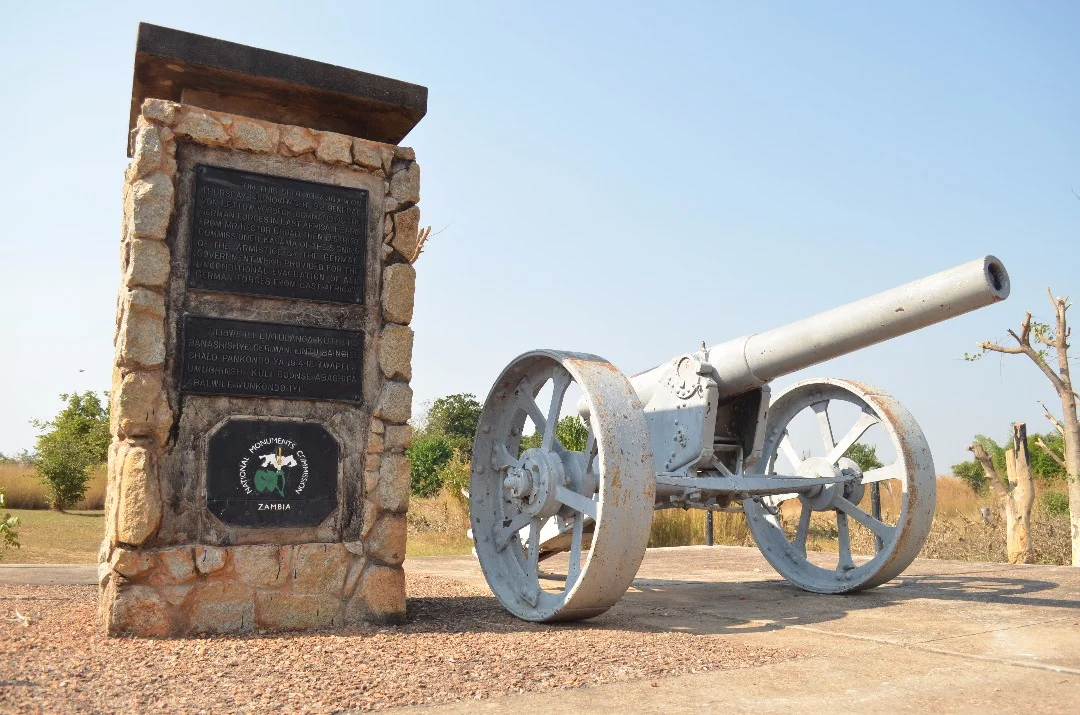

Chambeshi Monument
At 7:30 on the morning of 14 November 1918, on the bank of the Chambeshi River in what was then Northern Rhodesia, a British district commissioner named Hector Croad walked up to General Paul von Lettow-Vorbeck under a white flag and handed him a telegram. The general read it. He ordered his soldiers to stop firing. The First World War, which had ended in a railway carriage at Compiegne three days earlier, was now finally over for the undefeated German East Africa Schutztruppe and the British, South African, and - most of all - African troops who had been chasing them for four years across half a continent. A stone pillar stands on that spot today.
The General Who Would Not Quit
Lettow-Vorbeck commanded what was probably the smallest and most effective force of the First World War. Starting with about 14,000 men - the majority of them African askari soldiers serving under German officers - he had tied up ten times that many Allied troops by refusing to surrender and refusing to be caught. His strategy was pure mobility: live off the land, raid where possible, never engage on terms the British chose, and keep the war going in Africa for as long as it continued in Europe. By November 1918 he had marched his surviving force from German East Africa south through Mozambique and back north into Northern Rhodesia, still undefeated in any major engagement. He was heading for the British administrative center at Kasama when news of the Armistice caught him.
The Men at Chambeshi
The British defenders of the Chambeshi line were not much of a line. Kasama's tiny European population had already evacuated north to Mpika, leaving nine volunteers to hold the river crossing. They had two Maxim guns and no one who knew how to fire them. One of the nine, Charlie Simpson, had with him roughly ten thousand pounds in government and business cash - everything the Kasama offices had on hand - and he had buried it in a goat pen near his rubber factory, reasoning that the goats' hoofprints would hide the fresh digging and that the Germans would be more interested in stealing the goats than in looking for money underneath them. When the Germans arrived on 13 November, they duly machine-gunned the rubber factory. The buried cash went undisturbed.
The Telegram
The message that ended the war in East Africa came from General Jacob van Deventer, the South African officer commanding Allied forces in the region. It read, in essence: the English Prime Minister has notified us that an Armistice was signed on 11 November, and that fighting on all fronts should cease at 11 o'clock on that day. I order my troops to end hostilities as from now, and I expect you to do the same. Croad, the Kasama district commissioner, was given the telegram and told to deliver it to Lettow-Vorbeck under flag of truce. He rode to the Chambeshi, found the German camp, and handed it over. A plaque set into the monument today records what happened next in matter-of-fact terms: the general heard of the signing of the Armistice from Mr Hector Croad, and the unconditional evacuation of all German forces from East Africa followed. The monument marks the cessation of hostilities, not the surrender.
The Soldiers the War Used Up
The plaque beside the main inscription, in Bemba, ends with a line that the English version does not quite match: Twapela umuchinshi kuli bonse abashipa abalwile mu nkondo iyi - we honor all brave soldiers who fought in this war. The Bemba inscription matters because the majority of the dead on all sides in the East African campaign were African. On the German side, askari troops - most of them recruited from what is now Tanzania - had followed Lettow-Vorbeck across thousands of kilometers, fighting and dying in a war declared in cities they had never heard of. On the British side, the King's African Rifles, the Rhodesia Native Regiment, and above all the carriers - hundreds of thousands of African men conscripted or coerced into carrying supplies on their heads through bush and swamp - died in vast numbers from disease, hunger, and exhaustion. No one counted the carriers accurately. Estimates suggest 100,000 or more perished. The line on the Bemba plaque - we honor all brave soldiers - is the only marker any of them ever got here.
The Stone on the Riverbank
The Chambeshi Monument was unveiled on 14 November 1953, thirty-five years to the day after the event it commemorates, while Zambia was still Northern Rhodesia. It is a large stone platform with the plaques set into a stone pillar, beside a cannon of the First World War era - though not, for what it's worth, one actually used by the Germans. Visitors today come mostly from Kasama and the surrounding districts, pausing at the pull-off on the road between Kasama and Mpika. The site is quiet, as most battlefield memorials eventually become. The Chambeshi flows past it on its way to Lake Bangweulu and eventually - through a long system of swamps and rivers - into the Congo.
From the Air
Coordinates 10.92°S, 31.08°E - in Zambia's Northern Province near Kasama, on the banks of the Chambeshi River. The nearest airport is Kasama Airport (FLKS/KAA), about 30 km to the north, with occasional Proflight Zambia service from Lusaka. Lusaka's Kenneth Kaunda International (FLKK/LUN) is the nearest major hub, roughly 700 km to the southwest. Recommended visual altitude FL100-FL150 reveals the broad Chambeshi floodplain and the plateau country that stretches north to Lake Tanganyika. The terrain is typical of the Central Zambezian miombo woodlands - flat plateau broken by seasonal dambos. Dry-season visibility is excellent May-August; the ITCZ brings thunderstorms November through April.
Nearby Stories
- Shiwa Ngandu 26 km away
- Mwela Rock Paintings 59 km away
- Bangweulu Wetlands 67 km away
- Muchinga Province 90 km away
- Lake Bangweulu 92 km away
- North Luangwa National Park 92 km away
- Lavushi Manda National Park 115 km away
- Ntumbachushi Falls 205 km away