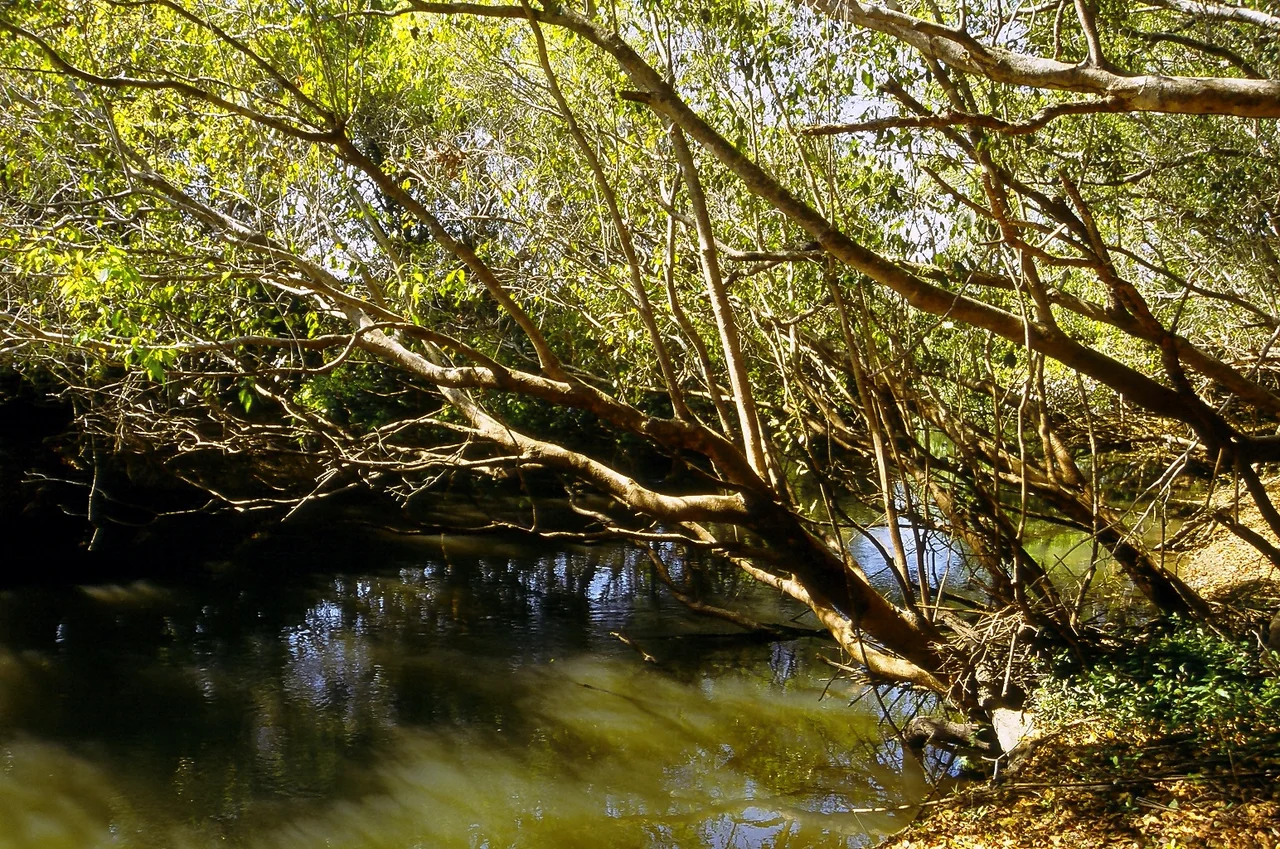

Kasanka National Park
Every November, the sky above one small patch of Zambian swamp forest turns black. Ten million straw-coloured fruit bats, drawn from as far away as the Congo, converge on a thicket along the Musola stream barely a few kilometers wide. They come for the masuku berries and waterberries ripening with the first rains. They eat 330,000 tonnes of fruit in three months and then disappear. Kasanka National Park, covering roughly 390 square kilometers in Zambia's Central Province, would be worth visiting for its miombo woodlands, its sable antelope and sitatunga, its 471 recorded bird species. But it is the bats that have made it famous, and the bats that make it strange.
The Bat Forest
The phenomenon centers on one of the last intact tracts of Mushitu forest in the country, a swamp-evergreen woodland of red mahogany, waterberry, and quinine trees. The first arrivals appear in mid-October. By mid-November the roost has thickened to its full density, estimated at eight to ten million animals hanging in layers so dense that branches snap under their weight. Biologists call it the highest concentration of mammalian biomass on the planet. From hides built into trees at the forest edge, visitors watch the evening exodus: a river of wings unspooling into the dusk, raptors and falcons and fish eagles circling the edges to pick off stragglers, crocodiles and Nile monitors waiting below for any that fall. The bats do not all come from one place. Their colonies trace back across central Africa, pulled south each year by the chemistry of ripe fruit. By early January they are gone.
A Park Saved by Gunshots
Kasanka's survival depends on one very unusual origin story. In 1985 a retired British colonial officer named David Lloyd visited the park, which by then was a neglected shell: no staff, no infrastructure, no budget, and plenty of poachers. Lloyd heard gunfire from inside the reserve. His reasoning was, in a sense, optimistic. If there was still poaching, then there must still be something left to poach. He made the restoration of Kasanka his life's work. In 1987 he and his collaborators founded the Kasanka Trust, a private non-profit that signed a memorandum of understanding with the Zambian government to manage the park. It was the first national park in Zambia, and one of the first in Africa, to be run under a private-public partnership. Zebra and buffalo have since been reintroduced. Elephant herds have returned. The model, once controversial, now shapes conservation across the continent.
Water, Woodland, Fire
Away from the bat roost, Kasanka is a mosaic of habitats shaped by water and fire. Miombo woodland covers seventy percent of the park, broken by grassy drainage channels called dambos that retain moisture deep into the dry season. Nine permanent lakes and five perennial rivers stitch the landscape together. The largest, the Luwombwa, drains out the northwestern corner into the Luapula, which feeds the Bangweulu swamps and eventually the Congo River itself. Fire is the organizing force here. Rangers set controlled burns early in the dry season to prevent the catastrophic late-season fires that would otherwise tear through the Mushitu and kill the trees the bats depend on. A Fire Exclusion Zone protects the heart of the roost. Without this management, the forest shrinks; with it, saplings return, the canopy thickens, and the phenomenon endures for another year.
Birds, Antelope, and Quiet Predators
Kasanka is also, by the reckoning of leading ornithologist Ian Sinclair, home to some of the finest birding in Africa. Over 470 species have been recorded in a park small enough to drive across in an afternoon. A boat along the Luwombwa might turn up Pel's fishing owl, African finfoot, Ross's turaco. The wetlands hide shoebills (confirmed here in 2010 after a twenty-year absence) and a breeding pair of wattled cranes. The mammals are quieter but present. Sitatunga splash through the papyrus. Sable and Lichtenstein's hartebeest graze the Chikufwe plain. Leopards are the largest resident predator; lions and hyenas come only as visitors. Walking the dambos at dawn, you can go hours without seeing another human. For three months a year the sky is the loudest thing in the park. For the other nine, it is one of the quietest places left in central Africa.
From the Air
Located at 12.50 degrees S, 30.50 degrees E in Zambia's Central Province, at an elevation of 1,160 to 1,290 meters. The park has an airstrip. Nearest major fields are Kasama (FLKS) to the north and Lusaka's Kenneth Kaunda International (FLKK) about 450 km south. From cruising altitude, the Luwombwa River and the Bangweulu basin provide the primary visual reference; the swamp forests appear as darker patches within the pale miombo woodland.
Nearby Stories
- Lavushi Manda National Park 46 km away
- South Luangwa National Park 64 km away
- Mfuwe 114 km away
- North Luangwa National Park 120 km away
- Bwana Mkubwa 129 km away
- Lake Bangweulu 137 km away
- Ndola 143 km away
- Mambwe people 190 km away