
Bwana Mkubwa
Call the mine Big Boss. That is roughly what Bwana Mkubwa means in Swahili - great master, the man in charge - and the name stuck sometime in the early 1900s when prospectors William Collier and Jack Donohoe were led to ancient copper workings outside Ndola and decided to name their new venture after the local Native Commissioner, Francis Emilius Fletcher Jones, whom the locals already called the Bwana Mkubwa. The miners who did the actual digging probably had other names for him. But on the maps, the name stuck.
Older Than the Paperwork
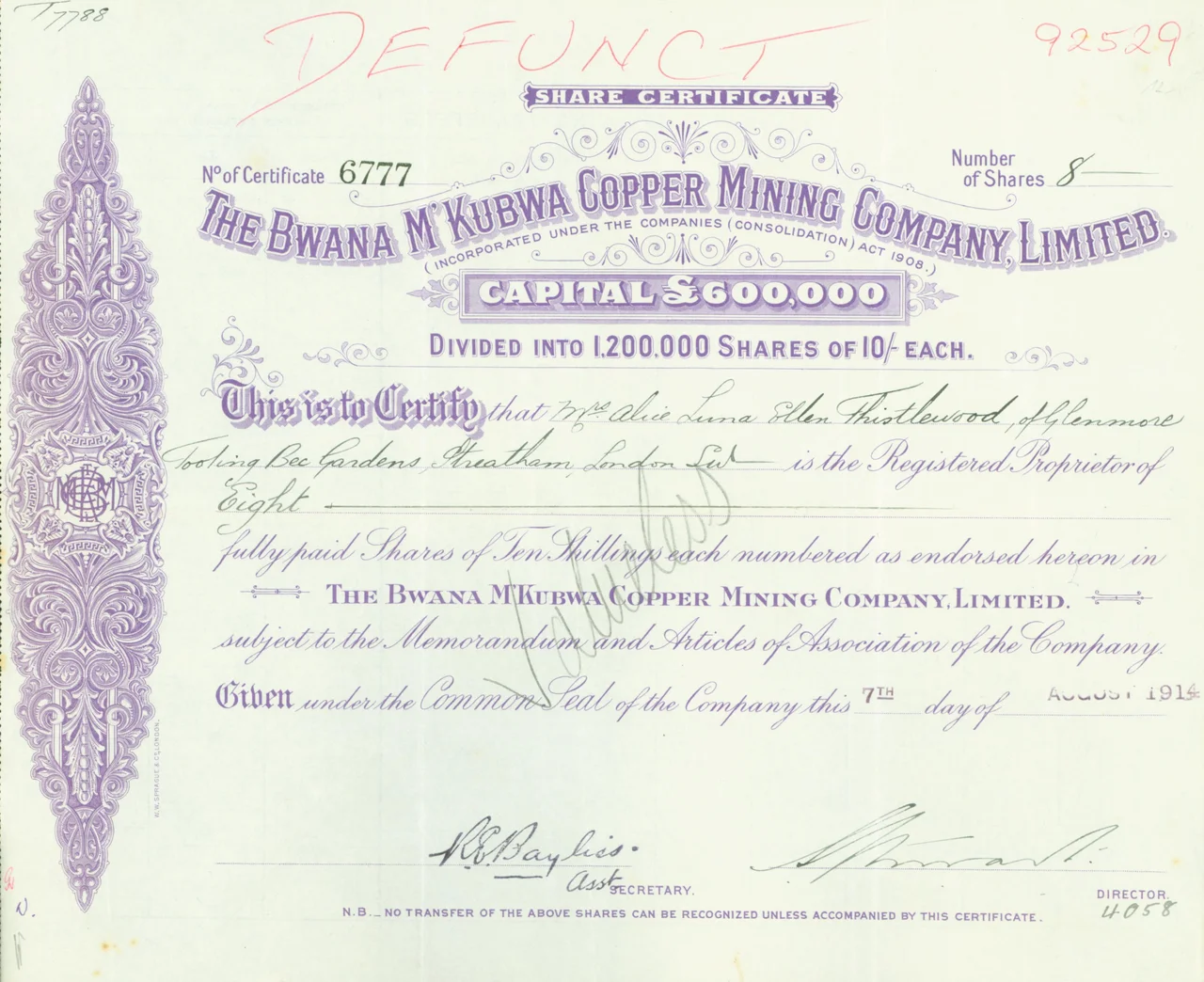
The colonial paperwork says Bwana Mkubwa opened in 1902. The rocks tell a different story. Archaeologists have found evidence of copper mining here in the fourteenth or fifteenth centuries, and in the centuries that followed - ancient workings at Bwana Mkubwa, Kansanshi, and Kipushi - that were what first drew European prospectors to the region. When the Rhodesia Copper Company arrived in 1902, it was building on top of workings that had already served central African metallurgists for hundreds of years. The Bwana Mkubwa Copper Mining Company was registered in London in 1910, which is the kind of detail colonial history likes to emphasize. The deeper detail is that this ground had been giving up copper long before anyone in London knew about it.
The Perkins Process Disaster
After the First World War, the Bwana Mkubwa Copper Mining Company made a bet. Low-grade ore was everywhere in the Copperbelt, and if you could find a way to extract copper from ore as lean as four percent copper, you could unlock enormous reserves - an estimated 3.7 million tons of ore, by their calculation. They hired the London-based Mineral Separation Agency, installed a new technique called the Perkins Process, and started processing 1,000 tons of ore a day beginning in 1922. It went badly. The sample testing used malachite that did not actually exist at Bwana Mkubwa in meaningful quantities, so the percentage estimates were wrong. The extraction losses mounted. The mines closed in April 1931. The company was sold to The Rhodesian Congo Border Concession Ltd., which passed it along to Rhokana Corporation. Meanwhile, in the late 1920s, Ernest Oppenheimer was maneuvering to keep American capital from dominating the Northern Rhodesian mining industry. Bwana Mkubwa became a case study in how not to read ore samples.
The Settlement That Never Became a Town
In 1929, the company proposed a public township with laid-out lots. By 1931, the proposal had gone nowhere - the final version was rejected chiefly because the company worried about local taxation cutting into its profits. So Bwana Mkubwa never gained municipal status. Today it is part of Ndola, whose city center lies ten kilometers to the northwest, east of the T3 Highway at an elevation of 1,373 meters in the Bwana Mkubwa Protected Forest Area. Residents participate in projects that a townsfolk elsewhere might take for granted: malaria prevention, school upgrades, sewage and drinking water improvements, wildlife conservation. The Bwana Mkubwa constituency sends a representative to the National Assembly, covering most of Ndola south of the Kafubu River. The community built itself without ever receiving the civic status that nearly every other Copperbelt settlement eventually got.
The SX-EW Years
Modern Bwana Mkubwa came back to life in 1998, when a 30-million-dollar solvent extraction and electrowinning plant - SX-EW in industry shorthand - was built to produce about 10,000 tonnes of copper cathode a year. In 2007 output reached 25,402 tonnes. In 2008 it collapsed to 5,851 tonnes - a 77 percent drop - and in October 2008 operations were suspended, putting around 400 people out of work. First Quantum Minerals restarted the plant in January 2010 to process stockpiled ore from the Lonshi mine across the border in the Democratic Republic of Congo, a pipeline that opened up again once the border reopened. The restart was modest: 800 tonnes of copper cathode per month. By August 2010, First Quantum had run out of raw material. The ore from Lonshi was exhausted. The plant closed again. Bwana Mkubwa's story is Copperbelt in miniature - ancient workings, colonial ambition, accounting disasters, boom years, care-and-maintenance shutdowns, and the constant question of what happens when the ore finally runs out for good.
From the Air
Coordinates 12.98 degrees south, 28.70 degrees east, elevation 1,373 meters. Bwana Mkubwa sits at the southern end of the Zambian Copperbelt, ten kilometers southeast of Ndola's center. The open-pit workings, tailings pond, and SX-EW plant are visible as a cluster of rectangular patches surrounded by protected forest. Nearest airport is Simon Mwansa Kapwepwe International (FLSK) at Ndola, roughly eight kilometers northwest. Cruise at 3,000 to 4,500 feet AGL for the best read on the pit geometry; the Copperbelt's typical afternoon convection builds quickly in summer.
Nearby Stories
- Chambishi 8.2 km away
- Kalulushi 9.2 km away
- Lake Kashiba 36 km away
- Congo Pedicle 43 km away
- Central Province, Zambia 98 km away
- Kasanka National Park 144 km away
- Zambezian flooded grasslands 173 km away
- Bangweulu Wetlands 177 km away