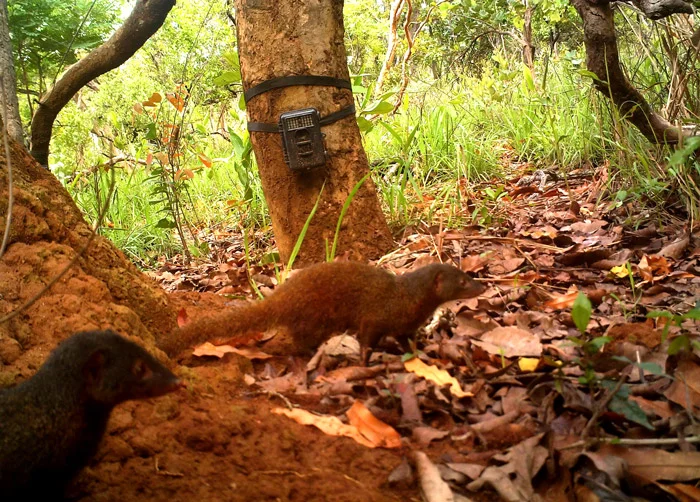

Chinko
Nearly seven thousand square miles of savanna and woodland sit on a volcanic plateau 2,000 feet above sea level in eastern Central African Republic. African wild dogs hunt here. Leopards stalk antelope through gallery forest. Lions move along the drainages. The Precambrian bedrock underfoot has eroded over millions of years into alluvial soil rich enough to support a density of wildlife that was once common across this whole belt of Africa and is now almost nowhere else. This is Chinko. It exists because a small group of people decided, against substantial evidence that such things no longer work, that it should exist - and then kept showing up to do the work.
A Safari That Became a Project
In 2005, Erik Mararv and his family acquired a hunting concession in the Chinko drainage. The following year they launched Central African Wildlife Adventures, a safari operation. For six years, they built what was needed to reach the country: two airstrips, guest rooms, hundreds of miles of tracks. They imported machinery and trucks. They trained staff. A Scottish pilot named David Simpson joined the operation in 2010; by 2011, he was the general manager. Simpson had watched the wildlife of eastern CAR come under steady pressure from cross-border poachers, armed militias, and the slow dissolution of Central African state authority. He co-created the Chinko Project to do something about it. The safari operation became the nucleus of a conservation effort.
African Parks Takes Over
In December 2014, African Parks - a nonprofit that manages protected areas across the continent in public-private partnerships with host governments - signed a fifty-year agreement with the CAR Ministry of Water, Forest, Hunting and Fishing to manage Chinko. The timing was bleak. CAR was still recovering from the 2013 coup that had collapsed its government, and armed groups roamed most of the country's eastern reaches. African Parks brought infrastructure and money, and hired rangers. Fondation Segré joined in 2016 to fund training, operations centers, communications, equipment, data systems. The approach was straightforward and expensive: pay people to protect the wildlife, pay them consistently, train them well, give them what they need, and expand the protected area only as fast as the organization could actually hold ground.
The Cost of the Work
In January 2017, a helicopter chartered by African Parks crashed in Chinko, killing the park's head of law enforcement, his deputy, and the pilot. Rangers across Africa die in the course of this work - sometimes in confrontations with armed poachers, sometimes in accidents like this one, sometimes from the diseases that lurk in the bush. There is no gentle way to say what conservation actually requires in places like Chinko. It requires people who are willing to fly small planes into rough airstrips, to patrol with rifles against armed incursions from the Lord's Resistance Army or Sudanese poaching militias or local bandits, to sleep in camps far from medical care. The names of the three men who died in that 2017 crash are in the project records. What their absence means cannot be measured.
Larger, Every Year
In April 2020, the CAR government and African Parks signed a revised agreement extending the core protected area to 24,335 square kilometers and the total protected management area to 55,000 square kilometers over 25 years. The expansion reflected something real: the rangers were holding ground. Wildlife was returning to parts of the range where it had been effectively absent for years. By 2024, African Parks reported that Chinko employed over 350 Central African nationals - making it the largest employer in the country outside of Bangui. Think about what that means. In a country whose economy has been ripped apart by two decades of civil war, a wildlife reserve four hundred kilometers from the capital is now putting more people to work than any private employer beyond the capital itself. The rangers here are local. So are the cooks, the drivers, the radio operators, the camp managers.
What the Plateau Allows
Chinko works because the land itself is rich. Rain and freshwater sources are plentiful. The alluvial soils support abundant vegetation, which supports abundant prey, which supports the carnivores. The volcanic plateau rises distinctly above the surrounding lowlands, creating natural refugia where populations can persist even when the broader landscape is under pressure. In a region where almost everything is trending the wrong way - insecurity, armed mercenary activity, state collapse, habitat loss, bushmeat pressure - Chinko has been trending, patiently, the other direction. African wild dogs hunt. Leopards stalk. The rangers go out on patrol. The plane lands on the airstrip. The work continues. It is the kind of stubborn, practical, expensive, dangerous undertaking that almost never makes the news, and that - in Chinko's corner of central Africa - may be the closest thing to a functioning public institution that the region has.
From the Air
Chinko sits at approximately 6.05°N, 23.90°E on a volcanic plateau in southeastern Central African Republic, 2,000 feet above sea level. From cruise altitude, the plateau rises as a distinct band of higher, more wooded country above the surrounding lowlands. The Chinko drainage and other streams cut dark veins through the landscape. Nearest airports: Chinko has two private airstrips used by African Parks for operational flights; Bangassou (ICAO: FEFG) is the nearest town with regular service. Bangui M'Poko International (ICAO: FEFF) is the regional hub. Best visibility: November-April dry season.
Nearby Stories
- Lengo Petroglyphs 47 km away
- Bakouma 62 km away
- Georges Le Marinel 71 km away
- Léon Hanolet 94 km away
- Western Bahr el Ghazal 248 km away
- Dār Fertit 317 km away
- Gbadolite 347 km away
- Garamba National Park 588 km away