_(blended).jpg)
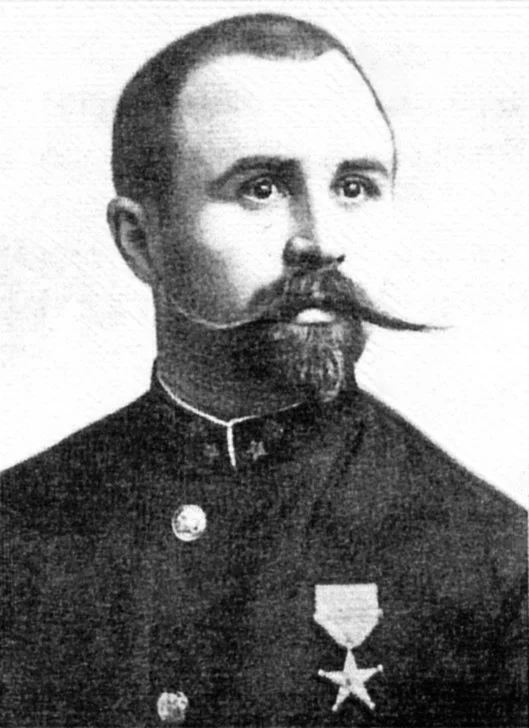
Léon Hanolet
Léon Hanolet walked for six hours at a stretch across the flat country north of the Mbomou without crossing a single stream. He was a Belgian army officer, 34 years old in the spring of 1894, commanding an expedition that had slowly been starving itself northward through what is now the Central African Republic. His maps were thin. His rations were thinner. His instructions from Léopoldville were to plant the flag of the Congo Free State as far north as it would go, to impress or bribe or coerce the sultans of Dar al-Kuti and the Wadai into treaties, and to beat the French to the waters of the Chari. He did not reach the Chari. He did not annex Dar al-Kuti. What he did do was convince the governments of France and Belgium to sign a line across a map that became, a hundred years later, a real border between two independent African states, along which today families can find themselves cut in half.
A Soldier's Career
Born in 1859 in the Belgian village of Mehaigne, Hanolet made the career of his century: army officer in Europe, then volunteer for colonial service in the Congo Free State, King Leopold II's personal possession. He first arrived in Africa in 1888. His first posting was Zongo, a river station on the north bank of the Ubangi opposite what the French were just then founding as Bangui. He commanded the post for two years. Reports from the period credit him with forcibly suppressing a local slave trade among the Bobangi, though the historical record is ambiguous on what the actual dynamics of labor in the Zongo-Bangui area were. It is worth saying clearly: the Congo Free State itself was built on forced labor that killed millions of Central Africans. Men like Hanolet carried out policies that, while not the worst of the atrocities in the Free State, were part of a system whose cruelty is now well documented.
The Expedition North of the Mbomou
His most consequential tour came between 1892 and 1895, when he commanded a series of expeditions into what is now the northern Central African Republic. He established the post of Gandu at the confluence of the Mbomou and Chinko rivers, and other posts at Dabago and Sattet. In 1894 his expedition pushed up the Mbari River, along valleys of the Bali and Kotto, following what he called 'the road of the Arab caravans.' The advance party reached the town of Mbélé on April 4, 1894. At that time Mbélé, in the Chari basin, was one of the most important trading centers of north-central Africa, with several thousand inhabitants and merchants coming from Rafaï, Zémio, Bangassou, and the Wadai empire further north. Hanolet joined them in June. The names he wrote into his journals (Katuaka, Kuria, Dabago, Sango, Yango) belonged to real towns with real histories, whose people had been traders, farmers, and rulers for generations before any Belgian arrived.
A Border Drawn in Europe
Hanolet's expeditions alarmed the French, who had their own designs on the Chari basin and the Wadai. On August 18, 1894, while Hanolet was still in the bush trying to persuade the Sultan of Dar al-Kuti to accept Congo Free State protection, France and Belgium signed a convention in Europe establishing the Mbomou River as the northern border of the Congo Free State. The country Hanolet had just surveyed was now French territory. Four months later, in December 1894, he received the news and withdrew. The border that convention drew is essentially the border between today's Democratic Republic of Congo and the Central African Republic. What Hanolet's men had chased across the savanna at great human cost (their own and their porters') was, for the European powers, a negotiation that took place over champagne in Brussels and Paris.
The Lado Enclave and After
Hanolet's third tour took him to the Lado Enclave, a strip of the upper Nile that Leopold had leased from Britain and Egypt. In November 1897 he took command at Rejaf, and on the night of June 3-4, 1898, his force fought off a much larger Mahdist army at the Battle of Rejaf. Mahdist forces, retreating south from their defeat at Omdurman, had attacked hoping to find refuge. About half the African soldiers defending under Hanolet's command were killed or wounded. These were the troops of the Force Publique, the colonial army whose African soldiers did most of the dying in Leopold's wars. After 1903 Hanolet left colonial service and joined the boards of the Abir Congo Company and the American Congo Company, rubber concessions whose records of violence against the Congolese workforce were especially brutal even by Free State standards. He died in Brussels in 1908, the same year King Leopold was finally forced to hand over the Free State to the Belgian parliament. The people whose lives his expeditions had upended (the traders of Mbélé, the sultanates of the Chari, the porters who carried his loads) have their own histories, which did not end when he left.
From the Air
The coordinates associated with Hanolet's most consequential expedition are roughly 6.97°N, 23.17°E in the Haute-Kotto or Mbomou regions of the Central African Republic. This is forest-savannah mosaic country with few landmarks visible from the air. Nearest paved airport is Bangassou (FEGU) well to the south. The Mbomou River forms a sinuous border to the south and is visible from altitude during the dry season. The region has limited air traffic and limited ground infrastructure; flight over these areas usually requires local permission.
Nearby Stories
- Chinko 79 km away
- Bakouma 112 km away
- Central African Republic 179 km away
- Manovo-Gounda St. Floris National Park 181 km away
- Ouanda Djallé 190 km away
- Western Bahr el Ghazal 266 km away
- Liffi 295 km away
- Gbadolite 315 km away