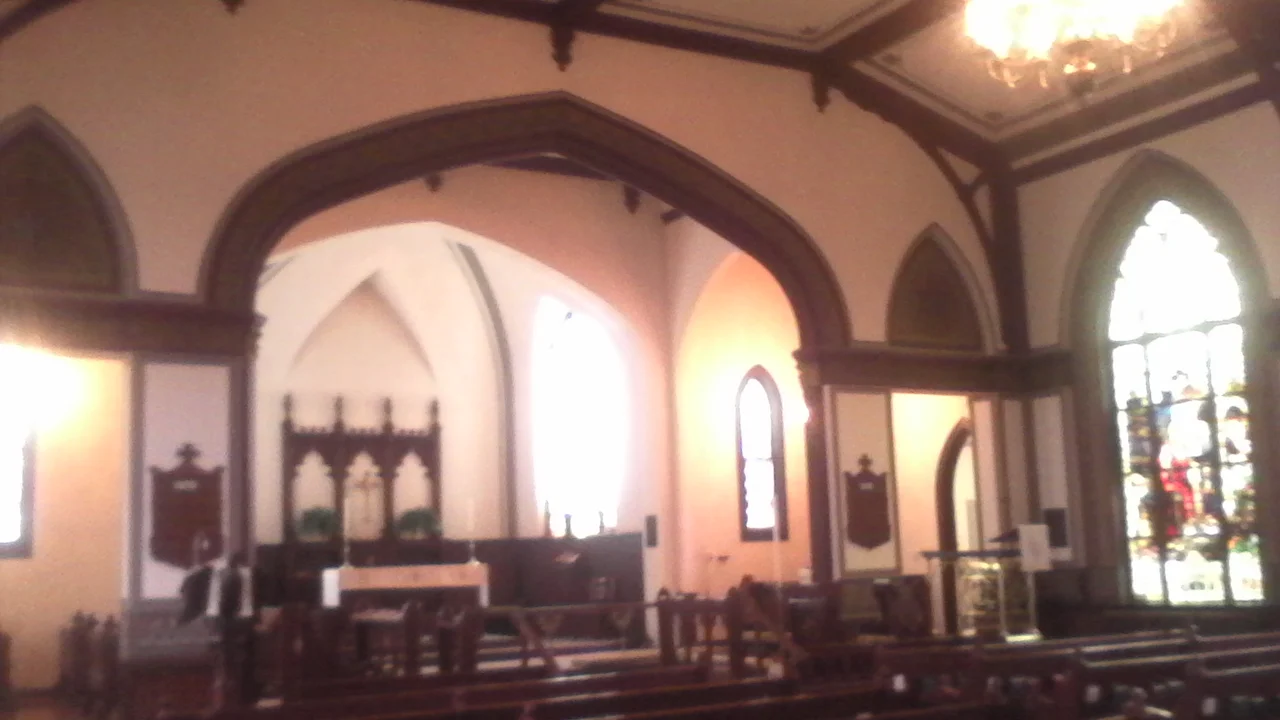

Christ Episcopal Church (Winchester, Virginia)
Lord Fairfax died in 1781 at his Greenway Court hunting lodge twelve miles southeast of Winchester, having lived through the Revolution as the last great proprietor of the Northern Neck - the man who claimed every acre between the Potomac and the Rappahannock. He had remained loyal to the Crown but was old enough by then that the new republic let him be. They buried him in the chancel of the Anglican church in Winchester. Forty-seven years later, the parish tore down the building over his grave and asked Robert Mills - the architect of the Washington Monument - to design a new one. His remains have since been moved to a tomb in the church courtyard. The building Mills drew still stands.
A Parish on the Edge of Settlement
Christ Church traces its founding to 1738, when the Virginia General Assembly created Frederick County from the western part of Orange County. Frederick Parish was its established church, and at its peak it covered half the Shenandoah Valley and a slice of what would become West Virginia. The first vestry was not elected until 1742, four years after the parish was created on paper, because the Anglican Church had been slow to follow English settlers into the lower valley. By the time the parish organized, the area around what would become Winchester was already home to Quakers from Maryland, Lutherans from Germany via Pennsylvania, and Scots-Irish Presbyterians from Donegal. James Wood, Lord Fairfax's surveyor, laid out the town of Winchester on his own land near Shawnee Springs and reserved lots for a courthouse, a jail, and a parish church. George Washington arrived in September 1755 as a young Virginia militia colonel, set up camp, and was eventually elected to represent Frederick County in the House of Burgesses with the parish's vestrymen organizing his campaign.
Balmain's Four Decades
After the Revolution disestablished the Church of England in Virginia, most parishes collapsed. Frederick Parish did not, largely because of the Reverend Alexander Balmain, a Scotsman who had trained for the Presbyterian ministry at St. Andrews before crossing the Atlantic. Balmain had been chaplain to Muhlenberg's First Virginia Brigade during the war and arrived at Frederick Parish in 1785 with a meager military pension and a habit of frugality so extreme that he restricted his own fireplace use in winter and rented out the glebe lands to support the poor. He served thirty-six years, the longest tenure of any rector to date, and personally mentored William Meade, who would become the third Episcopal Bishop of Virginia. Balmain was active in the American Colonization Society - a movement that proposed relocating freed African Americans to West Africa - and his will gave his wife Lucy the right to free their enslaved people. Lucy Balmain did so when she died in 1845, freeing all the people the household held.
Mills's Building
Balmain died in 1821. By 1827 the parish had grown enough to demand a larger building. The vestry hired Robert Mills, the South Carolina-born architect who was then working in Washington on the federal buildings that would culminate in the Washington Monument. Mills's wife Eliza was born outside Winchester and had family connections in the parish, which helped. The new Gothic Revival brick-and-stone church, three bays wide with a gable roof and carved stone detailing, was consecrated on October 30, 1829 - the first official act of William Meade after his consecration as assistant bishop of Virginia. The parish was formally named Christ Church around the same time, replacing the older designation as the Winchester Episcopal Church. The diocese held its annual convention in the new building the following year. A 48-foot central belfry was added before the Civil War. Mills's church is the oldest church building in Frederick County still in continuous religious use.
Winchester Changed Hands
During the Civil War, Winchester changed hands somewhere between 70 and 80 times, more than any other town in America. Three major battles were fought in or around the city. The rector of Christ Church, William Meredith, enlisted as a private in the 4th Virginia Cavalry within weeks of Fort Sumter and later served as regimental chaplain. He left a deacon - John Bell Tilden Reed - to look after the parish. Reed was already a mature man, a Mason, and the son of a Methodist minister. At the war's end Reed initiated a young Union major named William McKinley into Winchester's Hiram Lodge of Masons - the same McKinley who would become the 25th president of the United States. The two churchwardens, law partners Philip Williams and David Barton, were both Confederate sympathizers. Williams was arrested and imprisoned in Wheeling in 1864. Barton lost three of six sons in Confederate service before dying himself in 1863. Union generals Philip Sheridan and George Custer attended Christmas services at Christ Church in 1864. By that point, of 96 communicants on the rolls, at least 77 were women. At least 1,400 soldiers who died in Winchester hospitals during the war were buried in the Episcopal section of Mt. Hebron Cemetery.
What Remains Inside the Building
Lord Fairfax was originally buried in the chancel in 1781, but his remains were relocated over the years and now rest in a brick tomb in the church courtyard, beneath a marker that acknowledges his singular place in Virginia history. Memorial plaques line the walls - to Alexander Balmain, to his wife Lucy, to John Bruce who oversaw the construction, to the Confederate dead. The 1828 building survived the war with relatively little structural damage compared to other Winchester churches, though it lost windows and was briefly used as a Union jail. The 1882-1884 renovation added stained glass and re-roofed the building; a side entrance was added in 1895; electricity came in 1906. A 1983 renovation removed a large wooden organ to create a small chapel. The parish is now one of five Anglican congregations in Winchester. From the air the church reads as a brick Gothic Revival presence on Boscawen Street in the heart of the historic district, two blocks from George Washington's office and three blocks from Abraham Hollingsworth's stone house at Abram's Delight. The town that grew up around it has been a gateway to the Shenandoah Valley for almost three hundred years.
From the Air
Christ Episcopal Church sits at 39.1849 N, 78.1681 W, in the heart of historic Winchester, Virginia. Recommended viewing altitude is 1,500 to 2,500 feet AGL for the best look at the 1828 brick Gothic Revival building and its position within the dense historic downtown grid. The nearest airport is Winchester Regional (KOKV), about 4 nautical miles to the southwest. Front Royal-Warren County (KFRR) lies 12 nm southeast. The Blue Ridge rises about 10 nm east; the Allegheny Front about 15 nm west. The church is adjacent to several other historic buildings - George Washington's Office Museum, Abram's Delight, the old Lutheran church - all within a small area easily photographed from a single low-altitude pass.
Nearby Stories
- Bryce Resort 3.6 km away
- Disney's America 4.8 km away
- Loudoun County, Virginia 6.1 km away
- Hardy County, West Virginia 15 km away
- The Inn at Little Washington 16 km away
- Camp David: Where Presidents Escape and History Gets Made 36 km away
- Antietam: The Day America Lost 23,000 Men 42 km away
- Garrett County, Maryland 49 km away