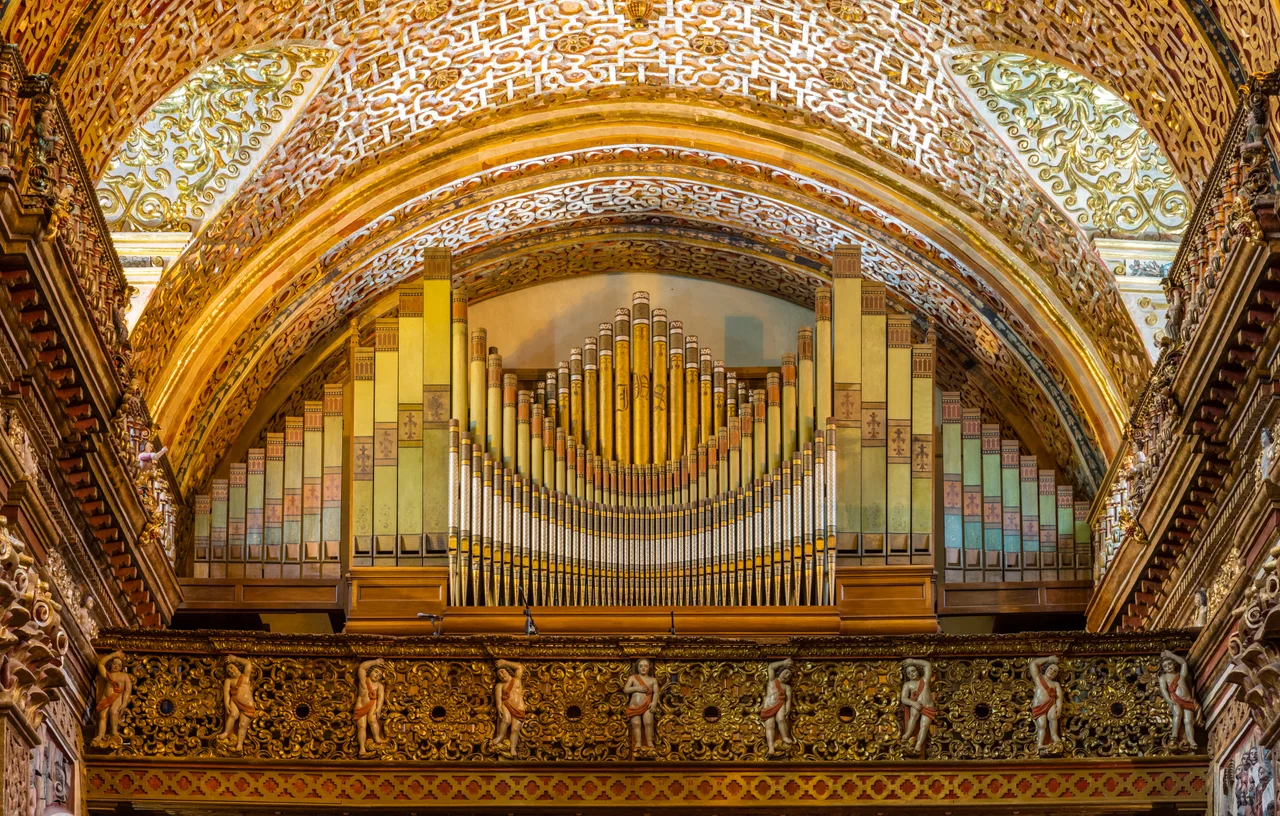

Church of La Compañía, Quito
A traveling Jesuit named Father Bernardo Recio called it "Golden Ember." Others have compared it to the Temple of Solomon. Walk through the doors of the Church of La Compania in Quito's historic center and the reason becomes obvious in a single breath: every surface of the interior - altarpieces, pillars, vaults, cornices - is sheathed in 23-carat gold leaf over carved cedar, glowing against a deep red ground. The effect is not decoration. It is immersion. The church is less a building than an engineering achievement in light.
One Hundred Sixty Years
The Jesuits arrived in Quito on July 19, 1586, hoping to establish a church, a college, and a monastery. Most of the prime land had already been claimed by the Franciscans, Mercedarians, Augustinians, and Dominicans. They settled for a plot south of the cathedral and began acquiring adjacent parcels. The construction of the main temple began in earnest in 1605 under the Italian priest Nicolas Duran Mastrilli, working with plans approved in Rome and executed by the Basque architect Martin de Azpitarte. The work would not finish for 160 years. Four architectural styles - Mudejar, Baroque, Churrigueresque, and Neoclassical - accumulated across generations of construction. The church's layout mirrors the Church of the Gesu in Rome, but with three naves instead of one. Only the central dome over the crossing resembles its Roman parent.
The Facade in Stone
The exterior facade is carved entirely from Ecuadorian andesite - volcanic stone quarried from El Panecillo hill and from the Jesuits' own Hacienda de Yurac. Work began in 1722 under Father Leonardo Deubler, was suspended in 1725, and resumed in 1760 under Father Venancio Gandolfi, who completed it in 1765. The main entrance is flanked by six Solomonic columns five meters tall, their twisted shafts modeled on Bernini's columns at the altar of Saint Peter's Basilica in Rome. Niches display life-sized statues of Saint Ignatius of Loyola, Saint Francis Xavier, Saint Stanislaus Kostka, and Saint Aloysius Gonzaga. Cherubs hold up a pediment. The Immaculate Conception stands surrounded by angels in a niche crowned by a dove of the Holy Spirit. The Italian artist Giulio Aristide Sartorio, visiting in the early twentieth century, wrote that complete buildings like La Compania de Jesus in Quito were still rare even in the old continent of Europe.
Gold Over Red
The interior is where the church becomes extraordinary. The main altarpiece was begun as stone and brick, but in 1735 the design changed to carved cedar wood following the guidelines of Jesuit brother Jorge Vinterer. The carving alone took ten years, from 1735 to 1745. Then, in January 1745, the master sculptor Bernardo de Legarda signed a contract to apply the gold leaf. His work took another ten years. The entire altarpiece required twenty years from start to finish. The technique - 23-carat gold over polychrome on a red ground - became the signature of the Quito School. The altarpiece rises in multiple tiers populated by the founders of religious orders: Saint Francis of Assisi, Saint Dominic, Saint Augustine, Saint Ignatius himself, and the Ecuadorian Saint Mariana de Jesus. Above them cluster angels holding a crown. The figures are attributed to Severo Carrion, except for the Child Jesus, carved by Jose Yepez.
The Pulpit and the Paintings
The pulpit on the north side carries 250 small cherubim faces alongside the four Evangelists and the Jesuit saints. The ceiling of the main dome, ten meters in diameter, bears images of twelve angels, then twelve Cardinals of the Society of Jesus, then images of the first Archbishops - Toledo, Bellarmine, Lugo, Palavicini, Pazmany, and others. The four Evangelists appear in polychrome relief on the pendentives. Along the walls hang the Sixteen Prophets by Nicolas Javier de Goribar, a Quitoan master of the late seventeenth century, with figures modeled on engravings from the 1701 Bible of Venice. The last two chapels hold massive paintings called The Hell and The Final Judgment, painted by Brother Hernando de la Cruz in 1620. The gallery numbers 21 small, 15 medium, 74 large, and 2 enormous oil paintings on the church walls alone - not counting the attached monastery.
A Saint, a Miracle, and Bells
Two treasures survived the 1767 expulsion of the Jesuits from the Spanish Empire, when many of La Compania's riches were auctioned or shipped to Spain. The first is the remains of Santa Mariana de Jesus, the young Quitoan woman who died at 26 in 1645 after offering her life for the people of the city during an earthquake and epidemic. Canonized by Pope Pius XII in 1950, her remains rest in a gilt-silver Gothic reliquary beneath the main altar. The second is La Dolorosa del Colegio - a small lithographed image of Our Lady of Sorrows that, according to thirty-five schoolboys and several clerics on the night of April 20, 1906, opened and closed its eyes for fifteen minutes in the dining hall of the adjacent Colegio San Gabriel. After formal examination, the ecclesiastical authority declared the event verified and unexplained. The original church bell tower - once the tallest in Quito - fell in the 1859 earthquake. Six bells, the largest weighing 4,400 pounds, now sit in a ground-floor room, silent but on display.
From the Air
Coordinates 0.22 S, 78.51 W. Located on the corner of calles Garcia Moreno and Sucre in Quito's Historic Center at 2,850 meters elevation. Part of the UNESCO World Heritage Site 'City of Quito.' Best viewing altitude 12,000-15,000 feet in clear weather. Nearest major airport: Mariscal Sucre International (SEQM), approximately 18 km northeast of central Quito.
Nearby Stories
- Pululahua Geobotanical Reserve 13 km away
- Illiniza 21 km away
- Baeza 28 km away
- La Mana 48 km away
- Quinindé Canton 56 km away
- Tena 57 km away
- Guandera Biological Station 76 km away
- Valencia, Ecuador 82 km away