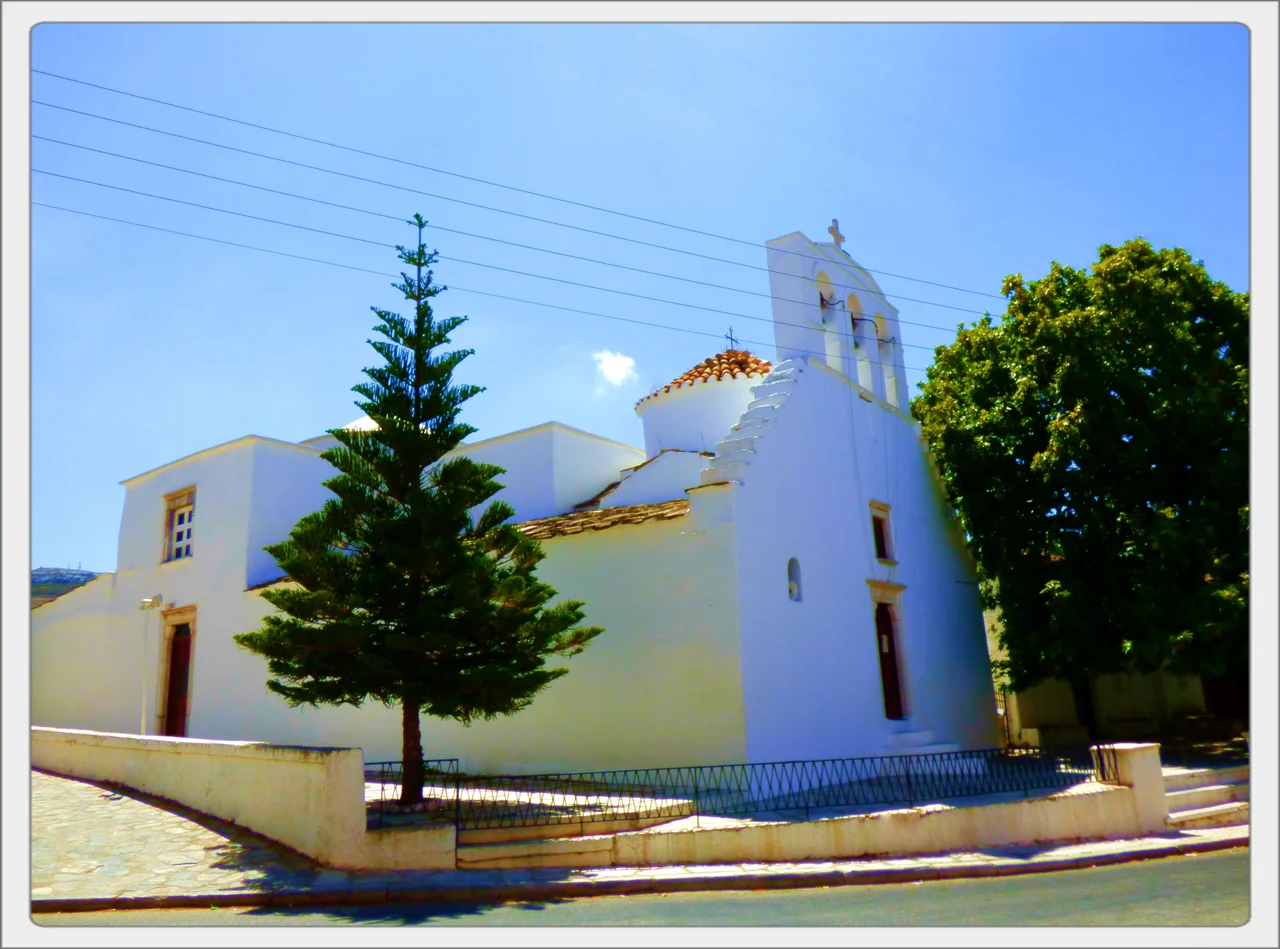

Church of Panagia Protothronos
Its name means "the Virgin of the First Throne," and the claim behind it is bold: that this was the first church built on all of Naxos. Standing in the village of Halki, in the green Tragaia valley at the island's heart, the Church of Panagia Protothronos does not look like much from the outside. Step in, and the walls tell a different story. Frescoes from seven centuries overlap and peer out from beneath one another, and the congregation that gathers here has, by tradition, never stopped, not since the year 1052.
Seven Centuries on One Wall
The interior holds five successive layers of painting, applied and overpainted across the early Christian era, the 9th century, and the 10th, 11th and 13th. During restoration, some layers were carefully detached and repositioned once the earliest was removed, so frescoes from wildly different periods now share the same space. The oldest, from the 7th century, shows apostles ringing the bottom of the sanctuary conch, with Saint Isidore beside a window. Over them, in the 9th-century Iconoclast period, painters added only crosses and ornament, no human figures, obeying an empire that had forbidden sacred images. Each layer is a frozen moment of changing faith.
A Church Older Than the Frescoes
The building itself is older than its paintings. It began life as an early Christian basilica, and from that first structure only the synthronon, the tiered bench for clergy, and the bishop's throne in the curved sanctuary still survive. In middle Byzantine times the basilica was rebuilt as a transitional cross-in-square church, the compact domed form that would define Byzantine architecture. Later a domed narthex was added at the entrance, with a small chapel dedicated to Saint Akindynos on one side and a vaulted room on the other, the church growing in stages across hundreds of years.
Names From the Year 1052
An inscription carved on a stone beam, probably once part of the templon screen, records a renovation in 1052 and names the people who paid for it: Bishop Leo, a man called Niketas who bore the imperial titles protospatharios and tourmarches of Naxia, and Count Stephen Kamilaris. A second inscription in the north chapel commemorates the passing of a woman named Anna in 1056. These are not famous names from the chronicles. They are ordinary, devout islanders, fixed in stone nearly a thousand years ago, their commission still standing exactly where they meant it to.
Still in Service
What makes Protothronos remarkable is not only its age but its continuity. While other ancient churches became ruins or museums, this one has held services without interruption since the 11th century, making it one of the oldest continuously functioning churches in Greece. Later inscriptions from the 16th and 17th centuries record still more repairs, the steady upkeep of a building people refused to abandon. To attend a service here is to join a thread of worship unbroken for nearly a thousand years, beneath the gaze of saints painted before the Crusades.
From the Air
The church stands at about 37.06 degrees N, 25.48 degrees E, in the village of Halki within the Tragaia valley in the interior of Naxos. The nearest airport is Naxos Island National Airport (LGNX) on the west coast, roughly 15 km away. From the air, Halki sits amid the green, well-watered Tragaia basin below the slopes of Mount Zas, a cluster of villages and Byzantine chapels ringed by olive groves. The interior valley is best viewed in the clear light of the dry season.
Nearby Stories
- The Big Blue 15 km away
- Italian submarine Jantina (1932) 17 km away
- Archaeological Museum of Sifnos 19 km away
- Miaouli Square 20 km away
- Astypalaia 37 km away
- Ikaria 38 km away
- Milos 49 km away
- Monastery of Saint John the Theologian 58 km away