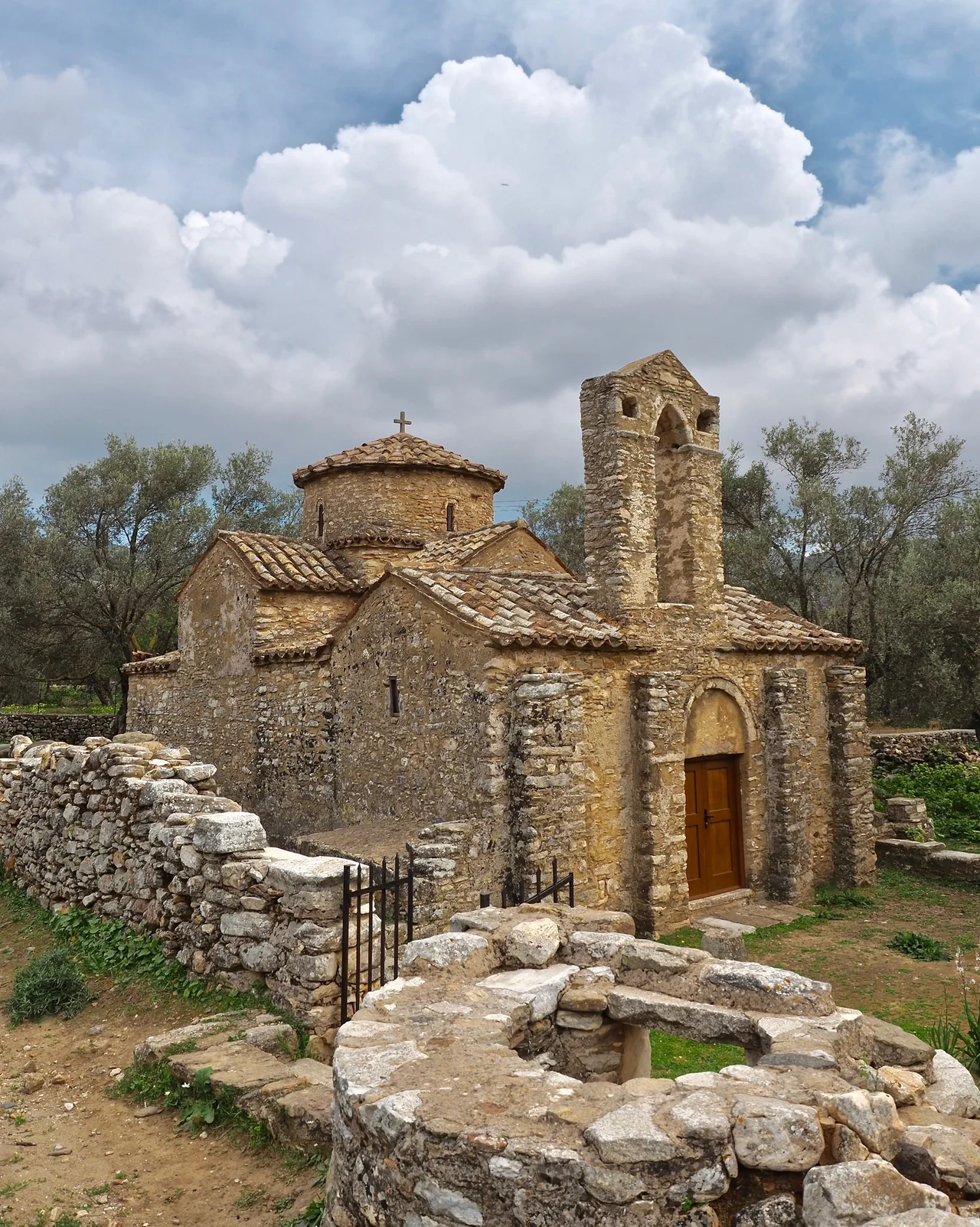

Church of Saint George Diasoritis
Push open the low door and the noise of the orchards outside falls away. Inside, the air is cool and still, and the walls are alive with faces. Saints in ochre and deep red gaze down from every surface; high in the dome, Christ Pantocrator looks back at anyone who looks up. This is the Church of Saint George Diasoritis, a modest building set among the olive and citrus groves about 600 metres from the village of Halki, in the lush central valley of Naxos. Ten minutes on foot from the road, and a thousand years back in time.
Built for the Powerful
The church went up in the 11th century, and it was no village chapel. Its makers chose the cross-in-square plan, a refined Byzantine form that is rare on Naxos, with a dome riding on four built piers and a vaulted narthex along the west side. Carved stone mouldings run the walls like horizontal ruled lines, dividing the painted surfaces into ordered registers. Into the thickness of the north and south walls, builders cut two arcosolia, arched recesses holding tombs that now lie empty. Everything about it, the architecture, the sculpture, the careful programme of images, signals that someone with means and authority wanted to be remembered here, in the heart of the island.
A Thousand Saints Looking Down
The frescoes are the reason people still make the short walk through the groves. Christ Pantocrator commands the dome, ringed by full-length figures in the drum. In the apse stand the Virgin and Child, flanked by frontal hierarchs, and below them Saint George himself, painted inside a frame like a panel icon, his parents set in roundels on either side. The cross arms carry scenes from the cycle of the Twelve Great Feasts, the Nativity, the Baptism, the Entry into Jerusalem, the Ascension, the Pentecost, the Annunciation. Along the walls march soldier-saints and martyrs. The painting belongs to the elegant, linear manner of its age, less concerned with weight and shadow than with the spiritual presence of the figures, who seem to lean out of the plaster toward the visitor.
Saint George, Again and Again
This is George's house, and the painters made sure no one forgets it. Beyond his icon-like portrait in the apse, he appears three more times across the church: in the Deesis, where he takes the place usually reserved for John the Baptist; on the vault of the northwest bay; and on the south wall of the southwest corner. Archangel Michael and John the Baptist share the place of honour, but it is George, the soldier-saint and protector, whose image multiplies. Centuries later, painters returned and laid a second layer of frescoes over parts of the apse and the lower walls in the 13th century, so that some surfaces now hold two ages of devotion, one painted over the other.
The Inscription in the Corner
The narthex was built for the dead, its tombs and its dim light given over to the theme of the Second Coming. In its southeast corner survives the church's most telling detail: a dedicatory inscription naming John the Protospatharios. The title belonged to a senior rank in the Byzantine court, and his presence here is a quiet revelation. It means this small church in the Naxian hills was tied to the machinery of the empire, that the fertile valley around Halki was an administrative centre worth controlling, a hinge between the coast and the island's interior. One carved name turns a country church into a marker of imperial reach.
Why It Still Matters
Naxos is the greenest and most fertile of the Cyclades, and its central valleys hide a remarkable density of Byzantine churches, more, by some counts, than anywhere else of comparable size in Greece. Saint George Diasoritis stands among the finest of them, prized for the completeness and quality of its painted programme. To reach it you walk a footpath between drystone walls and fruit trees, the same kind of path islanders have used for centuries. Then the door, the cool air, and the faces. For a building barely larger than a house, it carries an extraordinary weight of art, faith, and memory, all of it still here, still looking back.
From the Air
Located at 37.066°N, 25.481°E, in the central valley of Naxos near Halki (Chalki), roughly 600 m from the village among orchards at modest elevation. The site is tucked into green hill country and is not a distinct landmark from the air; navigate instead to Naxos Island National Airport (LGNX), about 12 km west-northwest on the coast near Chora, then follow the central valley inland toward Halki and Filoti. Best viewing altitude for the surrounding Tragaia valley is 2,500-4,000 ft AGL in clear morning light; afternoon haze and orographic cloud over nearby Mount Zas are common.
Nearby Stories
- The Big Blue 15 km away
- Italian submarine Jantina (1932) 17 km away
- Archaeological Museum of Sifnos 19 km away
- Miaouli Square 20 km away
- Astypalaia 37 km away
- Ikaria 38 km away
- Milos 49 km away
- Monastery of Saint John the Theologian 58 km away