_(cropped).jpg)
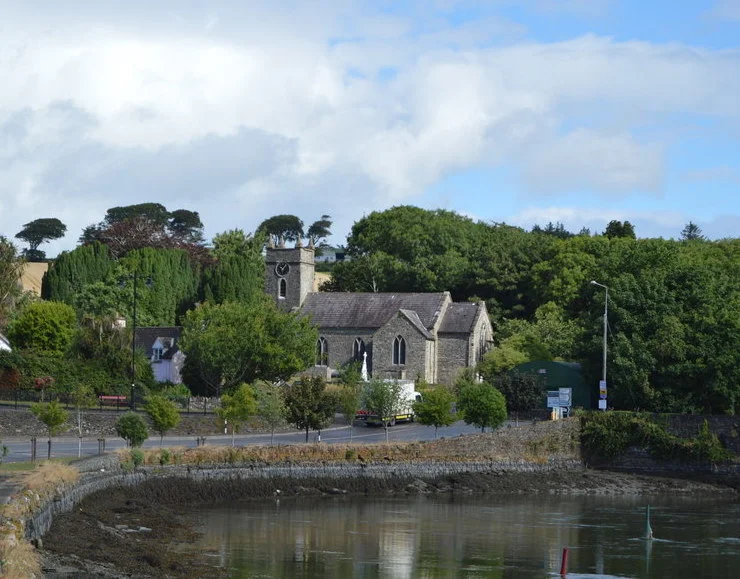
Church of the Ascension, Timoleague
From the outside, the Church of the Ascension looks like dozens of other small Church of Ireland buildings scattered across rural Ireland - rectangular, unadorned, a clock tower facing the village. Then you step inside, and Timoleague tilts toward Gwalior. Lotuses bloom on the walls. A pelican feeds her young above the chancel arch. Liver-coloured marble climbs to the dado, and above it, in mosaic tile, a Mughal-style garden unfurls beside a Star of David and a Paschal lamb. A small parish church in West Cork holds a quiet conversation with an Indian Maharaja, and has been holding it since 1925.
Built from the Old
A medieval church stood here first, still drawing congregations of around 80 in 1699. By 1802 it was unsafe, and the bishop ordered it pulled down - but with a careful instruction. The stones were to be saved and used again. Between 1810 and 1811, with a loan from the Board of First Fruits, the present church rose from the bones of its predecessor, and was consecrated on 25 May 1811. It followed the standard early-Board layout of a simple body and a western tower, though the architects added one local concession: a clock on the tower face, looking out across the village rather than toward heaven. The chancel and vestry that now anchor the building came later, between 1861 and 1863, designed by the firm of Welland & Gillespie - and the new chancel was not consecrated for a generation. Bishop John Gregg refused, calling the stained-glass Crucifixion in the east window a 'graven' image. For decades it stayed hidden behind a curtain.
A Murder in a Field
On 15 December 1832, the vicar of the parish, the Reverend Charles Ferguson, was beaten to death with a rock in a field near Bandon. His skull was so badly fractured that he was, in the words of the period, 'almost unrecognisable'. He had been collecting tithes - the mandatory church taxes the largely Catholic countryside was forced to pay to the Church of Ireland minority, and which had ignited the so-called Tithe War across rural Ireland. Ferguson's killing was never officially solved. He was one priest among many who died in those years, caught at the brutal intersection of a colonial religious settlement and a population stretched thin by famine and rent. The Church of the Ascension lost its vicar to the worst of Irish 19th-century grievance, and kept holding services.
The Maharaja's Gift
The story that draws visitors today began in India. Surgeon-General Alymer Martin Crofts, a Cork-born army doctor with family ties to Timoleague, sailed for India in 1877 and stayed thirty-seven years. There he became tutor, mentor and close friend to Madho Rao Scindia, the Maharaja of Gwalior. When Crofts died, the Maharaja wanted to honour him in the place that had shaped him. Between 1918 and 1925 he funded a second wave of mosaics for the small church in West Cork, paid for from a princely treasury halfway around the world. They join an earlier set begun in 1894 by Robert Augustus Travers, the local landowner, who commissioned mosaics for the chancel arch and then, after his wife Laura Isabel died in 1906, added Mughal-style panels of lotuses, fleurs-de-lys and paschal lamps in her memory. When Travers' son Robert Valentine died at Gallipoli in 1915 at age 22, more mosaics followed for him too. European Christian iconography and Indian Mughal motifs share these walls, designed - it is thought - by William Henry Hill, and bound together by personal grief and improbable friendship.
An Angel of Carrara
The font is carved from Carrara marble in the shape of an angel, dedicated to Alice Maud Travers - another loss the family commemorated in stone. Above the door, a painting of the Ascension shows the Apostles gathered beneath a panorama of Jerusalem, the city itself laid out behind them in careful detail. The east window, once curtained for its offence, now catches the morning light. The clock on the tower still keeps its face turned toward Main Street. In a country full of churches, the Church of the Ascension is unusual not for its architecture, which is plain by design, but for what its parishioners chose to put inside it: a record of who they loved, where they had been, and the people far away who had loved them in return.
From the Air
Located at 51.65 N, 8.76 W on the Argideen River estuary in West Cork, Ireland. Best viewed from low altitude in clear conditions; the church tower with its village-facing clock is a small but visible landmark beside the much larger Timoleague Friary ruin just across the road. Cruise altitude: 2,000-3,000 ft for orientation, lower for detail. Nearest major airport is Cork (EICK), about 25 nm to the northeast.
Nearby Stories
- Ballymaloe House 1.3 km away
- Ballincollig Castle 2.8 km away
- Skibbereen 9.8 km away
- Ballyvourney 10 km away
- Ballycotton 27 km away
- HMHS Llandovery Castle 53 km away
- Wolfpack Prien 74 km away
- SM U-27 85 km away