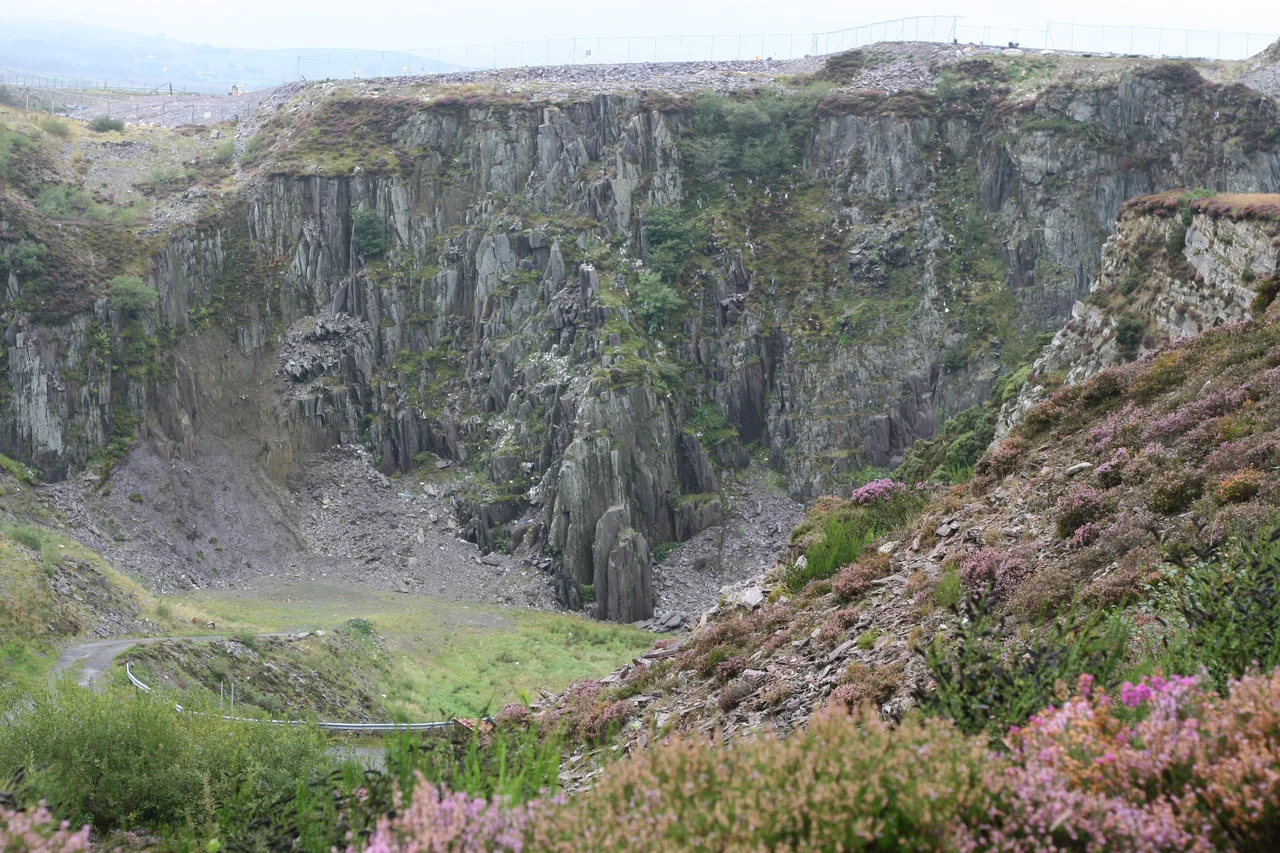

Cilgwyn Quarry
In 1842 a banker from Hertfordshire packed his bags, left the country, and abandoned a slate quarry on the north edge of the Nantlle Valley with debts of ten thousand pounds. He died in exile a year later. George Alfred Muskett was Member of Parliament for St Albans, a respected man with a respectable address, and his ruin made the quarrymen of Cilgwyn so destitute they were reduced to selling slates door to door, bypassing the company that owed them their wages. The strange thing about this episode is that it was not even close to being the most interesting thing that had ever happened at Cilgwyn - a slate workings so old that Edward I was reputed to have slept under one of its roofs.
The Oldest Slate in Britain
Cilgwyn was already in use in the twelfth century, hundreds of years before slate became a mass-market roofing product. Welsh tradition holds that during Edward I's conquest of Wales in the 1280s, the English king lodged in a house whose roof had come from this quarry - a story that may be apocryphal but neatly captures the quarry's antiquity. For most of its early centuries it operated as a scatter of small pits, worked by individual families and tied into the local economy of the Nantlle Valley. The eighteenth century saw consolidation. By 1800 a Caernarfon solicitor named John Evans had pulled the various pits together into the Cilgwyn Quarry Company, the first formal corporate structure ever applied to slate workings here.
The Banker's Folly
The corporate era was a disaster. The Cilgwyn and Cefn Du Slate Company took over the operation in the 1820s and collapsed in 1831. George Alfred Muskett, the St Albans banker and Liberal MP, then bought the quarry as an investment - a fashionable choice for the kind of speculator who saw Welsh slate as the next great industrial boom. He was right about the industry. He was wrong about everything else. By 1840 his workers had stopped getting paid, his accounts were in chaos, and his political career was over (he lost his seat in 1841). He fled abroad in 1842 owing ten thousand pounds and died a year later. A second attempt to keep the quarry running through 1843 and 1844 collapsed in turn, leaving fresh debts of twenty thousand pounds. The pits sat silent.
Three Big Pits
By the 1850s Cilgwyn was working again. Out of the dozens of small pits that had pocked the hillside emerged three big ones: Gloddfa Glitiau in the north-east, Old Cilgwyn in the west, and Veingoch in the south-east. By 1882 the quarry was producing 7,430 tons of finished slate a year - figures that put it solidly among the major Nantlle operations though always smaller than the giant Dinorwig and Penrhyn quarries up north at Bethesda and Llanberis. Steam locomotives ran along the internal tramways from 1876, hauling rough blocks to the splitting sheds. In 1923 a connection to the Welsh Highland Railway via the Bryngwyn line allowed slates to leave Cilgwyn without the awkward transshipment that had been the standard at Nantlle.
Cilgwyn the Locomotive
The diesel age came in the 1930s. A Ruston & Hornsby works number 175414, built in 1936, took up duty at Cilgwyn that year and worked the quarry's wagons until 1940. It survived - many small industrial locomotives did not - and now lives in preservation at the National Slate Museum at Llanberis under the name 'Cilgwyn', the only mechanical witness to most of a century of working at this site. In 1935 a new road down to Talysarn made the railway connection redundant, and from then on all slate left by lorry. The quarry kept going for several more decades, but it was now part of an industry in long, slow decline as concrete tiles and metal roofing ate into the markets that Welsh slate had once dominated.
The Pits Today
Stand on the north edge of the Nantlle Valley today and you look down into the wreckage of a thousand years of work. The pits hold water now. The huge spoil tips climb the hillside above them, brutally angular against the green Welsh hills - the same tips that an underwater treatment plant was eventually built to manage, after rainwater leached through them and contaminated streams below. Cilgwyn never gets the visitor traffic of the famous Penrhyn or Dinorwig sites, but it has the deeper history. Edward I may or may not have slept under its slates. Muskett certainly stole from it. The men who worked it built most of the roofs of nineteenth-century Manchester and Liverpool. The grass slowly comes back over what they left.
From the Air
53.06°N, 4.24°W on the north side of the Nantlle Valley in Gwynedd. Best viewed at 2,000-3,500 ft to make out the flooded pits and stepped spoil tips below Mynydd Cilgwyn. The Snowdon massif rises south-east; Caernarfon and the sea lie north-west. EGCK (Caernarfon) is the nearest active airport, 7 nm north.
Nearby Stories
- GeoMôn 1.9 km away
- Battle of the Conwy 3.2 km away
- Irish Sea Bridge 5.2 km away
- Ysbyty Ifan 10 km away
- Machynlleth 16 km away
- Barmouth Lifeboat Station 23 km away
- Irish Sea 27 km away
- HMS Tyler 32 km away