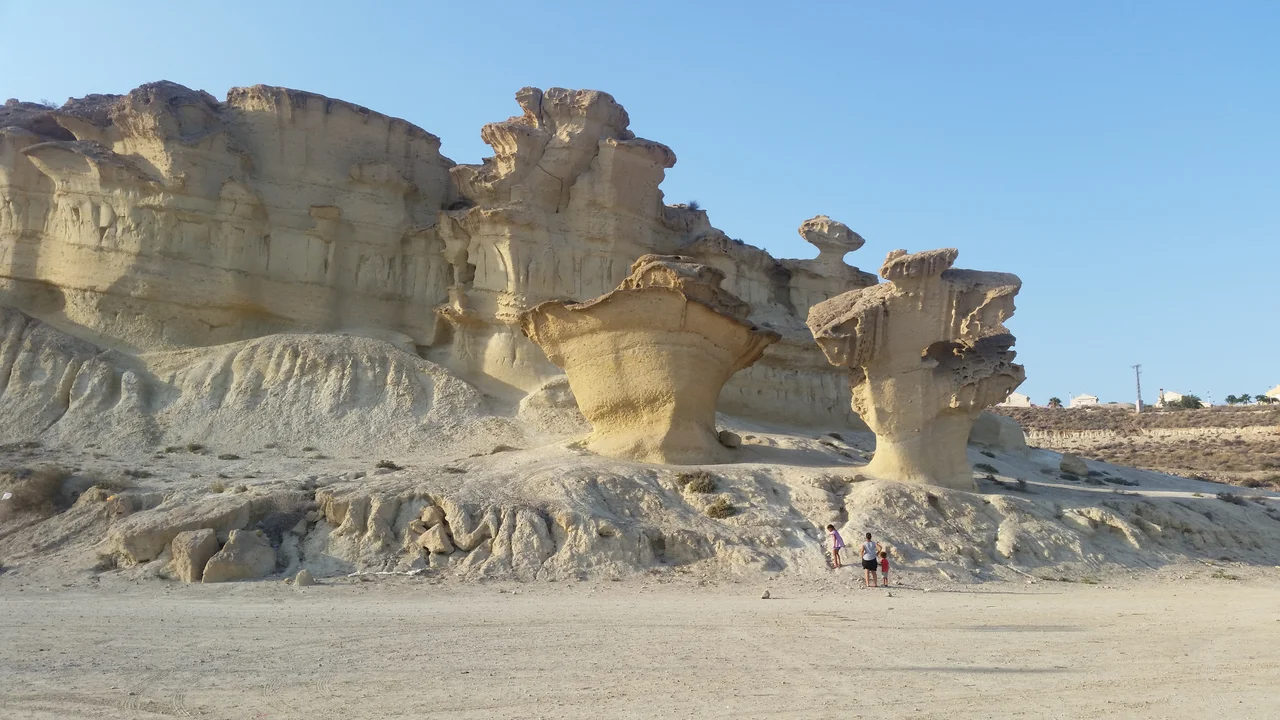

Ciudad Encantada de Bolnuevo
Walk south along the beach at Bolnuevo, past the last of the sunbathers, and the coastline turns strange. A cluster of golden towers rises straight out of the sand, each one capped by a wide, flat lid that balloons far beyond the slender column holding it up. They look carved, or half-melted, or somehow both at once. People here call the place the Ciudad Encantada, the enchanted city, and standing among these top-heavy pillars as they lean at angles that ought to send them crashing down, the name feels less like a tourist slogan than a plain description.
Shapes That Defy Gravity
There is no ruined settlement here, no lost civilization, though the silhouettes tease the eye into imagining one. What stands on this stretch of the Murcian coast, near the town of Mazarrón, is a field of sandstone formations sculpted entirely by the elements. Some rise almost vertically, thin as chimney stacks. Others spread into broad mushroom heads that seem to hover on impossibly narrow stems. The whole ensemble appears to defy the laws of gravity, which is exactly why the regional authorities protect it as a monument of natural interest. No architect drew these forms. The weather did.
Written in Yellow Clay
The material itself explains a great deal. These formations are built from gredas, a soft clay, and their warm ochre glow comes from the large amount of sand mixed through it. Look closer and the stone holds a deeper record still. The clay is packed with microfossils dating to the Pliocene, roughly 4.5 million years ago, when this coastline lay beneath a warmer, shifting sea. Every column is, in effect, a compressed page of ancient marine life, hardened and lifted into the Mediterranean sun. To touch one is to press a fingertip against a slow accumulation of vanished organisms.
The Patience of Wind and Water
Nothing here happened quickly. Over thousands of years, water and wind have worked at the exposed clay, cutting hardest where the rock is softest and sparing the more stubborn material above. What remains is the sculpture of that patient subtraction: pedestals worn thin at the waist, caps left broad on top, edges rounded by blown sand that still scours the beach on gusty afternoons. The process has not stopped. The shapes visitors photograph today are simply this moment's version, a snapshot of an ongoing erosion that will keep reshaping the enchanted city long after the current towers have crumbled and new ones have taken their place.
A City That Was Never Built
The name does half the work. Call a field of eroded clay the enchanted city and the eye obediently starts reading architecture into it, finding turrets in the caps, streets in the gaps, faces and beasts in the weathered flanks. It is hard not to give the pillars private nicknames as you pass. Yet there was never a city here and never any enchantment, only clay and wind and a great deal of time. The wonder lies precisely in the mistaking, in the moment the mind insists on a builder where there was none, before the plain truth of erosion sets it straight again.
Where the Land Meets the Sea
Context makes the spectacle sharper. The formations stand right at the edge of the beach, so the pale gold of the clay meets the blue of the Mediterranean with almost nothing between them. Families spread towels in the shadows of the pillars, and children thread through the columns as if exploring streets. Late in the day the low sun deepens the ochre to something closer to honey, and the shadows of the caps stretch long across the sand. The setting turns a geological curiosity into a place people actually live alongside, a natural monument that doubles as a seaside playground. Few coastlines fold four and a half million years of deep time so casually into an ordinary day at the beach.
From the Air
The Ciudad Encantada de Bolnuevo sits at 37.564 N, 1.313 W, on the coast just south of Puerto de Mazarran on Murcia's Costa Calida. From the air the clustered pale-gold sandstone formations read as a bright break in the darker beach and scrubland, tucked against the shoreline where the Mediterranean laps the sand. Best appreciated at lower altitudes, roughly 1,500 to 3,000 feet, in the clear, dry visibility typical of this coast. The nearest airport is Region de Murcia International at Corvera (LEMI), inland to the north; Alicante-Elche (LEAL) lies farther northeast. Use the Mazarron bay and harbor as your visual anchor and track the coast southwest to find the formations.
Nearby Stories
- Battle of Cape Palos (1815) 11 km away
- Sanctuary of Our Lady of Fuensanta 19 km away
- Torrevieja 21 km away
- German submarine U-573 36 km away
- Battle of Cape Palos (1758) 42 km away
- Cabo de Gata-Nijar Natural Park 62 km away
- Almería Cathedral 99 km away
- Battle of Las Navas de Tolosa 168 km away