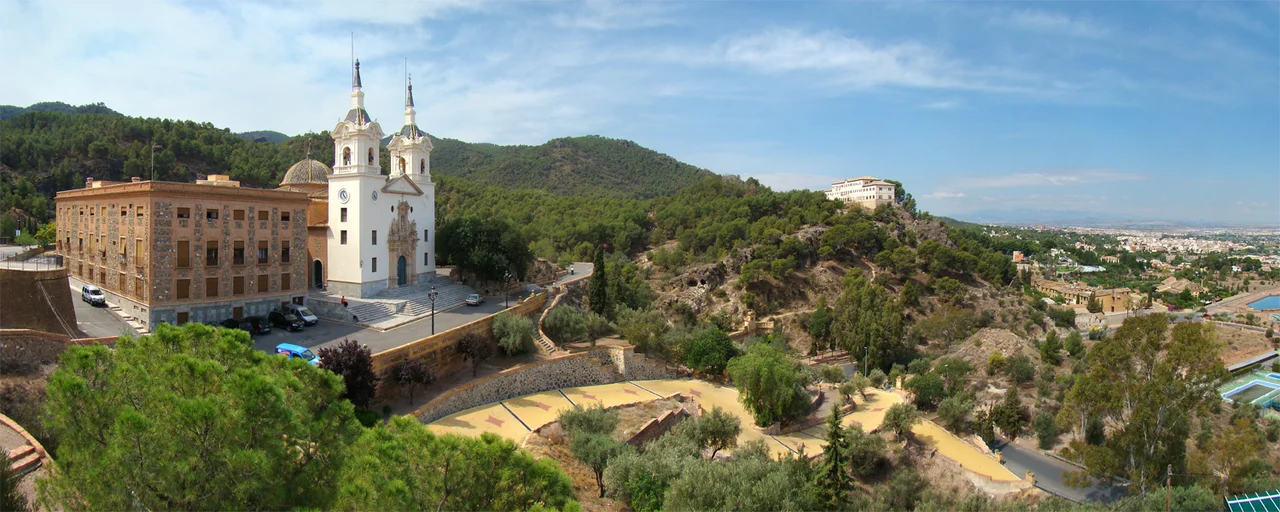

Sanctuary of Our Lady of Fuensanta
Early documents described the little hermitage that once stood here as something "between a church and a mosque" — a stone building that could not quite decide which world it belonged to, in a region where those worlds had long overlapped. That modest shrine is gone now, replaced by a grander Baroque sanctuary crowning a hill above Murcia. But the ambiguity in that old description lingers over the whole site, where a holy spring, a mountain apparition, and a Benedictine convent still share the same slope, five kilometers from the city they watch over.
Between a Church and a Mosque
The devotion came first, long before the building. Tradition traces it to an apparition of Mary on the mountain of El Hondoyuelo, an event said to have caused a holy spring, a fuente santa, to well up from the ground. That small spring still flows today. In the Middle Ages a hermitage was carved into a cave here and kept by monks, a rough and humble place of prayer. It was this cave shrine that the old documents called a thing between a church and a mosque, a phrase that captures the layered faith of medieval Murcia as neatly as any history could.
Building for the Crowds
Devotion has a way of outgrowing its buildings. By the late seventeenth century the modest hermitage could no longer hold the crowds who climbed the hill to pray, and the deteriorating structure demanded replacement. Two attempts to patch it up, in 1624 and again in 1664, came to nothing. The answer, finally, was a new church. Its facade was completed in 1705 to a design by Toribio Martinez de la Vega, dressed with reliefs and sculptures conceived by Jaime Bort and finished by Jose Balaguer. Two centuries later, in 1925, Rafael Castillo Saiz restored the sanctuary's twin towers, keeping the silhouette intact against the sky.
What War Took, and What Was Remade
The twentieth century nearly erased the interior. During the Spanish Civil War, Republican forces then controlling Murcia destroyed the inside of the sanctuary, and its original Baroque altarpiece was lost in 1936. The rebuilding that followed in the mid-century was a work of many hands. A new main altarpiece rose from the labor of Antonio Carrion Valverde and Nicolas Prados Lopez. Pedro Flores Garcia painted the dome and choir with scenes of pilgrimage and the crowning of Our Lady, while Juan Gonzalez Moreno carved ten reliefs from the life of the Virgin for the side chapels. The image of Our Lady herself, its author unknown, survived to rest again in its camarin, the small jeweled shrine at the sanctuary's heart.
Patron of the Huerta
Our Lady of Fuensanta is not a distant figure to the people below. She is the patron saint of Murcia and of its huerta, the fertile plain whose orchards and market gardens have fed the region for centuries. Twice a year, in Lent and in September, her image leaves the hill and travels down into the city, carried in procession to Murcia Cathedral and back, a rhythm of departure and return that binds the sanctuary to the farmers and townspeople who claim her as their own. To watch the pilgrimage wind along the road is to see faith and agriculture moving together, as they have here for generations.
The View from the Hill
The setting rewards the climb. The sanctuary sits in the heart of the Cordillera Sur, in the village of Algezares, on mountainous ground that flanks the Segura valley to the south and edges the protected Carrascoy and El Valle Regional Park. Around it cluster its companions: the Renaissance Fuente Santa fountain downhill, a Neo-Arabic house of the Cathedral Chapter on a neighboring rise, and a Benedictine convent whose nuns manage the shrine, linked to it by an arched passageway. From this hilltop the panorama opens over Murcia and the Segura Valley, a view so fine it draws pilgrims and sightseers alike and helps make the sanctuary one of the most visited in Spain.
From the Air
The Sanctuary of Our Lady of Fuensanta sits at 37.938 N, 1.118 W, on a hill in the Cordillera Sur above Algezares, on the southern edge of the city of Murcia. From the air it stands out as a twin-towered white sanctuary on high ground where the mountains meet the broad green Segura valley and the patchwork of the huerta. Best viewed at 2,000 to 4,000 feet, using the ridgeline of the Carrascoy and El Valle range and the river valley as guides. The nearest airport is Region de Murcia International at Corvera (LEMI), a short hop southwest; Alicante-Elche (LEAL) lies to the northeast. Clear, dry conditions are the norm, giving long sightlines across the valley.
Nearby Stories
- Phoenician shipwrecks of Mazarrón 7.2 km away
- Kingdom of Murcia 9.9 km away
- Torrevieja 11 km away
- Elche Palm Sunday Procession 14 km away
- Battle of Cape Palos (1758) 79 km away
- Cabo de Gata-Nijar Natural Park 98 km away
- Alcazaba of Almería 132 km away
- Battle of Las Navas de Tolosa 158 km away