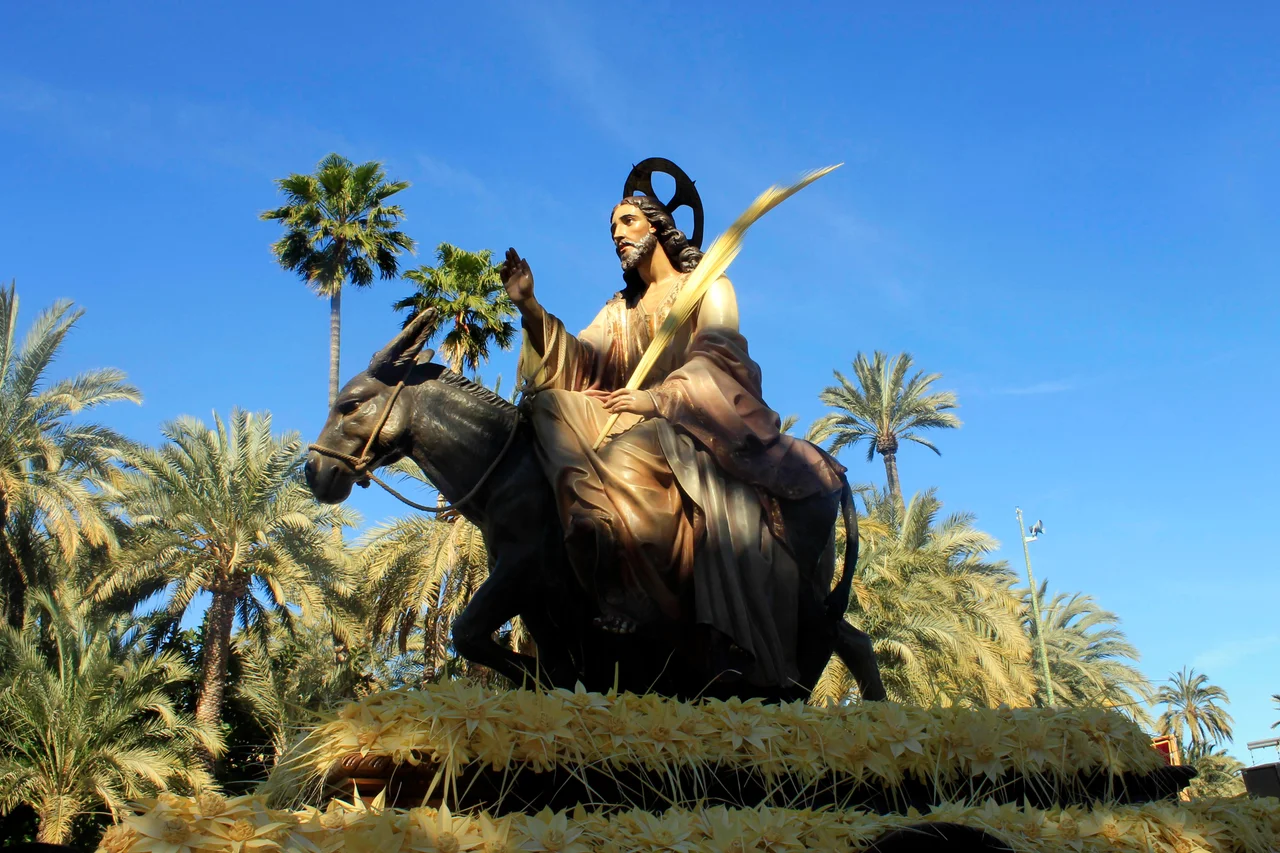

Elche Palm Sunday Procession
Most of the Christian world waves green palms on Palm Sunday. Elche waves white ones. Each spring, tens of thousands of the city's residents pour into the streets carrying pale, elaborately woven fronds, bleached to the color of old ivory, held aloft in a slow river of light that winds through the old center. They are following the pas de la burreta, the float bearing an image of Jesus entering Jerusalem on a young donkey, in a procession so distinctive that Spain has honored it as a Fiesta of International Tourist Interest. The white palm is not an import for the day. It grows a short walk away, in the great palm grove that has defined Elche since long before this procession began.
A River of White Palms
The scene has a strange, luminous quality. In place of the ordinary green frond, marchers here carry the palma blanca, the white palm, its leaves tied and shielded from the sun as they grow so they emerge pale, then split and braided by hand into curling, latticed forms that look more like lace than foliage. Whole families walk together, the palm held upright like a candle. At the heart of the crowd moves the burreta, the little donkey, on its throne, and around it surges a congregation drawn from across the city. This is not a spectacle performed for onlookers so much as a thing the town does to itself, together, on the same morning every year.
The Palm That Made a City Famous
The white palm is a craft, and in Elche it is a family inheritance. For generations, particular artisan families have tended the palms, coaxed them pale, and woven them into the intricate shapes that make an Elche palm instantly recognizable across Spain. Every frond in the procession is sourced from the Palmeral de Elche, the vast grove of date palms that surrounds and threads through the city, the largest of its kind in Europe and a UNESCO World Heritage Site. The link between the grove and the ritual is old and documented: references to the trade in white palm appear in the records of the local Cathedral Chapter as early as 1429. The tree and the faith grew up together here.
Six Centuries in the Street
This is no revival or invention for tourists. The earliest record of the celebration reaches back to 1371, when the Consell de la Vila, the town council, joined the festivities by distributing alms to the poor. From that medieval beginning the procession has carried forward, generation handing it to generation, through plague and war and the slow transformation of Elche from a walled town into a modern industrial city. That continuity is itself part of the meaning. When a family walks with a white palm today, they are repeating a gesture their ancestors made on these same streets more than six hundred years ago.
The Brotherhood and the Donkey
Every enduring tradition needs keepers, and this one nearly slipped before being caught. The brotherhood that organizes the procession was reorganized in 1941 by a man named Vicente Serrano, whose own factory workers first shouldered the throne and its sacred images through the streets. Responsibility later passed to Roberto Casanova, and eventually to the Major Board of Brotherhoods and Confraternities that governs Elche's Holy Week today. The central image, Our Lord Triumphant Jesus in His Triumphal Entry into Jerusalem, came from the renowned religious sculpture workshops of Olot in Catalonia, and it fixes a single tender moment: not the suffering to come, but the hopeful arrival, a man on a small donkey greeted with palms.
From the Air
The procession fills the historic center of Elche, at 38.267°N, 0.698°W, on the coastal plain of southern Alicante province. From the air, Elche is unmistakable for the dense green sea of the Palmeral, hundreds of thousands of date palms woven through and around the city, an oasis-like canopy found nowhere else in Europe on this scale. The Vinalopó River threads through the town, and the twin-towered blue-domed Basilica of Santa María rises from the old center where the Palm Sunday procession converges. Recommended viewing altitude 3,000-6,000 ft AGL to take in the city set within its palm forest. Alicante-Elche Airport (LEAL) sits just a few kilometers east, so Elche and its palm grove are often visible on approach; Región de Murcia International (LEMI) lies to the southwest. The region's clear light offers frequent excellent visibility.
Nearby Stories
- Cresta del Gallo 1.5 km away
- Canelobre Cave 10 km away
- La Muralla Roja 16 km away
- Kingdom of Murcia 25 km away
- San Pedro del Pinatar 27 km away
- Monte Arabí 30 km away
- Penyal d'Ifac Natural Park 45 km away
- Battle of Cape Cherchell 228 km away