
Phoenician shipwrecks of Mazarrón
La Playa de la Isla is known for calm water, which is precisely why two Phoenician ships lie beneath it. Sometime in the late seventh century BC, a rare storm caught them close to shore, drove them under, and buried them in sand before their crews could salvage the cargo. The sand that stranded that cargo also sealed it. For roughly 2,600 years the wrecks lay undisturbed off Mazarrón, on the coast of Spain's Region of Murcia, until the construction of a marina in 1988 shifted the currents and the sea began to peel back its cover, exposing ancient timber that should not have survived at all.
The Sand That Kept Its Secret
Archaeologists surveying the seabed near the Isla del Puerto in 1988 found what the new marina had uncovered: waterlogged wooden structures, protected for millennia beneath a layer of dead Posidonia oceanica, the Mediterranean tapeweed whose matted fibers had shielded them from decay. Under the direction of archaeologist Juan Pinedo Reyes, fieldwork at Playa de la Isla ran from 1988 to 1995. In July 1991 the team identified the first vessel, Mazarrón I, resting barely fifty meters from shore in just two and a half meters of water. It had lain there so long, and so completely swallowed by sediment, that the timbers still held their shape. The hull was recovered in 1995 and now sits in the National Museum of Subaquatic Archaeology in Cartagena, a short way up the coast.
Sewn and Pegged
What makes these ships remarkable is how they were held together. Mazarrón I combined two very different techniques in a single hull. Some planks were joined with pegged mortise-and-tenon joints, a hallmark of Phoenician carpentry, while others were literally stitched, laced with thin ropes of esparto grass through thousands of drilled holes. The keel, nearly four meters long, was cut from Mediterranean cypress and connected to the stem by a precise T-shaped scarf. The frames were rough cylinders of fig wood, and pine tar sealed the hull inside and out. This blend of pegging and sewing points to a boat built in Iberia itself, where Phoenician shipwrights and local hands worked side by side. Small and shallow-drafted, driven by a square sail and oars, Mazarrón I could carry up to four tonnes and hug the coast rather than brave the open sea.
The Most Complete Ship of Its Age
If Mazarrón I was a fragment, Mazarrón II was a miracle. Discovered in 1994, it survived nearly whole from bow to stern, roughly eight meters of hull, the most complete ancient ship yet recovered anywhere. Its fig-wood frames were sewn together with plant fiber; its pine planking was pinned with dowels and caulked with fiber. For years it stayed on the seabed under a protective steel cover installed in 2000, studied where it lay. Only in 2021 did Spain's Ministry of Culture approve raising it, a delicate operation carried out with UNESCO and the University of Valencia and led by Agustín Ángel Diez Castillo and underwater archaeologist Carlos de Juan Fuertes. As Fuertes warned, the sand that had protected the wreck for centuries was finally slipping away. The lift began on 13 September 2024 and finished on 7 November, ending the ship's long wait on the bottom.
A Cargo of Silver and Everyday Life
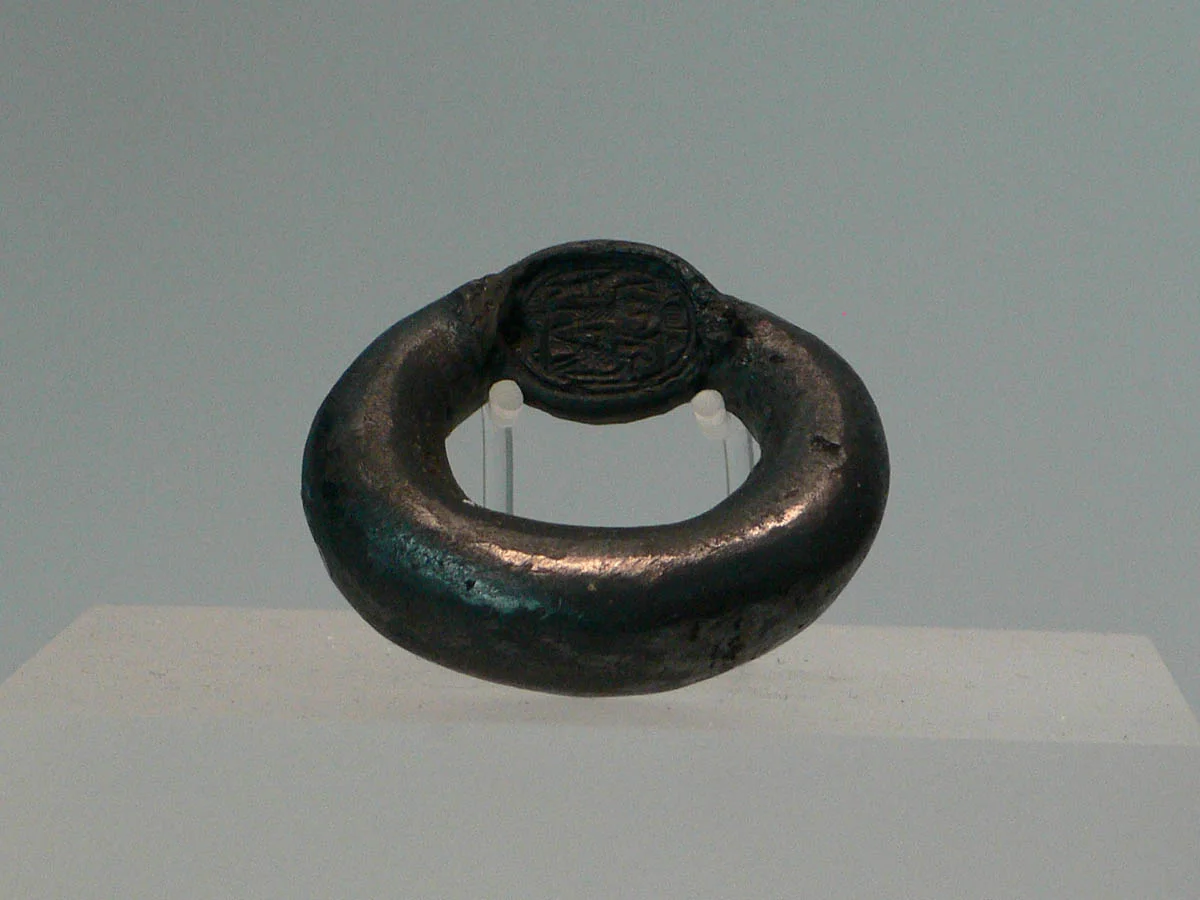
The ships carried wealth in a heavy, unglamorous form: litharge, the lead-rich blocks used to refine silver, of which 2,820 kilograms were recovered from Mazarrón II alone. Around the cargo lay the debris of ordinary life at sea, more than 7,300 Phoenician pottery fragments, a silver scarab, a spearhead of rare Atlantic Bronze Age metalwork, a hand mill, animal bones, and an esparto basket with its wooden handle still attached. Most extraordinary was the anchor, made of wood and lead, the first of its kind ever found. Together the wrecks fill a gap in the map of Phoenician trade, marking an intermediate stop between the settlements of Ibiza and Villaricos, and they now anchor the collection at the museum in Cartagena, while an interpretation center in Mazarrón's own port has told their story since 2009.
From the Air
The wreck site lies underwater off Playa de la Isla at 37.559°N, 1.268°W, so from the air the marker is the town and port of Mazarrón cradled in its shallow bay, with the small Isla del Puerto just offshore. Fly it at 2,500–4,000 ft for a clear read of the coastline and the marina whose construction first exposed the ships. The nearest airport is Región de Murcia International (Corvera, LEMI), about 30 km northeast; Alicante–Elche (LEAL) lies further north. The recovered hulls and cargo are on display roughly 35 km east at the museum in Cartagena. Coastal haze is common on summer afternoons, so the clearest light is early morning.
Nearby Stories
- Battle of Cape Palos (1815) 11 km away
- Sanctuary of Our Lady of Fuensanta 19 km away
- Torrevieja 21 km away
- German submarine U-573 36 km away
- Battle of Cape Palos (1758) 42 km away
- Cabo de Gata-Nijar Natural Park 62 km away
- Almería Cathedral 99 km away
- Battle of Las Navas de Tolosa 168 km away