
Clare Castle
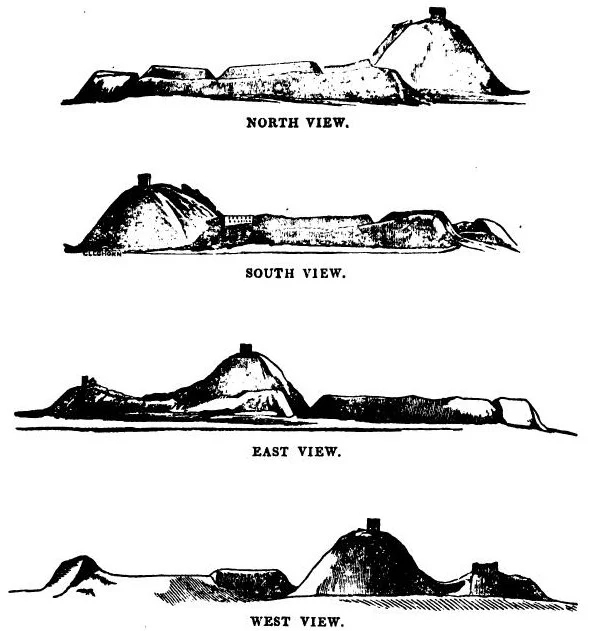
The motte at Clare Castle is 100 feet tall and 850 feet wide at its base. That is not unusual for a Norman earthwork. What is unusual is the train. In 1865, the Stour Valley line of the Great Eastern Railway was built directly through the castle — cutting across and largely destroying the inner bailey to make room for a new station. When the railway was itself closed in 1967, the tracks were removed, leaving behind a castle that had survived six centuries of medieval politics only to be bisected by the Industrial Revolution. What stands today in the public park at Clare is a landscape with layers: Norman earthworks, medieval stonework, Victorian ghost lines, and the quiet of a small Suffolk town.
Built to Declare Power
Richard Fitz Gilbert received the barony of Clare from William the Conqueror after 1066, along with large blocks of land in Kent and Suffolk. He built Tonbridge Castle first, then came to Suffolk and built Clare. The exact date of construction is unknown, though documentary records confirm the castle's existence by 1090. Its design — a motte and bailey with two baileys rather than the customary one — reflected the scale of the barony. The castle was built on the site of a former Anglo-Saxon manor house, a deliberate choice: Norman authority was most visible when it literally replaced what had been there before. Historian Robert Liddiard observes that Clare Castle served not only as a defensive installation but as a statement of rank and dignity. The three deer parks surrounding it, including the Great Park at Hundon established by 1090, made the statement physical. The castle was the capital of a significant territory.
Elizabeth de Clare's Household
By the early fourteenth century, Clare Castle had become the centre of one of the most sophisticated households in England. Elizabeth de Clare acquired the castle in 1314, after her brother Gilbert de Clare — the 8th Earl of Gloucester — died at the Battle of Bannockburn. Her husband had died the previous year. The combined inheritance made her one of the wealthiest women in England, with an income of approximately £3,500 a year. Most of it was spent on her household at Clare. Over £1,750 annually went to food and drink: swans, salmon, and German wines. The castle's bakers could produce up to 2,360 loaves of bread a day; around 900 gallons of ale were brewed every five days. Her staff included falconers, tailors, chaplains, and goldsmiths, supported by 30 knights and squires. The castle had four stone towers protecting the entrance to the inner bailey, each with its own name: Auditorstower, Maidenstower, Constabletower, and Oxfordtower. A water garden and vineyard completed the estate. Clare under Elizabeth was not a military fortification. It was a statement of civilised power.
Decline and Disruption
After Elizabeth de Clare's death, the castle passed through marriage to the royal house — to Lionel of Antwerp, son of Edward III — and then to the Mortimers. By 1405, when Sir Edmund Mortimer acquired it, contemporaries reported it "in good repair and stocked." The masonry then quietly deteriorated over the following two centuries, its stone probably stripped for use as local building material, as this part of England was traditionally short of suitable stone. By 1600 the castle was disused. What the medieval decades could not accomplish, Victorian engineering managed in a season: the Great Eastern Railway cut the inner bailey in half. The railway closed as part of the Beeching Axe in 1967, and its tracks were pulled up — but the scar of the cutting remains in the landscape, a peculiar monument to a different kind of ambition.
What Remains
The ruins at Clare today consist of the unusually tall earthen motte — one of the most dramatic surviving examples in England — surmounted by remnants of the shell keep wall and the round tower. Fragments of the inner bailey's stone wall are still visible. In 2014, English Heritage assisted with extensive consolidation of the keep and curtain wall. The following year, the stewardship of the park transferred from Suffolk County Council to Clare Town Council, which now manages it with the support of local volunteers. The site is protected as a scheduled monument and Grade II* listed building. Visitors enter a public park, walk the outer earthworks, and look up at a motte that has been standing for nearly a thousand years — and at a railway ghost cutting that has been standing for about one hundred and sixty.
From the Air
Clare Castle is located at 52.077°N, 0.582°E in the market town of Clare, Suffolk. The motte is the most prominent feature visible from altitude — a distinctive conical earthwork rising above the surrounding parkland and town. The River Stour runs nearby to the south. Nearest airports: Cambridge (EGSC) approximately 25 miles northwest; Stansted (EGSS) approximately 20 miles south.
Nearby Stories
- RAF Lakenheath 3.5 km away
- Needham Market 3.6 km away
- St Osyth's Priory 6.4 km away
- Pleshey Castle 9.7 km away
- Bourn Windmill 11 km away
- Welwyn Tunnel rail crash 13 km away
- Norfolk Tank Museum 16 km away
- Connington South Rail Crash 17 km away