
Claudy bombing
A nine-year-old girl named Kathryn Eakin was cleaning the front window of her father's grocery shop on Main Street in Claudy when the first car bomb went off about ten yards from where she stood. She died there on the pavement. The village pub next door, McElhinney's, was blown apart at almost the same instant. Within minutes a second bomb tore through Main Street and a third bomb destroyed Church Street as people fled toward what they had thought was safer ground. Nine people were dead by mid-morning, thirty more were wounded, and a small market village of barely a thousand people had been turned into one of the worst single atrocities of the Troubles. Claudy locals call it Bloody Monday. The bombers tried to phone in a warning. The telephones were out of order because of an earlier bomb.
Operation Motorman
Earlier the same day, at four o'clock in the morning, the British Army had launched Operation Motorman to retake the no-go areas of Belfast and Derry that had been controlled by the IRA since the previous summer. Bulldozers cleared barricades. Soldiers occupied the Bogside and the Creggan. The Free Derry experiment, which had survived in some form since the August riots of 1969, was over by breakfast time. The Provisional IRA had been outflanked militarily and humiliated politically; its leadership had to be seen to respond. The Claudy car bombs went off at about ten past ten in the morning. The IRA never officially admitted responsibility, and its chief of staff Seán Mac Stíofáin initially said an internal inquiry had found local volunteers not involved. Decades later, in December 2002, the organisation finally acknowledged that an IRA unit had carried out the bombings.
The Nine
Three of those killed at Claudy were children. Kathryn Eakin, nine, killed by the first bomb outside her father's shop. Patrick Connolly, fifteen. William Temple, sixteen. Six adults died with them: Joseph McCloskey, James McClelland, Elizabeth McElhinney, Rose McLaughlin, David Miller, and Arthur Hone. They were Protestant and Catholic, working in the village or visiting. They were people doing the most ordinary things on the most ordinary kind of morning. McElhinney's pub was destroyed; the post office was destroyed; vehicles on Main Street were shredded; windows were blown out for hundreds of yards in both directions. Thirty more people were wounded, some severely. In a village of about a thousand residents, almost no family was untouched. The dead were buried within the week. The wounded were treated and went home. The conversations in the village about who could have done such a thing took longer to end.
A Priest Under Suspicion
Within days of the bombing, the RUC began to suspect that a Roman Catholic priest, Father James Chesney, parish priest at Bellaghy in County Londonderry, was the IRA's quartermaster and director of operations for South Derry. The investigation became a problem for the British state almost as soon as it began. In the first week of August 1972 detectives arrested a suspect, Man A, whose car matched the description of a vehicle used by those attempting to phone in the warning. He produced an alibi: he had been at Father Chesney's house in Bellaghy. The priest and another person corroborated the alibi. The suspect was released. The following month, when Chesney was stopped at a police checkpoint, a sniffer dog detected traces of explosives in his car. RUC officers concluded that the alibi had been pre-arranged, that Man A had been part of the bombing team, and that Chesney himself had played a senior operational role.
A Deal in the Dark
What happened next, the Police Ombudsman for Northern Ireland confirmed in a report published on 24 August 2010, was a deliberate cover-up by police, government, and the Catholic Church. Senior politicians, briefed on the suspicions against Chesney, decided that arresting a Catholic priest for mass murder in the summer of 1972, with sectarian killings already at the brink of civil war, would tip the province into something worse. A deal was therefore arranged behind closed doors to remove Fr Chesney from the province. Cardinal William Conway, the Catholic Primate of Ireland, discussed the matter with Northern Ireland Secretary William Whitelaw. Chesney was transferred to a parish in Donegal, in the Republic of Ireland, across the border and out of British jurisdiction. He never faced charges. He died of cancer in 1980. The Ombudsman called the handling of the case a collusion in the worst sense. Whether a Catholic prosecutor would have charged him with the evidence available remains an open question, but he was never given the chance.
What the Village Holds
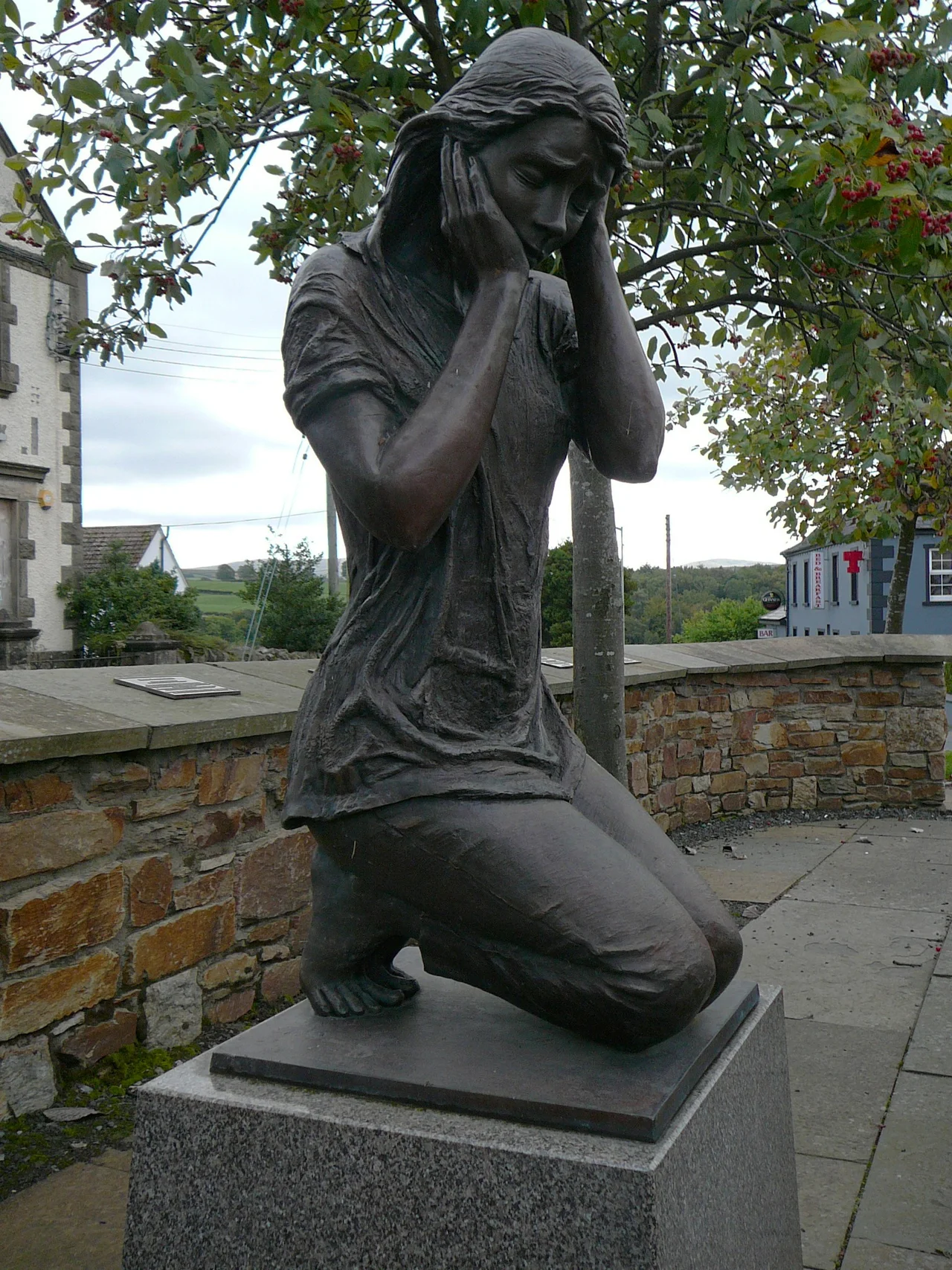
Claudy is still a small village in the lee of the Sperrin Mountains, with a Main Street and a Church Street and shops along both. A memorial statue, The Hand of Friendship, was unveiled to mark the dead in 2000; vandals knocked it from its plinth in 2006, and it was restored. On the fortieth anniversary of the bombing, in 2012, the former IRA leader and by then Northern Ireland Deputy First Minister Martin McGuinness called the events of that day appalling and indefensible and inflicted on totally innocent people. No one has ever been convicted. Of the nine families, several have spent five decades arguing for a fuller investigation, a fresh inquest, a public acknowledgement that the IRA, the security forces, the government, and the Catholic Church all bear some share of the responsibility for what happened or for what was not done afterward. The village remembers, every July, with a quiet service. Kathryn Eakin's father lived another twenty-five years after his daughter died. He kept the shop open until almost the end.
From the Air
Claudy sits at roughly 54.91 degrees north, 7.15 degrees west, in the Faughan valley about 14 km southeast of Derry in County Londonderry. From the air look for the small village along the B40 between Derry and the Sperrin Mountains, with the wooded hills of the Sperrins rising to the south. The nearest controlled airport is City of Derry (EGAE) about 12 km northwest; Belfast International (EGAA) lies roughly 85 km east. Donegal Airport (EIDL) is about 60 km west across the border. From cruise the valley of the Faughan River and the gentle climb toward the Sperrins make the area immediately recognisable, with Derry and Lough Foyle visible to the north on clear days.
Nearby Stories
- Portrush Lifeboat Station 1.9 km away
- Main Street, Letterkenny 2.1 km away
- Inishowen 6 km away
- Rosguill 6.3 km away
- County Tyrone 7.1 km away
- St Patrick's College, Maghera 9.6 km away
- St Patrick's Purgatory 11 km away
- Coalisland Canal 17 km away