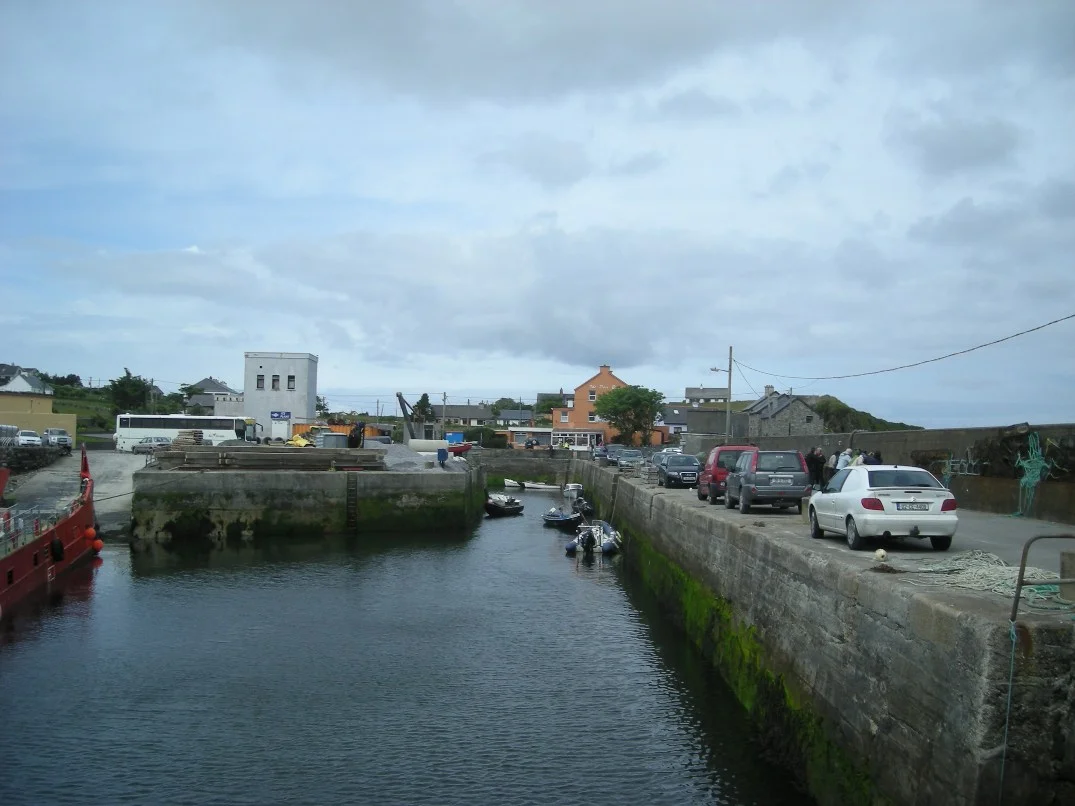

Cleggan
An Cloigeann means head or skull - most likely a reference to the coastal headland that gives the harbor its shape. The other story is older and stranger. St. Ceannanach, a missionary in early Christian Connemara, was beheaded by a pagan chief who then - according to local lore - picked up the saint's head, carried it to the Holy Well at Clooncree, washed it carefully, lay down beside it, and died. The chief presumably had his reasons. The village that grew up around the headland kept the name. Today Cleggan is a small Connemara fishing village, the ferry port for Inishbofin, the western terminus of buses from Galway, and the place where, almost a century ago, the Atlantic broke a community in a single night.
Nimmo's Pier
The Scottish engineer Alexander Nimmo arrived in Connemara in 1822. He had been sent at the request of the Clifden landlord John D'Arcy after the potato crop failed in 1821-22 and famine relief required new infrastructure. Nimmo would spend the next decade designing piers, roads, and bridges across the west of Ireland - more than thirty harbors bear his hand. He built the Cleggan pier the same year, opening the village to regular trade with the islands and easier movement of fish to market. The pier was extended in 1908. It is still the focal point of the village. Above the harbor, at the top of Cleggan Head, are the remains of a watchtower built during the Napoleonic Wars when Britain feared a French landing on the west of Ireland.
The Night of 28 October 1927
Twenty-five men were out in the bay that evening, fishing for mackerel by hand-line from currachs - the small canvas-and-tar boats that had carried Connemara fishermen for centuries. The gale rose without warning and from the worst quarter. They could not run before it. They could not turn into it. The neighboring village of Rossadilisk lost sixteen of its men that night - a community already small enough that the loss of sixteen breadwinners ended it. Within a few years the place was abandoned. Nine men from Inishbofin and twenty from County Mayo also died. International aid came in from the United Kingdom, the United States, and Australia, but no amount of money could restore families. The Cleggan poet Marie Feeney later wrote a book about the disaster. The Connemara poet Richard Murphy, who lived for years on Inishbofin and Omey Island, included 'The Cleggan Disaster' in his 1963 collection Sailing to an Island. A 2013 TG4 documentary, An Báthadh Mór - The Great Drowning - retold the story in Irish for a new generation.
The Bog and the Bones
Outside the village the landscape is dominated by blanket bog - the spongy, water-saturated, acidic vegetation cover that forms across much of the Connemara lowlands wherever rainfall exceeds drainage. Few plants tolerate that soil chemistry, but those that do produce a vegetation found almost nowhere outside Ireland: bog cotton, bog asphodel, sundews, sphagnum mosses. The bog is also an excellent preservative. Near Cleggan are scattered prehistoric monuments - tombs, standing stones, walls - some of them buried for millennia under peat that grew over them. The bones beneath are older than the saints. The names beneath are older still.
Village Today
Cleggan's traditional economy was fishing supplemented by farming on land that fought back. Fishing remains an important industry, joined now by tourism: the village has four bars, a grocer, a sit-down restaurant, a seasonal takeaway, and the ferry that runs twice a day across to Inishbofin. The crossing takes thirty minutes. The poet Micheál Mac Suibhne (1760-1842), who composed his work in Connacht Irish, lived in the area. The PR consultant James Morrissey, spokesperson for Denis O'Brien, has a house here. On a clear evening with the wind off the bay you can stand on Nimmo's pier and watch the ferry coming in from Inishbofin, the same passage the fishermen rowed on the night of 28 October 1927.
From the Air
53.5500 N, 10.1167 W, on the head of Cleggan Bay in northwest Connemara. From the air the village is a small cluster of houses around a sheltered inlet, with the bay opening westward toward Inishbofin and the open Atlantic. The Twelve Bens rise to the southeast. Connemara Regional Airport (EICA) at Inverin lies about 60 km southeast. The ferry pier extends from the village northwest into the bay. Look for the watchtower ruin on the high ground above the harbor. Atlantic weather dominates - Cleggan Bay can shift from calm to dangerous within an hour. The runway at Cloon, just east of Cleggan, was built in 2008 as part of the abandoned Inishbofin air link project; assigned the code EICD, it has never opened for traffic.
Nearby Stories
- Clare Island Abbey 2.1 km away
- Lough Mask Murders 3.7 km away
- RMS Carinthia (1925) 9.4 km away
- Battle of Castlebar 15 km away
- The Burren 23 km away
- Inishmore 25 km away
- Action of 7 May 1794 73 km away
- Inishtooskert 155 km away