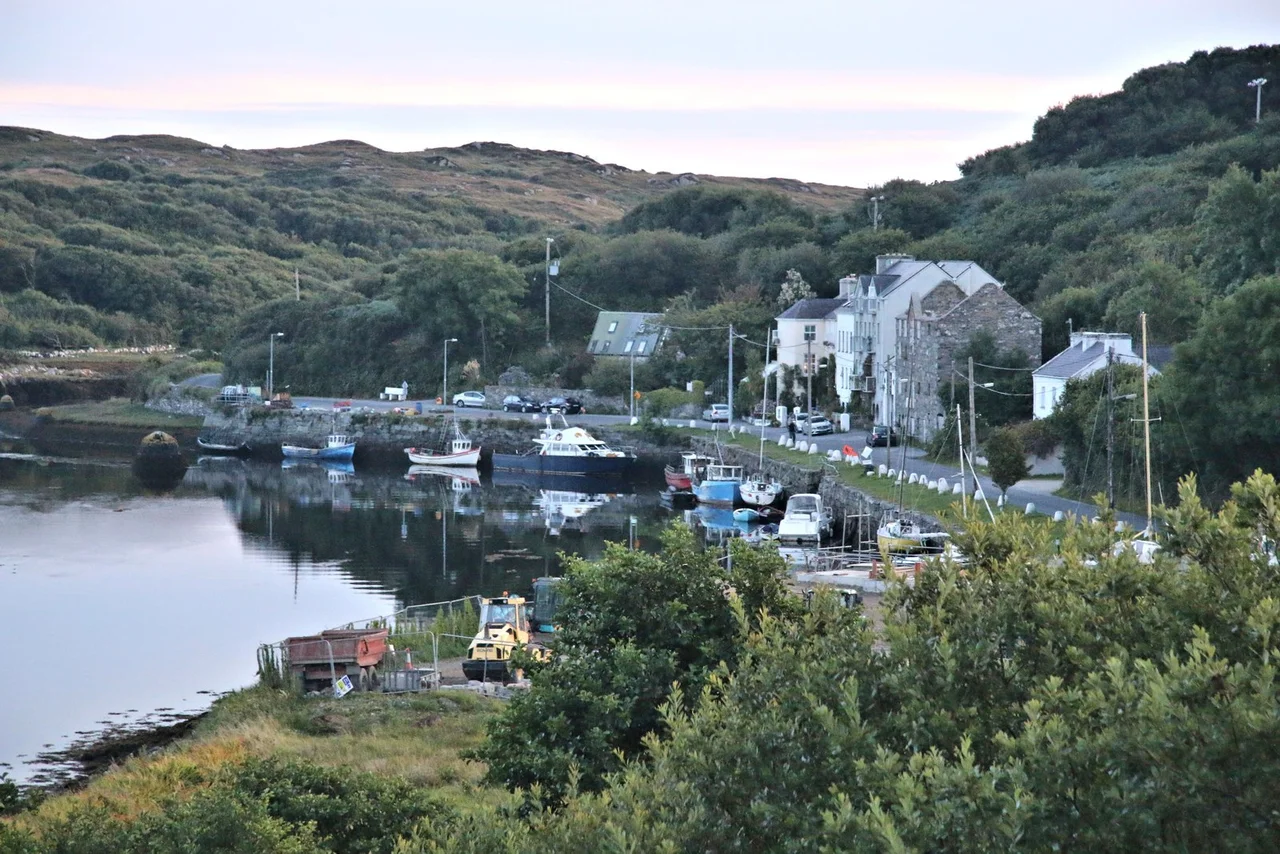

Clifden Lifeboat Station
Walk down The Quay in Clifden on a winter morning and you can see the lifeboat house with its slipway angling down toward the Owenglin River where it meets Clifden Bay. Inside, the 13-43 St Christopher sits ready - a Shannon-class all-weather lifeboat, 2.4 million euros' worth of orange-and-blue Atlantic muscle, with ten thousand engraved names threaded through the digits of its hull number. Each name represents a donor or a remembered loved one. The boat has been on this station since 2022. It is the latest answer to a problem the Atlantic has been posing on this coast for at least two centuries: when the storms come and a vessel goes down, who goes out to bring back the crew?
Charles Mills, March 1847
On 20 March 1847, in the worst year of the Great Famine, the brig Halifax was driven ashore from her anchorage in Ardbear Bay just south of Clifden. She was on passage from Peru to Cork with a master and sixteen crew. The Royal National Lifeboat Institution did not yet exist in its modern form - it was still the Royal National Institution for the Preservation of Life from Shipwreck, founded in 1824 and renamed the RNLI in 1854. Charles Mills, chief boatman of the local H.M. Coastguard station, put off in a small boat with four other men. They made three trips through the surf. They brought every man on the Halifax back alive. Mills received the RNIPLS Silver Medal. He had no lifeboat. He had a coastguard rowing boat, four colleagues, and the conviction that those seventeen lives were worth the risk of his own. It would be another 141 years before Clifden had a permanent lifeboat station of its own.
1988: A Single Inflatable
The RNLI placed its first lifeboat at Clifden on 15 March 1988, on a one-year evaluation period. It was an Atlantic 21 - a development of the rigid-inflatable design first introduced in 1963, but with two engines giving a higher top speed. The boat was towed on a trailer by the station's Land Rover and could be launched from any suitable point along the coast. The trial worked. The station was made permanent in March 1989. Like many inshore stations at the time, it was initially operational only during the summer months. In 1992 a residential building on The Quay was demolished, providing space to build a proper station house with workshop and crew facilities. The crew, then as now, were volunteers - working day jobs and waiting on pagers.
The All-Weather Decision
The waters off Clifden are some of the most exposed on the Irish west coast. The Atlantic comes in unbroken from Newfoundland. The seas between the mainland and the offshore islands - Inishbofin, Inishshark, Inishturk South, Omey - are strewn with submerged rocks and tide races. An inflatable, however fast, can do only so much in those conditions. After a coastal review, the RNLI placed an all-weather lifeboat on station for a one-year trial in 2014: the 22-year-old 12-27 Pride and Spirit. The trial became permanent. A succession of temporary all-weather boats followed - the 12-33 Fisherman's Friend in 2016, the state-of-the-art 13-21 Brianne Aldington from 2019 - while Clifden waited for its own. Meanwhile, the inshore lifeboat that had served the station since 2013 received a name change: the Gráinne Uaile was replaced in 2017 by the Celia Mary, donated by Mr Peter Ross in memory of his late wife.
Ten Thousand Names
The permanent all-weather lifeboat arrived on 15 May 2022. Even on its passage to Ireland it took its first call - escorting a fishing vessel into Newlyn after responding to a coastguard alert. It had been funded in two parts. The first was the legacy of a man named Christopher Harris. The second was the RNLI's Launch-a-Memory campaign, in which donors paid to have a name engraved within the digits of the boat's hull number. Ten thousand names. Loved ones. Donors. People remembered. At a ceremony on Saturday 22 April 2023, Phillipa Harris - Christopher's daughter - formally handed the boat to the crew, who named it 13-43 St Christopher. When it launches now, it carries them all out into the swell.
From the Air
53.4860 N, 10.0297 W, on The Quay at Clifden where the Owenglin River meets Clifden Bay. The lifeboat house has a slipway leading directly into the river channel. From the air look for the Sky Road circling the peninsula west of Clifden town, the distinctive shape of Clifden Bay opening to the southwest, and the ruined Clifden Castle on the north shore. Connemara Regional Airport (EICA) at Inverin is about 45 km southeast. Shannon Airport (EINN) lies 110 km south. The seas in this area are notoriously difficult - tide races between Inishturk South and Omey to the north, rocks and shallow channels approaching Slyne Head Lighthouse to the southwest. Best visibility in winter high-pressure conditions; summer brings Atlantic fog and low cloud.
Nearby Stories
- Clare Island Abbey 2.1 km away
- Lough Mask Murders 3.7 km away
- RMS Carinthia (1925) 9.4 km away
- Battle of Castlebar 15 km away
- The Burren 23 km away
- Inishmore 25 km away
- Action of 7 May 1794 73 km away
- Inishtooskert 155 km away