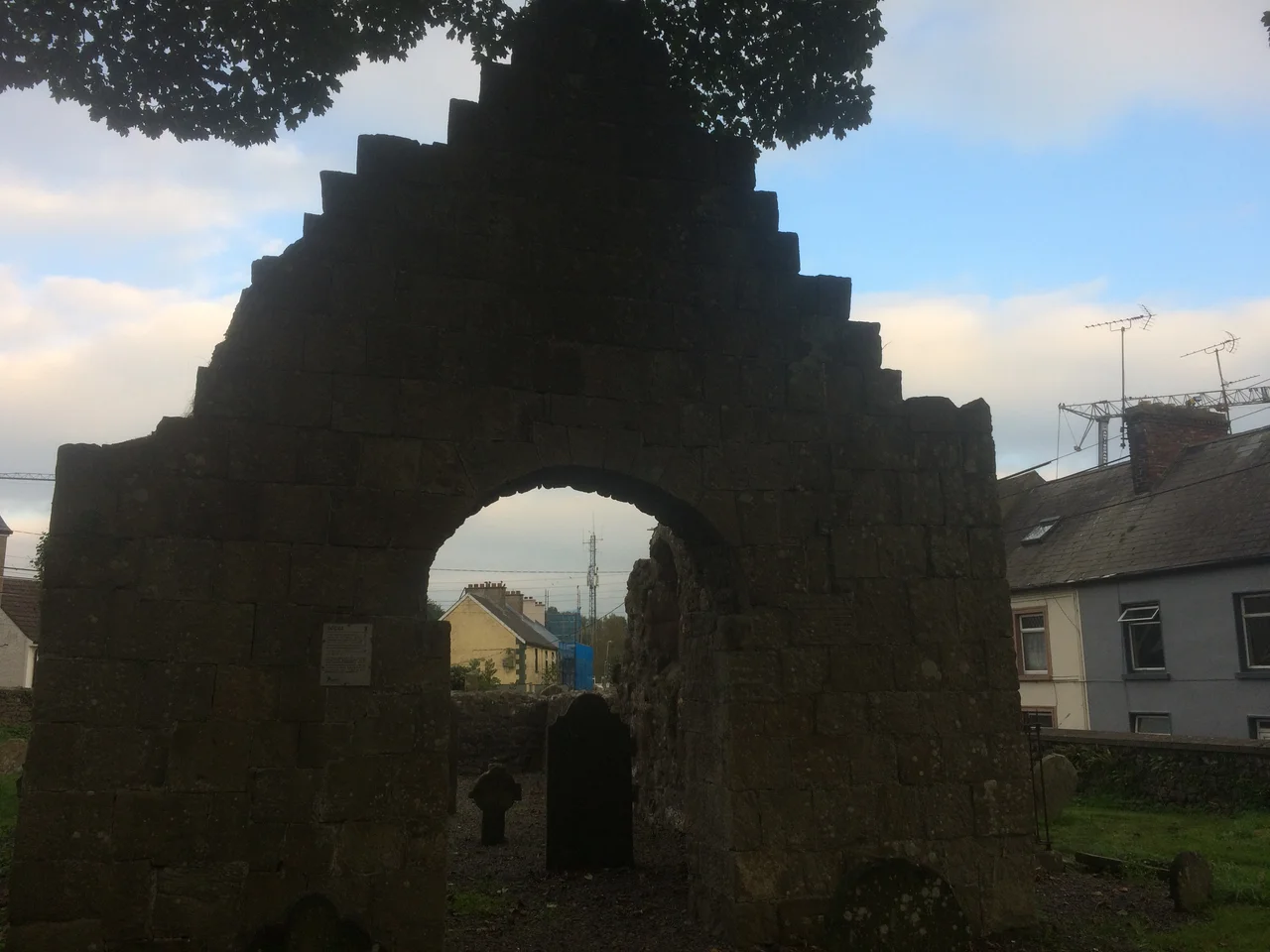

Clones Abbey
Stand in the centre of Clones and look up. A blunt grey stub of a tower rises above the rooftops, fifty-one feet tall, missing the conical cap that once added another twenty-four to its silhouette. This is the round tower of Clones Abbey, built in the ninth century from coursed sandstone, in the typical Irish tradition of free-standing belfries that doubled as refuges when the Vikings or rival kings turned up. The Town of Clones was founded by St Tigernach in the sixth century, anglicised in some local sources as St Tierney, and the monastery he placed here has been burned and rebuilt and burned again and rebuilt again until almost nothing of his original work survives. What does survive is a small museum of medieval Irish ecclesiastical art scattered across half a dozen streets.
The Saint and His Patron
Tigernach of Clones lived in the late fifth and early sixth century. He was reputedly a grandson of an Ulster king and received his religious education in part at Whithorn in Galloway. According to medieval tradition he received the benediction of St Maccartin, was granted the bishopric of Clogher, and performed miracles widely reported in Ireland, Britain, and France. Folklore says an angel directed him to build his monastery in the territory of his grandfather. He dedicated the foundation to St Peter and St Paul. The cult of Tighernach, the version of his name in Old Irish, was promoted by a branch of the Ui Cremthainn who migrated into the Clones area in the eighth century and made his veneration into a regional industry. Even into the sixteenth century, the position of coarb of Clones, the hereditary lay successor to the saint, was passed down through families like the McMahons.
Burned Three Times, Rebuilt Three Times
Clones Abbey was destroyed by fire in 836, again in 1095, and again in 1184. Each time the monastic community rebuilt. In 1207 Hugh de Lacy, Earl of Ulster, razed both the abbey and the town. Five years later, in 1212, the English rebuilt them and added a castle. Around this period the foundation appears to have been formally reconstituted as an Augustinian house, and the Romanesque church whose ruins stand on McCurtain's Street today probably belongs to this twelfth-century reconstruction. Look closely at the lower courses of the round tower on the side opposite the door. The masonry there is cracked in a way that suggests heat damage, almost certainly a souvenir of one of the medieval burnings.
The High Cross on the Diamond
In the centre of Clones, on the Diamond, the medieval marketplace, stands a fifteen-foot sandstone high cross. The shaft and head are separate pieces, the shaft older and dating from roughly 825 to 875 AD. Interlacing beads run up its sides and form a collar at the top, in the high-classical style of Irish sculpture. The faces are covered in narrative panels: the Fall of Man, the Adoration of the Magi, Daniel in the lion's den, Abraham's sacrifice of Isaac, Adam and the tree and the serpent. Turn the cross around and the New Testament takes over: the multiplication of the loaves and fishes, the miracle at Cana, the baptism of Christ. Each panel is a single comic-book frame in stone, dramatic and gestural, and the whole monument is essentially a stone Bible for a population that could not read.
The Tomb in the Graveyard
In the abbey graveyard sits a stone sarcophagus shaped like a small steep-roofed house, decorated with worn animal-head carvings, traditionally said to contain the bones of St Tigernach. It is what archaeologists call a skeuomorph, a stone copy in miniature of an earlier wooden shrine, of the kind once used for relics of saints in early Christian Ireland. The sarcophagus probably dates from the late twelfth century, replacing or imitating a wooden original. The animal-head carvings are too eroded now to read in detail, but the architectural form, the steep house-shaped roof, the corner finials, the rectangular body, is unmistakable. The relics inside, if any actually remain there, were placed in such shrines so pilgrims could touch the lid and hope for healing.
What Survives, and Where to Find It
The four pieces of the medieval monastic complex are scattered across the modern town. The round tower is in the old graveyard off Abbey Street, where the small Romanesque arch and window of the twelfth-century church also stand. The sarcophagus is nearby. The high cross is on the Diamond, a short walk away. A drawing from around 1587 shows the church of the Augustinian abbey, labelled simply a churche, still standing at the time with its tower and choir intact, east of the round tower and west of the surviving small Romanesque ruin. The Reformation under Henry VIII suppressed the monastery in the 1530s. By the seventeenth century the abbey was in ruins, although solitary monks lived in the neighbourhood until well into the eighteenth century. An English garrison was billeted in the ruins for a time. The Augustinian community is long gone. Their building stones are not.
From the Air
Clones Abbey lies at 54.183°N, 7.234°W in the centre of the town of Clones in County Monaghan, just south of the international border with County Fermanagh in Northern Ireland. From the air, Clones is a small grid-plan town inland from the southwestern end of Upper Lough Erne, identifiable by the stubby round tower rising above the rooftops in the old graveyard near the town centre. St Angelo Airport (EGAB), 4 miles north of Enniskillen, is 15 nautical miles north. Belfast (EGAA) is 80 nautical miles east; Dublin (EIDW) is 80 nautical miles southeast. The town sits at roughly 50 metres elevation; visibility is usually moderate in standard maritime conditions.
Nearby Stories
- Coalisland Canal 2.8 km away
- Ballygawley Bus Bombing 2.9 km away
- Cuilcagh 5.9 km away
- County Cavan 6.1 km away
- Pettigo 8.9 km away
- Monastery of Mohill-Manchan 9.8 km away
- Roman Catholic Archdiocese of Armagh 13 km away
- County Louth 17 km away