.jpg)
Clun
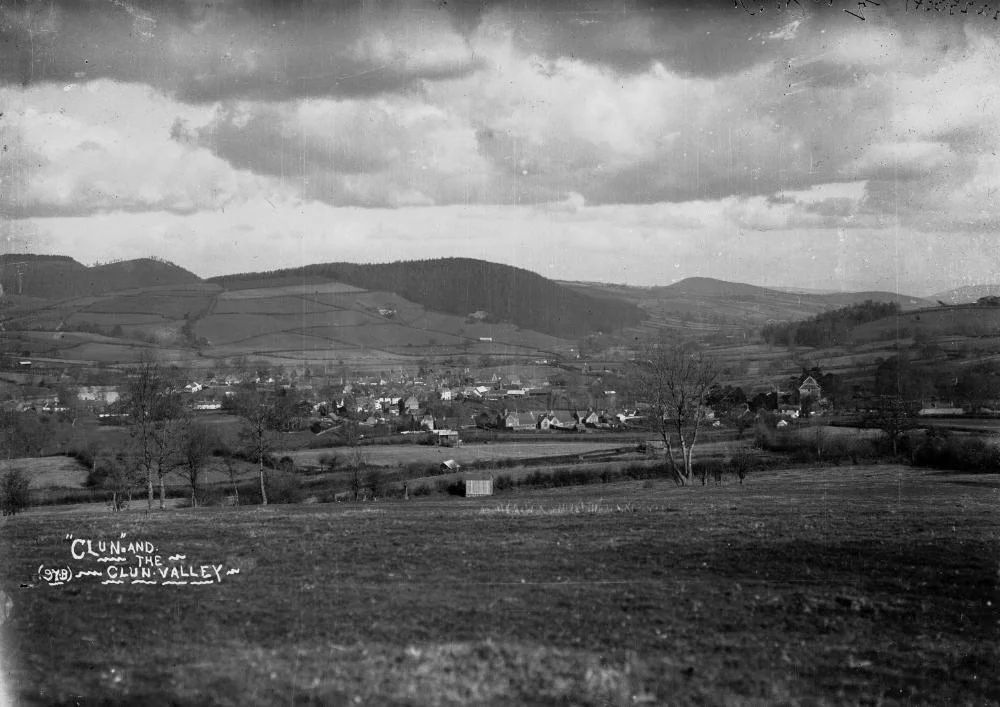
There is a verse in A Shropshire Lad that has hung over four small Welsh-border villages like a benediction for more than a hundred years: 'Clunton and Clunbury, Clungunford and Clun, are the quietest places under the sun.' A.E. Housman wrote it in 1896 without ever having lived in any of them. In 2009 the Campaign for the Protection of Rural England published its national tranquillity map, and Clun ranked among the most peaceful places in England. The town has 680 people. It has a 14th-century packhorse bridge, a ruined Norman castle, two pubs, and a saying that whoever crosses Clun Bridge comes back sharper than he went. Housman, who never bothered to visit, somehow heard the place exactly right.
A Town on a Drove Road
Clun takes its name from the river running through it, the name itself coming from the very early Brythonic root that also produced the Lancashire and Essex rivers called Colne. The Anglo-Saxons built a church here around the end of the 7th century on what is now the south bank of the river, on the high ground around St George's Church. Scattered settlement in the surrounding hills goes back to the Neolithic, more than five thousand years. For centuries Clun sat on the great drove road by which Welsh flocks were driven east to the markets of the English Midlands and London. The town's two halves, Saxon south of the river and Norman north of it, were connected in the 14th century by a stone packhorse bridge so well built that it still carries the A488 today, almost every stone original.
The Marcher Frontier
When the Normans took the land after the Conquest, Edric the Wild's confiscated estate was given to Roger de Montgomery, who passed Clun on to Picot de Say. The de Says raised the castle whose ruin still dominates the bend of the river to the north, and Clun became the seat of a Marcher Lordship governed by its own law rather than the king's. The lord of Clun could execute criminals on his own authority, a privilege so unusual that condemned men were brought from as far as Shrewsbury to be hanged here. The lordship eventually passed to the Fitzalans, then to the Howards, and the Duke of Norfolk holds the title Baron Clun to this day. Through the medieval centuries the town shrank and grew with the fortunes of the castle. By the Tudor period the castle was a ruin and the town was settling into the agricultural quiet that defines it now.
Writers, Cartoonists, Playwrights
Sir Walter Scott is said to have stayed at the Buffalo Inn here while writing parts of The Betrothed in the 1820s, basing his fictional fortress Garde Doloreuse on the ruin above the town. The Buffalo has been shuttered since 2004 and waits empty for someone to know what to do with it. E.M. Forster visited and turned Clun into Oniton in his 1910 novel Howards End. Malcolm Saville set his Lone Pine Club children's adventure books in and around Clun. Bruce Bairnsfather, the cartoonist who created the muddy, mustached Old Bill character that defined the British soldier's view of the First World War, lived at Cresswell House through the Second. John Osborne, the playwright who detonated the British stage with Look Back in Anger in 1956, lived just down the valley in Clunton and died there in 1994. Quietness has its uses for people who write.
Green Man and Quiet Streets
Modern Clun keeps itself busy in small ways. Over the May bank holiday the Green Man festival sees a man in foliage cross the bridge to do ritual battle with the spirit of winter, and a May Fair fills the castle grounds with a May Queen and stalls. The last weekend in June, around twenty private gardens open for Clun Open Gardens with cream teas and plant sales. In August comes the Clun Carnival, with marrow and Victoria sponge competitions in the show tent and a procession through the streets. The first weekend in October brings the Clun Valley Beer Festival, six pubs from Anchor to Aston on Clun pouring local ale. There are two cafes, one on the bridge, a primary school, a museum in the old Town Hall, the 17th-century Trinity Hospital almshouses on Hospital Lane, and Clun Mill, the so-called malevolent mill of local legend, now a youth hostel. The malevolence is in the name only. Mostly what Clun has is itself: a small town on a quiet river, half-Saxon and half-Norman, the castle in ruins above it and Housman's verse still hanging over the hills.
From the Air
Clun lies at 52.42 degrees N, 3.03 degrees W in southwest Shropshire's Shropshire Hills Area of Outstanding Natural Beauty, on the A488 about 7 nm north of Knighton on the Welsh border. The town centre is at roughly 600 ft elevation in the Clun valley, with Clun Forest to the west and Offa's Dyke nearby. Best viewed at 1,500-2,500 ft AGL to take in the bridge, castle ruin, and the surrounding patchwork of hill farms. The town is small (population ~680) so look for the river bend and ruined keep as the primary landmarks. Nearest airfields: Shobdon (EGBS) to the south, Welshpool (EGCW) to the north, Shawbury (EGOS) to the northeast.
Nearby Stories
- Kidnapping and Murder of Lesley Whittle 6 km away
- Malvern Museum 14 km away
- Battle of Maserfield 15 km away
- Hay Castle 18 km away
- Battle of Mynydd Hyddgen 20 km away
- Battle of Blore Heath 20 km away
- Cymer Abbey 26 km away
- Talley Abbey 42 km away