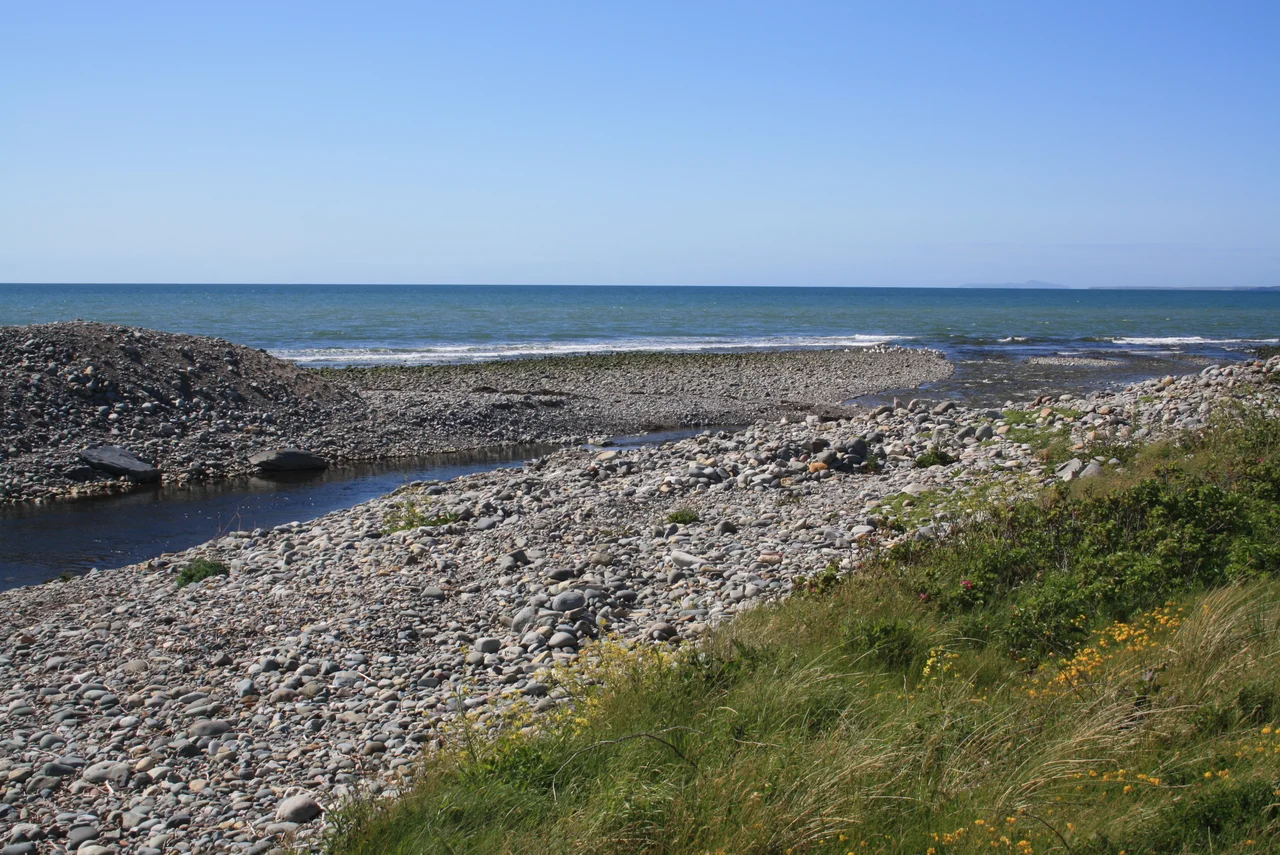

Clynnog Fawr
The church is the giveaway. A village of nine hundred people has no business owning a building this size - high-walled, broad-aisled, more cathedral than parish church - and the discrepancy tells you immediately that something larger happened here once. Clynnog Fawr was a way station on the medieval North Wales Pilgrims Way, the road to Bardsey Island, where two thousand saints were said to be buried and where three pilgrimages were held to equal one to Rome. Every pilgrim heading down the Llŷn for the final boat crossing stopped here first to pay their respects to St Beuno, the seventh-century missionary whose tomb was the most powerful relic on the peninsula.
Beuno's Place of Holly
The name comes from the Welsh for holly trees - Celynnog in Middle Welsh - the Llŷn cognate of Breton Quelneuc and Gaelic Cuilneach, all three reflecting some ancient Celtic placename for a grove the missionaries found here. Beuno arrived in the early seventh century and founded a monastery that became one of the most important Celtic Christian centres in north Wales. Welsh law granted the Abbot of Clynnog a seat at the court of the king of Gwynedd, a remarkable honour reflecting how central the foundation was to the early Welsh church. The Vikings burnt the church in 978. The Normans burnt it again. The community rebuilt every time, and by the end of the fifteenth century Clynnog was one of only six collegiate churches in Wales.
Bullocks and Sick Children
Long after the Reformation closed Bardsey to formal pilgrimage, an older folk practice persisted at Clynnog into the eighteenth century: parents brought epileptic and disabled children to St Beuno's tomb and laid them on the stone overnight, hoping for a cure. A separate ritual involved 'Beuno's bullocks' - a specific Welsh black breed that, if born with peculiar markings, was held to belong to the saint and had to be sacrificed at the church on his feast day. These practices were among the most stubborn survivals of pre-Reformation devotion in Wales, and travel writers of the period recorded them with a mixture of fascination and disapproval. The wooden alms chest in the church - Cyff Beuno, hollowed from a single ash trunk - still holds the donations of pilgrims who passed through eight hundred years ago and the few who come back now.
Stones and Water
Beuno's Well, Ffynnon Beuno, stands at the south-west end of the village - a Grade II* listed structure rebuilt in stone over the original spring, where pilgrims would wash before entering the church. Beuno's Stone, Maen Beuno, carries marks that local tradition attributes to the saint's fingers when he raised the dead. Outside the church, a canonical sundial dated somewhere between the late tenth and early twelfth century stands free in the churchyard - one of the oldest such timekeepers in Britain, marking the canonical hours for the medieval monastic community. The walk from well to church to stone to tomb retraces a sequence pilgrims followed for a thousand years.
The Battles in the Hills
The country around Clynnog has been twice the staging ground for fights that decided the kingship of Gwynedd. The Battle of Bron yr Erw in 1075 broke the first attempt by Gruffudd ap Cynan to claim the throne; Trahaearn ap Caradog defeated him, though Gruffudd would eventually return and rule for nearly fifty years. The Battle of Bryn Derwin in 1255, in the hills just east of the village, saw Llywelyn ap Gruffudd defeat his own brothers Owain and Dafydd and make himself sole ruler of the principality - a fight that put him on the path to becoming the last native Prince of Wales. Both battlefields lie within a few miles of St Beuno's, near the same stretch of coast road where pilgrims passed every summer.
Quiet on the A499
Drive the A499 between Caernarfon and Pwllheli today and Clynnog Fawr is a brief slowing of the road - a pub, a few shops, the church looming on the left. The village had only 130 residents in 1991, although the boundary changes that defined a larger community lifted that figure to 997 by the 2011 census; nearly three-quarters of the population still speak Welsh. The North Wales Pilgrims Way has been quietly revived as a marked long-distance footpath, and St Beuno's Church is open every day from Easter to October. Inside, the alms chest still sits where the medieval pilgrims would have left their coins. The bullocks no longer arrive. The pilgrims, slowly, are coming back.
From the Air
53.02°N, 4.36°W on the north coast of the Llŷn Peninsula. Best viewed at 1,500-2,500 ft to take in the village strung along the A499 below Bwlch Mawr, with Caernarfon Bay opening to the north. EGCK (Caernarfon) is the nearest active airport, 10 nm north-east.
Nearby Stories
- GeoMôn 1.9 km away
- Battle of the Conwy 3.2 km away
- Irish Sea Bridge 5.2 km away
- Ysbyty Ifan 10 km away
- Machynlleth 16 km away
- Barmouth Lifeboat Station 23 km away
- Irish Sea 27 km away
- HMS Tyler 32 km away