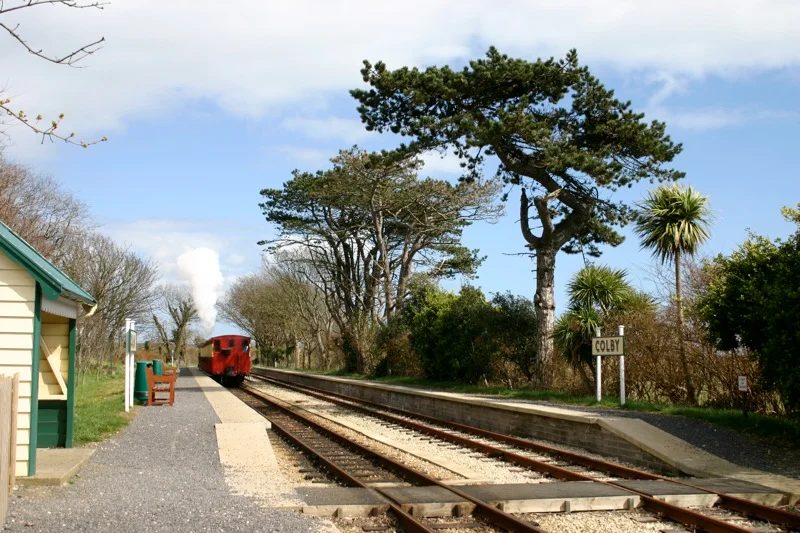

Colby Railway Station
Colby is the only station on the Isle of Man Steam Railway where the bilingual nameboards are not really bilingual. The Manx version — Stashoon Raad Yiarn Cholby — has exactly the same spelling for the village name as the English, so there has never been much to translate. It is the kind of small accident of language that, on a railway proud of its Manx signage, has left this one stop quietly different. The station is otherwise modest: a passing loop, two short platforms, and an oddly low waiting shelter on the southern edge of the village of Colby. But that shelter has its own story, and the spot it sits on has been a stopping place for trains since 1874.
An Original Station
Colby opened with the rest of the south line in 1874. The original building was identical in design to the one at Ballasalla — a ground-level platform with a small waiting room and a station master's office, all sitting on the north side of the running line. The same plan still survives, in living timber, at Santon railway station up the line. There was a single goods siding for the local agricultural trade. In 1907 a passing loop was added, breaking the long single-line section between Castletown and Port Erin — 5 miles 5 furlongs of straight running — into two roughly equal halves and putting Colby permanently into the working rhythm of the line. The trains had been calling here for thirty-three years by then, but it took the loop to make the station genuinely useful as an operational tool.
The Building That Wasn't There
The original Colby station building was demolished in 1980, two years after the line was nationalised in 1978. For a while there was no shelter at all on the platform — passengers waited in the open. In 1991 a small shelter was retrieved from Braddan Bridge on the long-abandoned Peel Line, refurbished, and moved here. Then in 2002, in tandem with the building of an all-island sewerage network that required new track works through this part of the line, the platforms themselves were raised on both up and down sides of the loop. The Braddan shelter, however, was not raised with them. It still stands where it was placed in 1991, at the lower ground level of the original platform — a faintly stranded structure now serving passengers who step up onto the new platform alongside it rather than into it. It is the most visibly improvised feature on the line: a piece of one closed railway repurposed on another.
Local Traffic
Colby is a mandatory stopping place and one of the busiest on the line for local rather than tourist use. The village is small, the railway is the village's connection to Douglas and Port Erin, and the train is a practical way for residents to shop in either direction. The Colby Glen pub sits in the trees just north of the station, visible from passing trains; the local-authority housing backs onto the perimeter on the inland side. In 2011 the village football club established a new headquarters in the seaward field next to the station, and the railway built a new automated level crossing at the northern end to serve it — the first new level crossing on the Isle of Man Railway in more than a century. The former goods platform on the westerly side of the line is still distinguishable; the siding itself has been gone for decades. Until 1991, point work survived at the northern end of the station; it was removed during that year's remedial work.
A Stop in the South
Trains approach Colby from the north on a right-hand curve. Departing south, the line straightens out and runs down to the level road crossing at Kentraugh Farm — an occupational crossing rather than a fully gated one, served by the village rather than a public road. The wider south line connects Colby to Castletown to the north and to Port Erin and the Isle of Man Railway Museum a few minutes further south. The Manx signage on the running-in boards is, in every other case on the line, a genuine bilingual exercise that asserts the recovery of the language. At Colby it simply confirms a coincidence. Cholby, Colby — same village, same word. The trains stop. The locals get on with their shopping. The signs do what signs do.
From the Air
Colby railway station is at 54.094N, 4.704W, on the southern edge of the village of Colby in the south of the Isle of Man. Best viewed at 1,500 to 2,500 feet — the village sits in agricultural country between Castletown and Port Erin, with the steam railway running roughly east–west through it. Look for the low platform alongside the line on the southern edge of the village, with Kentraugh Farm crossing visible to the south. Nearest airfield is Ronaldsway (EGNS), 5 NM east-northeast.
Nearby Stories
- RAF Jurby Head 14 km away
- German submarine U-246 16 km away
- German submarine U-1051 17 km away
- Kilclief Castle 18 km away
- Ardglass 31 km away
- St Bees Lighthouse 44 km away
- Trwyn Du Lighthouse 54 km away
- Seascale Lifeboat Station 61 km away