
College of William & Mary
On December 5, 1776, with the Revolutionary War already a year old, two William & Mary students named John Heath and William Short sat down in the Apollo Room of Williamsburg's Raleigh Tavern and founded a secret society. They called it Phi Beta Kappa. The Greek letters stood for "Love of wisdom is the guide of life." The society was the first of its kind in America, the prototype of every Greek-letter fraternity that would follow. The students had no way of knowing that 250 years later their improvised club would still be the highest academic honor an American undergraduate could earn. They were eighteen years old.
A Royal Charter, A New World College
The College of William & Mary was chartered on February 8, 1693, by King William III and Queen Mary II. The charter ordered the creation of "a certain Place of Universal Study, a perpetual College of Divinity, Philosophy, Languages, and other good arts and sciences, to be supported and maintained, in all time coming." It was the second college in what became the United States, after Harvard (1636), and the ninth-oldest in the English-speaking world. The charter named James Blair as the founding president, a position he held until his death in 1743, a tenure of fifty years. Blair had picked Middle Plantation, the small inland settlement that would soon become Williamsburg, because the Indian massacre of 1622 had destroyed an earlier attempt at a college at Henricus on the western frontier. He bought 330 acres from Thomas Ballard. The school opened in temporary buildings in 1694.
The Oldest Academic Building in America
Construction on the College Building, now known as the Sir Christopher Wren Building, began on August 8, 1695, and was occupied by 1700. It is the oldest college building still in continuous use in the United States. The original structure burned within a few years and was replaced by 1716; what stands today is essentially the 1716 design, named in 1931 for Christopher Wren after a 1724 history written by mathematics professor Hugh Jones credited Wren with the initial design. Whether Wren himself drew the plans is now considered uncertain. The college's own alumni association has acknowledged the question as still open. What is not in doubt is the building's role: it housed the entire college for its first century, including the years when Jefferson studied here. Around it, the Brafferton (1723), originally home of the Indian School, and the President's House (1732) form what is called Ancient Campus today.
Founders, Firsts, and a Defender of Slavery
Three U.S. presidents, Thomas Jefferson, James Monroe, and John Tyler, took degrees here. George Washington received his surveyor's license from the college in 1749 (he never enrolled as a student) and was later named the college's first American chancellor after the Revolution. Chief Justice John Marshall studied law here under George Wythe, who held the first chair of law at any American college. Speaker of the House Henry Clay, Peyton Randolph, Edmund Randolph, Richard Henry Lee, and dozens of other founding-era figures passed through. The college's record of firsts is striking: the first honor code in America (1736); the first college fraternity, the F.H.C. Society or Flat Hat Club (1750); the first Greek-letter society, Phi Beta Kappa (1776); the first elective system of study; the first American law school (established in 1779 under Jefferson and James Madison's reforms). That same wave of reforms abolished the Divinity School and modernized the curriculum. But the same institution also produced Thomas R. Dew, president from 1836 until his death in 1846, who became one of the most influential academic defenders of slavery in the antebellum South. The college, like Virginia itself, contained both kinds of history at once. A 2022 memorial near the Wren Building now commemorates the enslaved people the college owned and used for labor.
War and the Long Recovery
When the Civil War began in 1861, enlistments depleted the student body so completely that on May 10 the faculty voted to close the college for the duration. General Charles A. Whittier reported that thirty-two of thirty-five professors and instructors had joined the Confederate army. The College Building served first as a Confederate barracks, then as a hospital for both armies. The Battle of Williamsburg was fought just outside town on May 5, 1862, and the Union army occupied the city the next day. On September 9, 1862, drunken soldiers from the 5th Pennsylvania Cavalry set the College Building on fire, supposedly to keep Confederate snipers from using it for cover. After the war, Virginia was destitute. President Benjamin Stoddert Ewell reopened the college in 1869 using his own money. It closed again in 1882 for lack of funds, and reopened in 1888 only after the state appropriated $10,000 to support it as a teacher-training institution. The state took over the grounds entirely in 1906. In 1918, William & Mary became one of the first universities in Virginia to admit women.
Restoration and the Modern Tribe
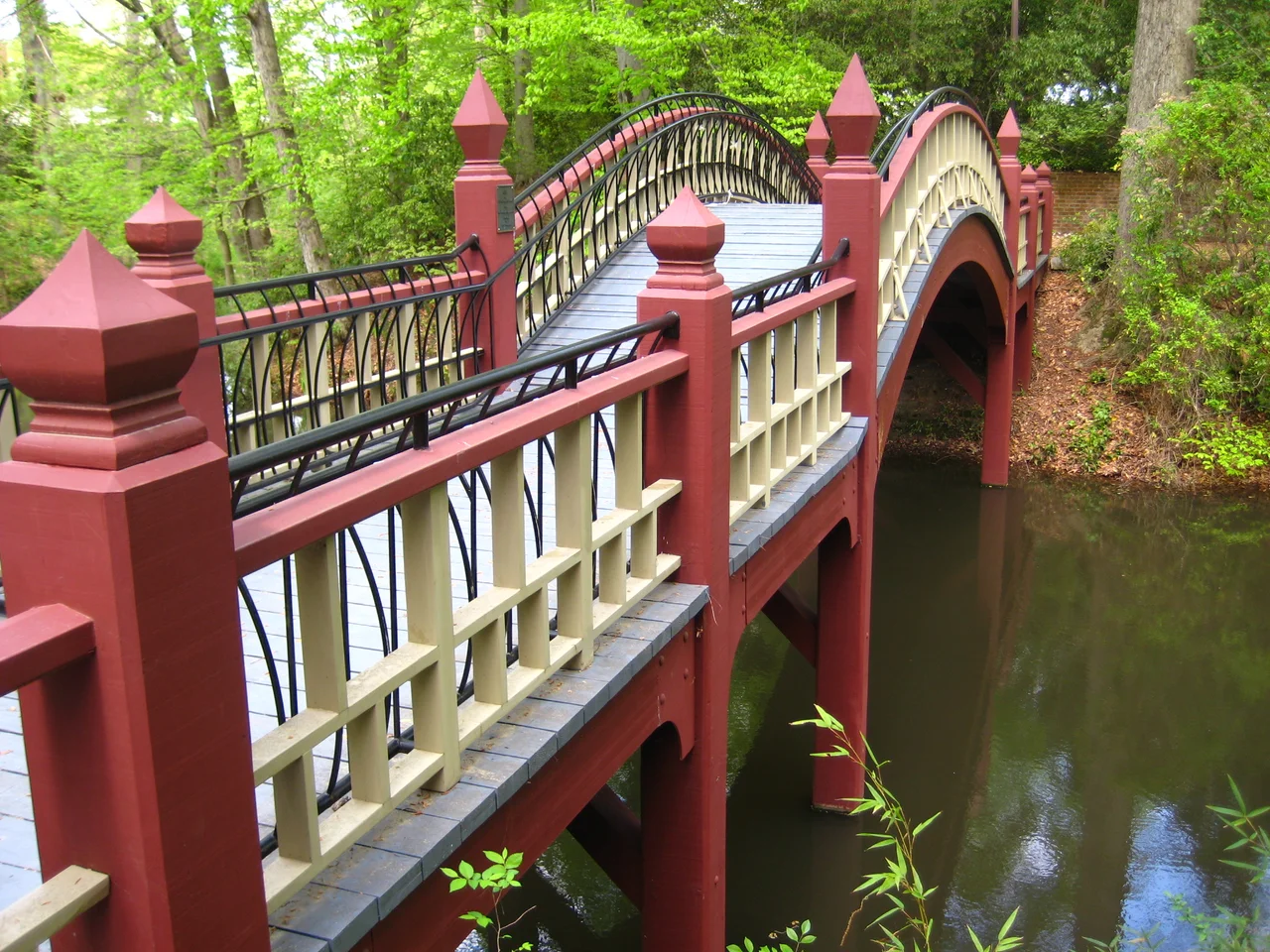
In the 1920s, W.A.R. Goodwin, rector of nearby Bruton Parish Church and a professor at the college, persuaded John D. Rockefeller Jr. to fund a restoration that grew into Colonial Williamsburg. The Wren Building was restored in 1928-1931, the President's House in 1931, the Brafferton in 1931-1932. Today the campus covers 1,200 acres of brick buildings, woodlands, and the artificial Lake Matoaka created by colonists in the early 18th century. Phi Beta Kappa's birthplace marker still stands on campus. The college's chancellors have included Chief Justice Warren Burger, Margaret Thatcher, Henry Kissinger, Sandra Day O'Connor, and Robert Gates, an alumnus. Hulon Willis was admitted in 1951 as the first Black student (in a graduate program unavailable at Virginia State). Full integration did not come until around 1970. In 2018, Katherine A. Rowe became the first woman president in the college's history, three hundred and twenty-five years after its founding.
From the Air
William & Mary's campus is centered at 37.27 N, 76.71 W in Williamsburg, Virginia, with the historic Wren Building at the western end of Duke of Gloucester Street directly opposite the Capitol about three-quarters of a mile to the east. From the air, the campus is unmistakable: a 1,200-acre mix of red brick buildings, the rectangular Sunken Garden, and the wooded shore of Lake Matoaka to the southwest. Ancient Campus (Wren, Brafferton, President's House) frames the eastern edge of campus where it meets Colonial Williamsburg. Nearest field is Williamsburg-Jamestown (KJGG) 3 nm west, KPHF (Newport News/Williamsburg International) 13 nm east, and Felker Army Airfield (KFAF) at Fort Eustis 13 nm southeast. Best viewed at 1,500-3,000 feet AGL with the morning sun lighting the Wren Building's east-facing facade.
Nearby Stories
- Battle of Trent's Reach 2.7 km away
- Mathews County, Virginia 7.4 km away
- Lewis Ginter Botanical Garden 11 km away
- Ocean View Amusement Park 16 km away
- USS Texas (1892) 21 km away
- Christopher Newport University 29 km away
- Menokin 44 km away
- Fort Christanna 63 km away