
Confederate Ireland
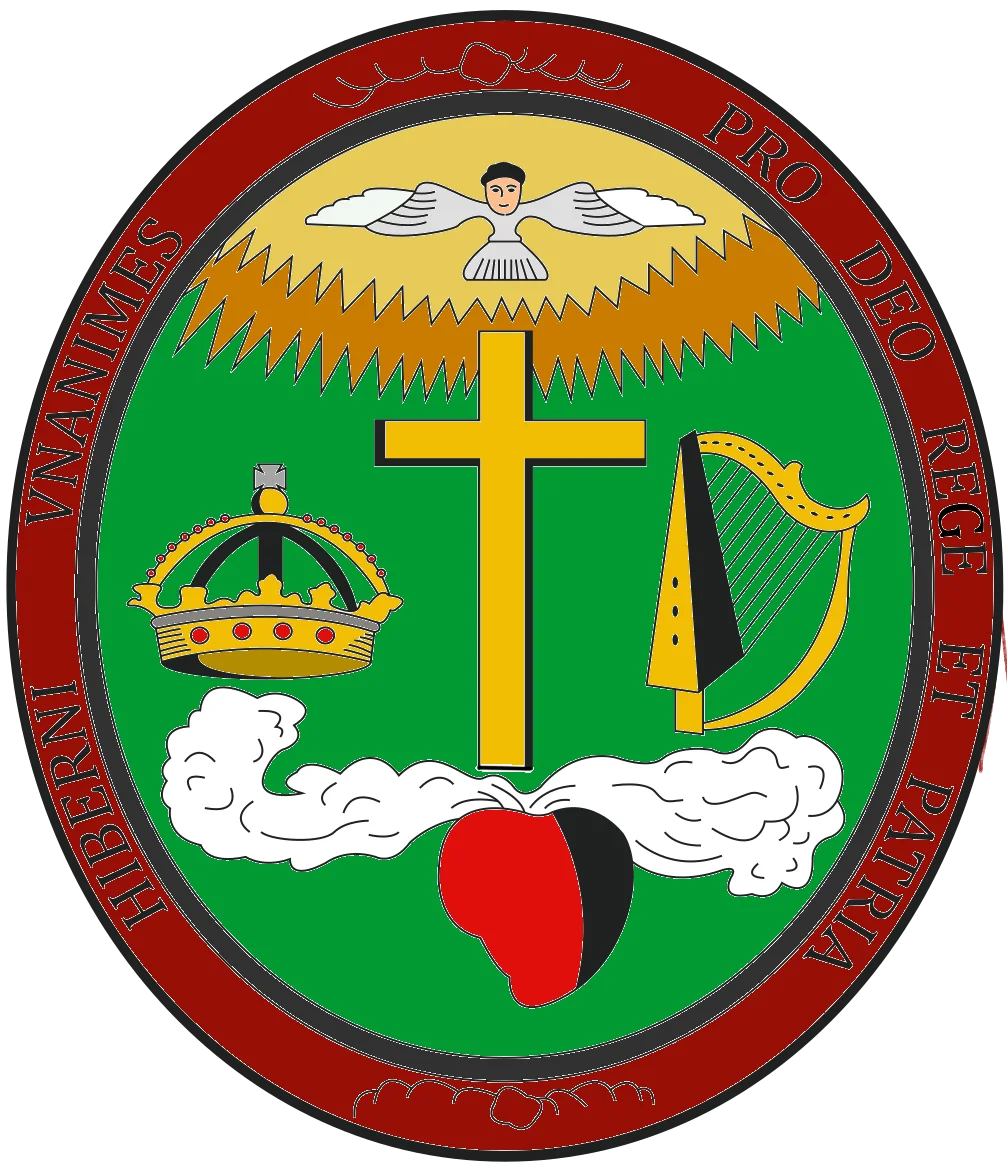
Pro Deo, Rege, et Patria, Hiberni Unanimes. For God, King, and Fatherland, Ireland is United. The motto encircled the seal of the Supreme Council of the Confederate Catholics of Ireland - a flaming heart at the foot of a cross, a dove above, the harp of Ireland on one side and the English crown on the other. It was minted at Kilkenny in 1642 by a body of Catholic aristocrats, clergy and military men who had just declared themselves the government of two-thirds of Ireland. They would not survive a decade. But for ten years they did something Ireland had never quite managed before and would not manage again until 1922: they governed themselves.
How a rebellion became a state
The Confederation grew out of the Irish Rebellion of 1641, when long-simmering Catholic grievances - about land seized in the plantations, about religious discrimination, about exclusion from office - erupted in Ulster and spread south. By the autumn of 1642 the rebels had organised themselves into something more durable than a rising. They convened a General Assembly at Kilkenny, modelled loosely on the Parliament of Ireland but operating without royal sanction. They elected a Supreme Council of twenty-four men, twelve of whom were required to remain in Kilkenny at all times. They named four generals for the four provinces: Owen Roe O'Neill for Ulster, Thomas Preston for Leinster, Garret Barry for Munster, John Burke for Connacht. They voted to levy £30,000 and to raise 31,700 men in Leinster alone. Then they set up a treasury, a mint and a printing press, and began to act like a country.
Two Irelands inside one alliance
The Confederation was always, awkwardly, two coalitions glued together. The Old English were descendants of the Anglo-Norman families who had come over with Strongbow in 1169; they were Catholic, but they thought of themselves as loyal subjects of the English crown whose property had been improperly squeezed by Tudor and Stuart land policies. The Gaelic Irish - Owen Roe O'Neill's people - had lost far more. Their ancestral lands were under English settlement, and they wanted the plantations reversed entirely, the settlers expelled, an Ireland that was Catholic and Irish in the older, sterner sense. Both groups professed loyalty to King Charles I. Both hoped that by helping the King against his Parliamentary enemies they could buy a generous settlement at war's end. It was a reasonable wager, and over the long run it lost everything.
The Papal Nuncio and the politics of refusal
In 1645 Pope Innocent X sent Giovanni Battista Rinuccini, the archbishop of Fermo, to Kilkenny as nuncio extraordinary. He landed at Kenmare from La Rochelle carrying weapons, military supplies and what one contemporary called a very large sum of money. Rinuccini's brief was to defend the Catholic religion, recover church property, and stiffen the Confederates' spine against any compromise that left Catholicism merely tolerated rather than restored. He pushed his allies hard. When the Supreme Council signed the first Ormonde Peace with the Royalists in March 1646 - a deal that allowed Catholics to hold public office but did not guarantee public Catholic worship - Rinuccini threatened to excommunicate the peace party. The General Assembly rejected the deal. The Supreme Council was arrested. The nuncio had effectively become the head of one of the two factions inside the Confederation, and the cracks were now structural.
Benburb and the seductions of victory
In June 1646, three months after Rinuccini's intervention, Owen Roe O'Neill destroyed a Scottish Covenanter army at Benburb in Tyrone, killing several thousand. For a few weeks Confederate Ireland looked unstoppable. O'Neill's Ulster Catholic army was now the most formidable force on the island. The militants - the Rinuccini party - believed the moment had come to reconquer Ireland for the Church. But Benburb proved a tactical victory inside a strategic disaster. The hard-line Catholic faction's confidence pushed them to reject deals that, in retrospect, were better than what came next. In 1647 Thomas Preston's Leinster army was annihilated by Parliamentarians at Dungan's Hill. Three months later the Munster army was destroyed at Knocknanauss. Within eighteen months of Benburb the Confederation had lost two of its four field armies.
1649 and the price of being late
Oliver Cromwell landed near Dublin in August 1649 with the New Model Army. By then the Confederates had reluctantly joined a formal alliance with the Royalists, but the internal fights had cost them their best year. Drogheda fell in September with a massacre that became its own argument; Wexford fell in October. Kilkenny - the Confederate capital, where the General Assembly had met and the mint had struck coin - surrendered after a short siege in March 1650. The Cromwellian conquest, accompanied by plague and famine, was the bloodiest war Ireland had ever seen. When it ended in 1653, the pre-war Catholic landowning class was effectively destroyed; estates were confiscated wholesale; senior Confederates who could escape died in exile in France, attached to the court of the future Charles II. Those who stayed mostly lost everything. After the Restoration, some land was returned. Most was not.
What Kilkenny remembers
The Confederate Assembly met in what is now Rothe House on Parliament Street, in a city that wore its Catholic identity openly and at considerable risk. The printing press at Kilkenny issued proclamations and the mint struck coins worth real silver. The flag of the Confederation, the harp on a green field, was hoisted on castle walls from Connacht to Munster. Walk through medieval Kilkenny now and the Confederation is everywhere implicit - in the surviving city walls, the great houses of the merchant families, the Cathedral of St Canice on its hill. For a brief, intricate decade, this small Irish town governed most of an island. The settlement that ended it - the Cromwellian transplantations, the confiscations, the breaking of the Catholic gentry - shaped Irish politics for the next three centuries. The motto on the seal was, in the end, more aspiration than fact. But the aspiration had once been a government.
From the Air
The Confederation's seat of power was Kilkenny city, roughly 52.65°N, 7.25°W in southeast Ireland. The article centroid sits just west of Kilkenny on the gentle ridges between the Nore and the Barrow. Cruise altitude 4,000-6,000 ft gives a clear view of the river valleys and the walled medieval core; Kilkenny Castle on its bluff above the Nore is the orienting landmark. Nearest airports: Waterford (EIWF) 50 km south, Kilkenny (EIKL) within the city. The M9 motorway tracks the Barrow east of the city - useful in poor visibility.
Nearby Stories
- 2008 Irish Pork Crisis 4 km away
- Civil Defence Ireland 6.1 km away
- Thurles 6.5 km away
- Abbeyleix 9.5 km away
- Castletown Cox 11 km away
- Ardfinnan Woollen Mills 13 km away
- Johnstown Castle 16 km away
- County Wicklow 20 km away