.jpg)
Confederate Monument (Greenville, South Carolina)
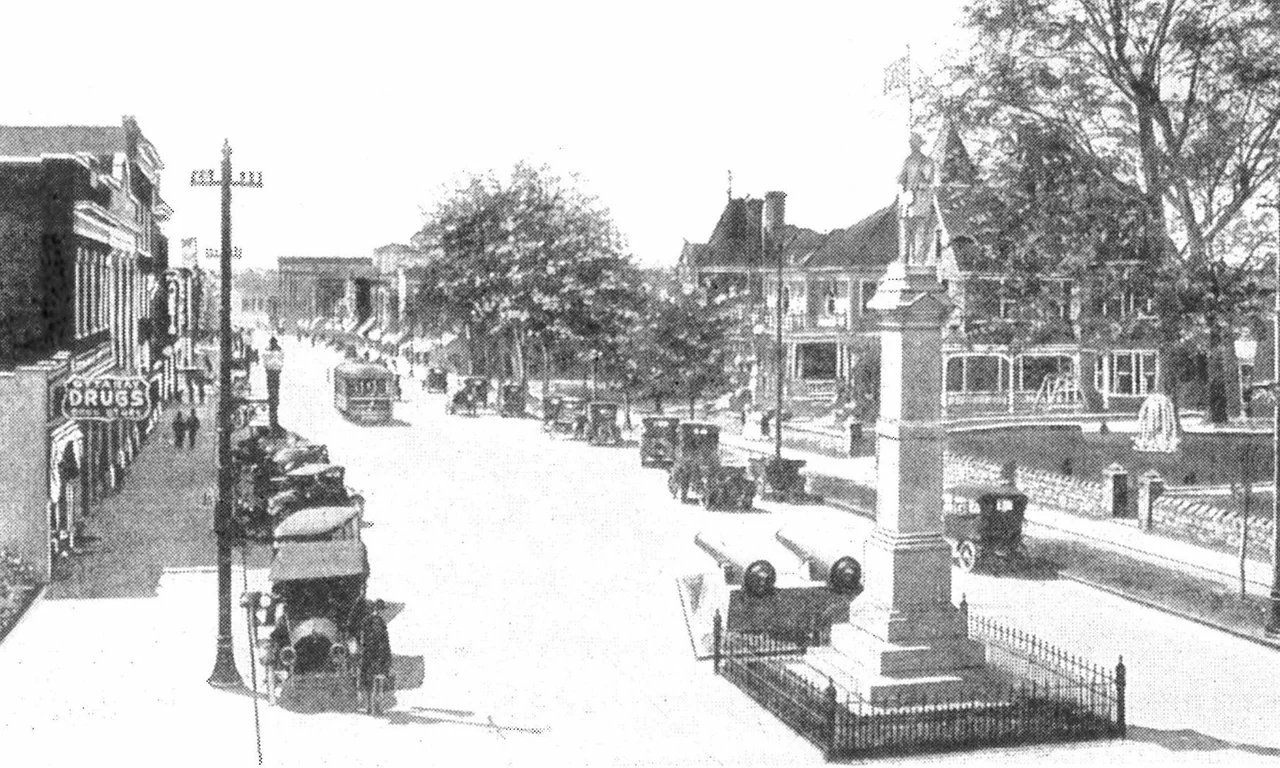
In October 1922, after losing a public fight over relocating the Confederate monument from the middle of Main Street, members of the Greenville City Council did something quietly extraordinary. They went out one night, partially dismantled the granite shaft, and hid the marble statue of the soldier. For nearly two years afterward, a headless stub of monument stood in the middle of downtown Greenville, while lawsuits flew and the United Daughters of the Confederacy demanded its restoration. That episode is mostly forgotten now. But the monument itself is still standing, and the arguments about it are still happening.
1892: The Dedication
The monument was erected in 1892, eight years after the local Ladies Memorial Association began raising the money. It cost $3,500, which was the equivalent of more than $100,000 in early twenty-first century dollars. A sculptor named C.F. Kohlrus of Augusta, Georgia, was said to have carved the marble soldier on top from photographs of James B. Ligon, by then a middle-aged Confederate veteran and Greenville's police chief. The dedication on September 27, 1892, was a major civic event: speeches, a grand parade, railroads offering reduced fares for visiting state militia companies, who fired their weapons and gave the rebel yell. The Columbia State newspaper praised it as 'one of the handsomest and costliest in the South.' The dedication came at a specific moment in southern history. The 1890s were the years when Jim Crow laws were being written into state constitutions across the former Confederacy, when Black voters were being systematically disenfranchised, when lynching reached its peak. Monuments like this one went up by the hundreds during those decades. They were memorials to the dead. They were also statements about who controlled public space.
The Lost Cause in Stone
The inscription on the shaft is a textbook expression of what historians call the Lost Cause interpretation of the Civil War, the post-war effort to recast secession as a noble defense of states' rights rather than a war to preserve slavery. One line on the monument reads: 'The world shall yet decide in truth's clear far off light that the soldiers who wore the grey and died with Lee were in the right.' By 1919, with streetcars and automobiles increasingly common, the monument in the middle of Main Street had become a traffic hazard. The city council voted to move it. The United Daughters of the Confederacy and Confederate veterans pushed back hard. On October 11, 1922, learning that opponents had filed for a restraining order, council members had the shaft partially dismantled and the statue hidden away. A temporary injunction halted further demolition. On June 9, 1924, the South Carolina Supreme Court ruled unanimously that the city had the right to determine the use of its streets, and that relocating the monument would actually focus more attention on what it called its 'sermon in stone.' That decision became precedent across the state. Confederate monuments throughout South Carolina moved off their main streets and into town squares and courthouse lawns.
Confederate Plaza
After negotiations with the veterans and the UDC, the monument was reinstalled in a pocket park created by carving a corner out of Springwood Cemetery at the intersection of East Elford and North Main Streets. The new park was named Confederate Plaza. The rededication on June 19, 1924, included the marble statue back on top, plus the two Parrott rifles and cannon balls that had stood at its base downtown. The Parrott rifles were manufactured at the West Point Foundry in New York during the war. Over the following decades the plaza accumulated additional memorials: a 1935 bronze plaque honoring Robert E. Lee, originally placed in front of the county courthouse and later moved here, a 1973 marker recognizing the Kershaw Brigade that fought at Gettysburg, and a 1956 monument to the 81st Wildcat Division, which trained at Camp Sevier in Greenville for World War I. Confederate Plaza became a layered site, war memorials piling on top of war memorials over a century.
2017, 2020, and the Questions That Remain
Greenville's debate over the monument flared back to life in 2017, following the violence at the Charlottesville white supremacist rally, and then again more intensely in 2020 after the police killing of George Floyd. Greenville Mayor Knox White proposed adding a plaque to provide historical context. The plaque never came to a vote because no one could agree on the wording. In August 2020, supporters and opponents held simultaneous rallies at the monument, and police made several arrests. Mayor White noted that the South Carolina Heritage Act of 2000 forbids the removal of any war memorial from public property without a two-thirds vote of the state legislature, a threshold no Confederate monument removal effort in South Carolina has yet cleared. The monument is still there. The Parrott rifles are still flanking it. The arguments are still being had, in different terms now, by descendants of the people who put it up and descendants of the people excluded from the public square when it went up. The granite has not moved in over a century. Almost everything around it has.
From the Air
Located at 34.86 degrees North, 82.40 degrees West in downtown Greenville, South Carolina. Confederate Plaza sits at the corner of East Elford Street and North Main Street, adjacent to Springwood Cemetery. The monument is a granite shaft with a marble figure on top, roughly 25 feet tall. Nearest airports: Greenville Downtown (KGMU) about 2 nm east-southeast, Greenville-Spartanburg International (KGSP) about 10 nm east. Best viewed at 1,200 to 2,000 feet AGL; the monument is too small to be visually distinct from altitude, but Springwood Cemetery's grid is a useful landmark.
Nearby Stories
- Battle of Musgrove Mill 6.9 km away
- Carl Sandburg Home National Historic Site 13 km away
- Stumphouse Mountain Tunnel 17 km away
- Forest City, North Carolina 20 km away
- Chiquola Mill Massacre 20 km away
- Battle of Blackstock's Farm 26 km away
- Great Smoky Mountains National Park 65 km away
- Tree That Owns Itself 84 km away