.jpg)
Cooks Monument and Reserve
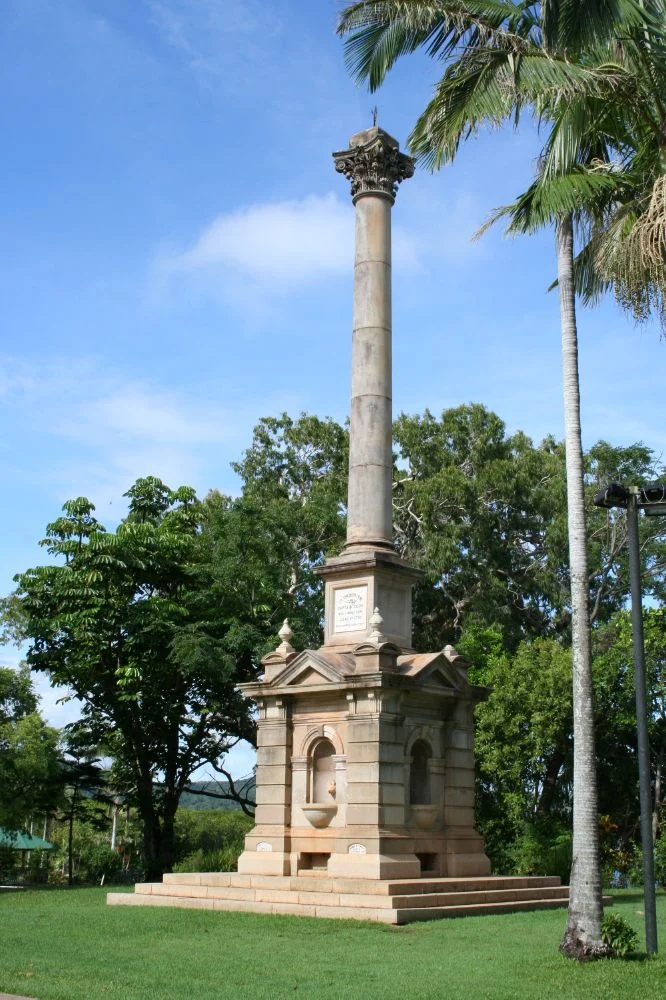
Cooktown wanted a statue. When the town set out in the 1880s to mark the spot where Cook had beached the Endeavour, the council pictured the great navigator cast in stone, gazing out over the river he named. What they got instead was an empty column - because in 1887 the Premier of Queensland, Sir Samuel Griffith, flatly refused to pay for the figure on top. It was more important, he said, to commemorate the event than the person. The slender sandstone shaft that resulted has stood on its rise above the Endeavour estuary ever since, a monument defined as much by what is missing from it as by what is there.
A Column for a Gold-Rush Town
By the mid-1880s Cooktown was riding high. It was the port for one of Queensland's richest goldfields on the Palmer River, a railway was pushing inland toward Laura, and the discovery of tin on the Annan River in 1887 added to the boom. A town this confident wanted to advertise its sense of importance, and commemorating Cook's 1770 landing was the way to do it. The reserve also had a working life beneath the ceremony: a deep, brick-lined town well was sunk here to supply ships at the wharves, its shaft dropping more than twenty feet through arched channels that funnelled storm runoff underground, with a capacity of some 47,000 gallons.
Politics in Sandstone
The monument was as much a political gesture as a historical one. When Premier Griffith toured the northern ports in 1886, the Separation movement - a push to split the far north off into its own colony - was gathering steam, and Griffith was keen to show that Brisbane cared about the region. Committing the Colonial Architect's office to design the Cook column was politically convenient. Designed under architect George St Paul Connolly and built by Hobbs and Carter of South Brisbane, the column was raised on sandstone hauled from Murphys Creek in the state's southeast. Its foundation stone was laid on 1 September 1887, and it was reputedly the first stone structure ever erected in Cooktown.
A Reserve of Memorials
Over the following century the small grassed reserve filled with other markers, each a chapter of regional memory. A granite cairn raised in 1948 honours the explorer Edmund Kennedy, who died on Cape York in 1848. Another, set in 1977, marks the start of the National Horse Trail, the route Dan Seymour rode to prove a horse track could run all the way from Melbourne to Cooktown. In 1989 the old town well was capped with a fountain celebrating Cooktown's first reliable water supply, piped at last from the Annan River. And to the north stands an 1803 cannon, cast in Scotland and shipped here during an 1885 panic over a feared Russian attack - now fired once a year for the Cook landing re-enactment.
The Landmark on the Rise
Today the column is a fine survivor - one of the best sandstone public memorials in Queensland - rising from a granite base whose drinking fountains once poured water from the mouths of sculpted animal heads. It sits on a slight rise between Charlotte Street and the river, almost exactly where the Endeavour was hauled up the sand below Grassy Hill in the winter of 1770. From the water it is a recognisable Cooktown landmark, and to the townspeople it remains a place of identity, the gathering point each June where the long, complicated story of this shore is told again - this time, increasingly, from both sides of it.
From the Air
Cooks Monument and Reserve sits at 15.46 degrees S, 145.25 degrees E, on Charlotte Street in central Cooktown, on a slight rise between the street and the Endeavour River estuary. The tall, pale sandstone column is a recognisable landmark from the water and from low altitude, set just below the rounded form of Grassy Hill. Best viewed at low level (1,500-3,000 ft) in the clear dry-season air of June to August. Cooktown Airport (ICAO YCKN) lies on the edge of town; Cairns (YBCS) is the regional gateway about 250 nm to the south. The annual Cook landing re-enactment, with its 1803 cannon, takes place at the reserve each June.
Nearby Stories
- Kuku Nyungkal 13 km away
- Old Laura Homestead 42 km away
- Byerstown 45 km away
- Mrs Watson's Cottage 51 km away
- Rinyirru (Lakefield) National Park 101 km away
- Green Island (Queensland) 124 km away
- HMS Mermaid (1817) 206 km away
- Kapa Kapa Trail 617 km away