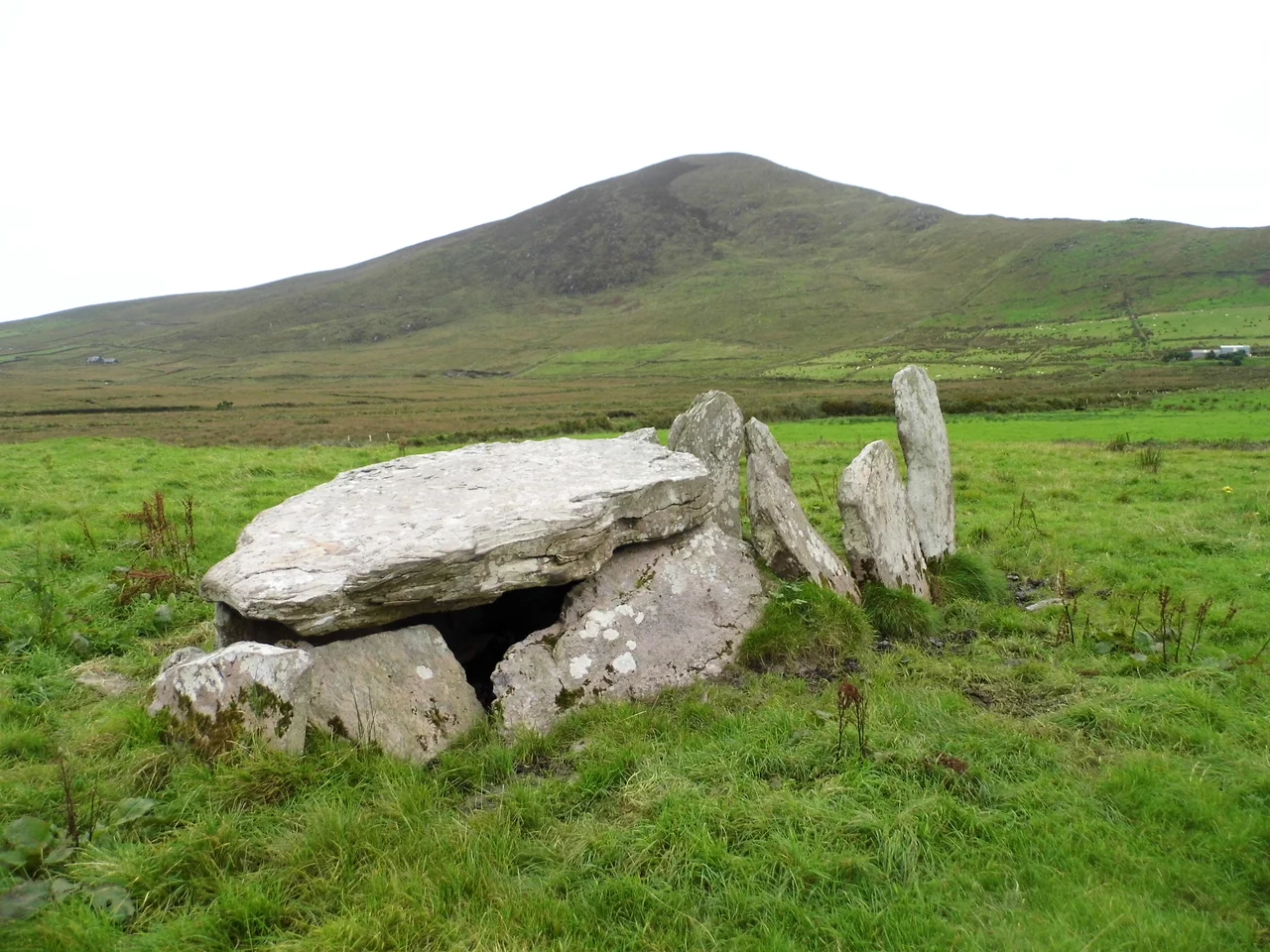

Coom Wedge Tomb
The stone slab that roofs this small chamber has been in place since the Bronze Age. The people who set it there lived between the late Neolithic and the early metal-using world - sometime around 2500 to 2000 BC, give or take a few centuries. They knew how to move stones much heavier than themselves and they knew, evidently, what they wanted those stones to do. They aligned this tomb west to east, opened its entrance to the setting sun, and walked away. What they were thinking about while they worked is gone. The tomb itself, a low spine of granite on a Kerry hillside near the Skellig Ring, is still there.
What a Wedge Tomb Is
Ireland has about four hundred of these structures, more than the rest of Europe combined. They are called wedge tombs because the chamber inside tapers - higher at the front, lower at the back - giving the building a long, thin wedge profile when seen from the side. Archaeologists classify them as gallery graves, a transitional form that bridges the late Neolithic and the early Bronze Age. They are not the oldest megalithic monuments in Ireland; the great passage tombs at Newgrange and Knowth are older. But they are the last megalithic burial tradition before the metal-using cultures shifted to other ways of marking the dead. Coom is a small, plain example of the type. The chamber is about three meters long, covered by a single capstone. In front of it lies an open antechamber bordered on each side by three large standing stones, the tallest about a meter and a half high - low enough to step over, tall enough to register as deliberate.
Diarmuid and Grainne's Bed
Local memory has a different name for the place. In Irish tradition, it is one of many Leaba Dhiarmada agus Ghrainne - Diarmuid and Grainne's Beds - scattered across the country. The story belongs to the Fenian cycle, the great body of medieval Irish legend that orbits the warrior Fionn mac Cumhaill. In it, the beautiful Grainne, promised in marriage to the aging Fionn, runs away with the younger warrior Diarmuid. The lovers spend years on the run, sleeping in caves and under standing stones, with Fionn's band of fighters always somewhere behind them. Where no cave was at hand, Diarmuid was said to have built shelters from the stones around him - and the wedge tombs, dotted across the landscape, became the imagined record of his fugitive nights. The historical chronology is impossible. The tombs predate the legend by thousands of years. But the legend explains, in a culture that lived close to these monuments, what they were doing on the hillside.
The Setting
Coom sits in a townland near the Skellig Ring, the smaller and quieter loop drive that branches off the better-known Ring of Kerry along the southwest of the Iveragh Peninsula. The tomb is not signposted on the main road and not always easy to find without a guide; it stands on private land and the path is informal. The land around it is open pasture - cropped grass, gorse, occasional bog - and from the chamber the ground falls away toward the Atlantic. The west-east alignment of the entrance suggests its builders wanted whoever or whatever was inside to face the sunset, or perhaps to be lit briefly by the setting sun at certain times of year. Other wedge tombs in Ireland show similar orientations, and the consistency is itself a piece of evidence. These were not casual structures.
What Survives
No human remains have been published from Coom, and even where wedge tombs have been excavated in detail, what they have produced is sparing: scatters of cremated bone, sherds of Beaker-period pottery, the occasional flint. The people who built these monuments did not leave writing, did not leave portraits, did not leave the kind of trail later cultures would. They left the stones, the alignments, the choices of place. Standing at Coom now, with the wind off the open Atlantic moving through the grass and the silhouette of the chamber low against the sky, you are looking at one of the older surviving structures in western Europe. The roof slab is still on. The antechamber stones still hold their shape. Whatever was meant to happen here happened, and the building remembered the shape of the intention long after the people who made it had gone.
From the Air
Located at 51.824°N, 10.314°W on the southwest of the Iveragh Peninsula, west of Ballinskelligs and near the Skellig Ring drive. Recommended viewing altitude 1,500-2,500 feet AGL for hillside detail. The tomb itself is small and difficult to spot from the air; use Ballinskelligs Bay to the south and St. Finian's Bay to the north as orientation. Nearest airport is Kerry (EIKY), about 35 nm to the northeast. The terrain is open Atlantic uplands - winds can be strong and gusty, especially on the windward sides of the low ridges in this area.
Nearby Stories
- Dunlough Castle 2.6 km away
- Beara Peninsula 4.2 km away
- Dunbeg Fort 8.4 km away
- Pouldergaderry Sinkhole 13 km away
- HMHS Llandovery Castle 40 km away
- The Laki Eruption: The Volcano That Changed World History 1404 km away
- The Northern Lights: The Sky Show That Vikings Thought Was Bridge to the Gods 1505 km away
- Sao Miguel 1906 km away