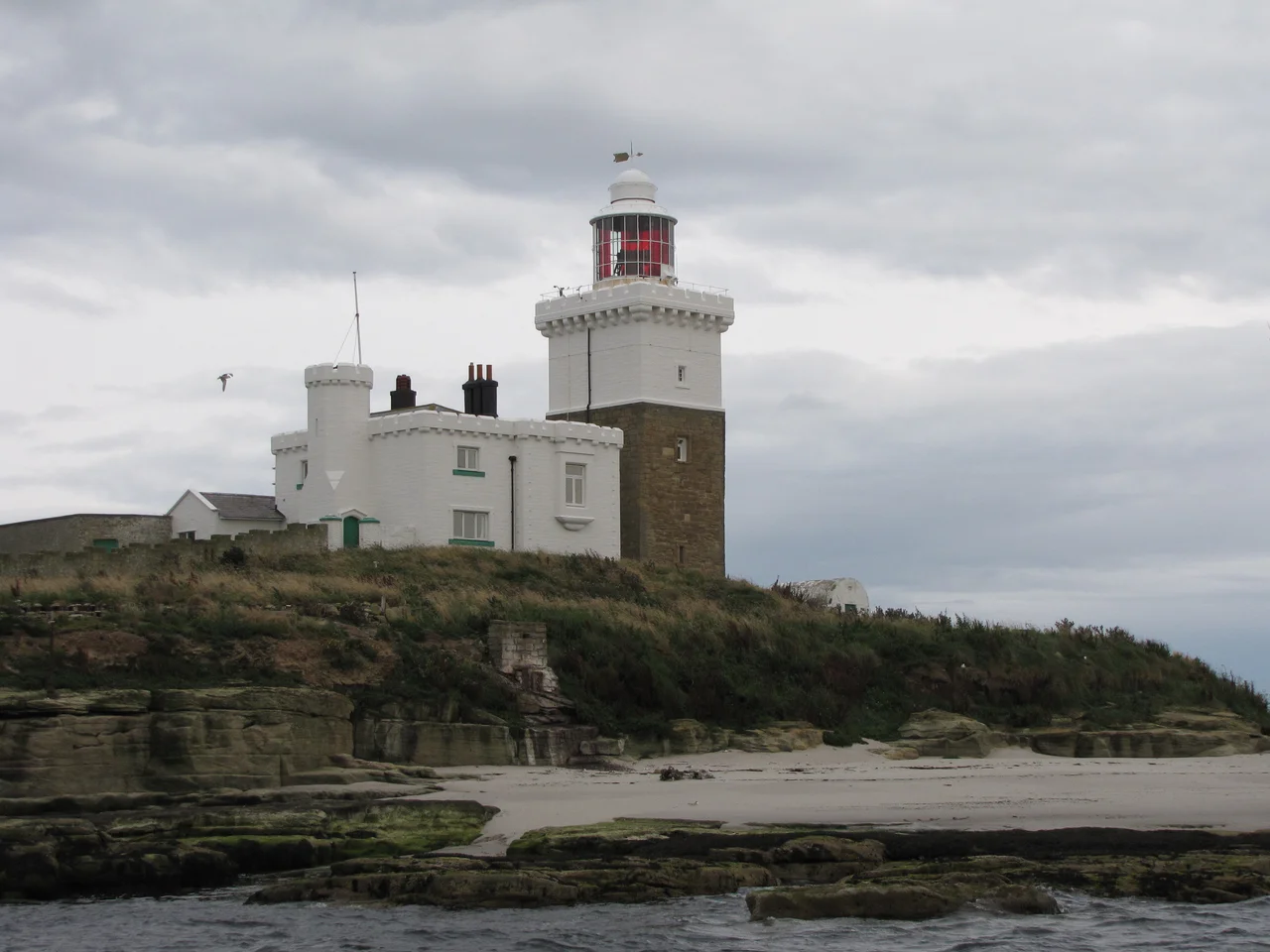

Coquet Island
Henry of Coquet died on a six-hectare island a mile off the Northumberland coast in 1127. He was a Dane who had come to England, taken holy orders, and chosen this scrap of stone in the North Sea for his hermitage. He prayed there, attracted miracles in the local telling, and was buried there. Eight centuries later, the island is uninhabited again in winter, but the small medieval monastery that grew up around his cell has been incorporated into a white sandstone lighthouse, and Henry's quiet rock now holds about 18,000 pairs of puffins.
The Dane and the Monastery
Henry of Coquet lived as a hermit on the island until his death in 1127. The Benedictines of Tynemouth Priory later founded a small monastery on the southwestern shore, and the surviving stonework of that medieval foundation was eventually absorbed into the buildings of the nineteenth-century lighthouse. Whether Henry preferred the solitude for spiritual reasons or simply for the silence of the sea is not recorded, but Coquet Island offered both. It is a low, grassy mass owned today by the Duke of Northumberland, surrounded by clear water and currents that have wrecked many a ship between here and the mainland.
The Lighthouse
Trinity House built Coquet Lighthouse in 1841 at a cost of £3,268. James Walker designed it - a white square sandstone tower with walls more than a metre thick, ringed by a turreted parapet. The first keeper was William Darling, elder brother of the famous Grace Darling. A first-order fixed dioptric lens, made by Isaac Cookson of Newcastle, sat in the lantern room with mirrors that were replaced by refracting prisms ten years later. Red sectors warned ships of Hauxley Point to the south and Boulmer Rocks to the north from 1854. An eight-wick mineral-oil burner replaced the original lamp in 1891. The light has been solar-powered since 2008, and in 2025 Trinity House announced that the original 1841 optic, exhibited for years at museums in Penzance and at Souter Lighthouse, would return to Coquet to work again alongside a modern LED.
The Roseate Tern Colony
The Royal Society for the Protection of Birds manages Coquet Island as a seabird reserve, and it carries an importance out of all proportion to its size. The largest colony of the endangered roseate tern in Britain nests here, and conservation work - including nest boxes that shelter the eggs from gulls and bad weather - has lifted the population to 118 pairs in 2018, climbing from very low numbers. Around 18,000 pairs of puffins nested here in 2002, the most numerous species on the island. Sandwich terns, common terns, Arctic terns, black-legged kittiwakes, fulmars, three other gull species and eider duck all breed on the island. The combination of a small protected area and intensive management has made Coquet one of the most important seabird sites on the east coast of Britain.
Looking, Not Landing
Public landing on Coquet Island is prohibited; the birds are too vulnerable to disturbance. Seasonal wardens live on the island throughout the summer to protect the nesting colonies. What visitors get instead is a boat trip from Amble, with operators running close to the shore in good weather so that the puffins, the terns, and the kittiwakes can be seen well. The lighthouse stands above it all, its white walls still doing the job they were built for in 1841, and Henry of Coquet's old monastery is buried in the masonry below. It is a place that has worked hard for its inhabitants for nine centuries - first a hermit, then keepers, now seabirds - and still asks visitors to keep their distance and let it work.
From the Air
Located at 55.34°N, 1.54°W, about 1.2 km offshore from Amble on the north Northumberland coast. Nearest commercial airport is Newcastle (EGNT) about 28 nm south-west. The small island is unmistakable - white lighthouse with red lantern visible from miles offshore. CAA advises avoiding low overflight during seabird breeding season (April-July) due to nesting birds and to reduce disturbance to the RSPB reserve. Best viewed from 2,000-3,000 ft AGL with the Northumberland coast as backdrop. The Farne Islands lie about 30 km north.
Nearby Stories
- Beadnell 3.5 km away
- Great North Museum: Hancock 4.8 km away
- Battle of Otterburn 7.5 km away
- Battle of Flodden 10 km away
- Housesteads Roman Fort 14 km away
- Saltburn Pier 49 km away
- German submarine U-2367 74 km away
- Alexander L. Kielland (Platform) 278 km away